
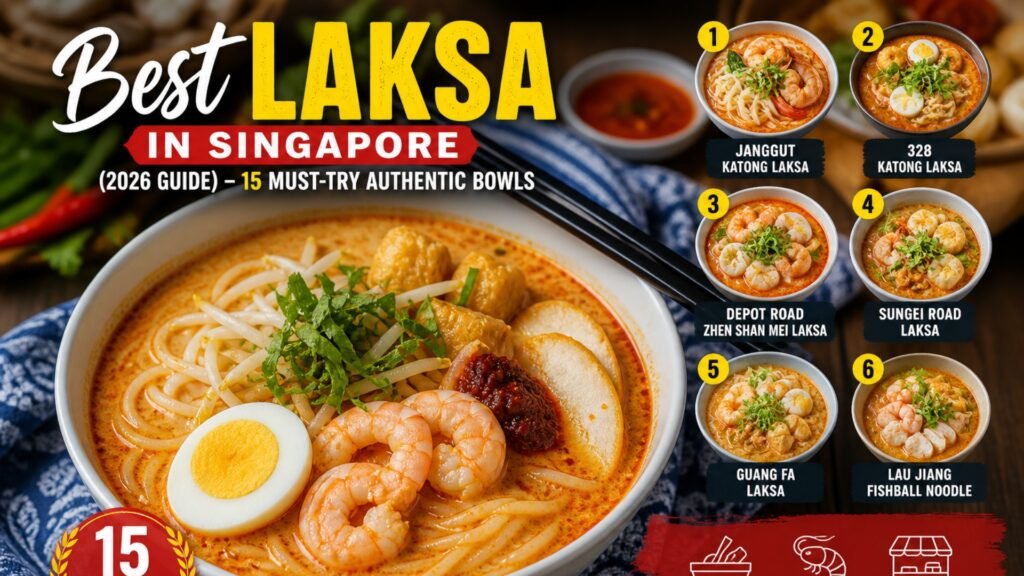
Best Laksa in Singapore (2026 Guide) – 15 Must-Try Authentic Bowls
The first time someone took me to a proper laksa stall in Singapore — like, an actual neighbourhood stall, plastic chairs, ceiling fans doing basically nothing in the heat — I genuinely didn’t know what I was about to eat. The bowl arrived and honestly? The smell alone was enough. That thick, orange-red broth, cockles sitting on top, tofu puffs half-submerged, fat prawn curled up like it owned the place. I remember just… staring at it for a moment before the person across the table said “eat it while it’s hot, lah.”
Best advice ever, honestly.
Finding the best laksa in Singapore is not just a food thing. It’s more of a — how do I put this — a cultural thing. A Singapore thing. You know how some cities have pizza debates? Or ramen wars? Singapore has laksa. And people here are serious about it. Like, will-argue-with-a-stranger serious. Will-travel-from-Jurong-to-Bedok-just-for-one-specific-bowl serious.
And in 2026, the scene is genuinely thriving. So yeah — let’s get into it. This guide covers everything. The 15 best spots, the types you need to know, where to find them, what to pay, and what to actually look for when you’re standing in front of a stall sweating in the humidity wondering which bowl to order.
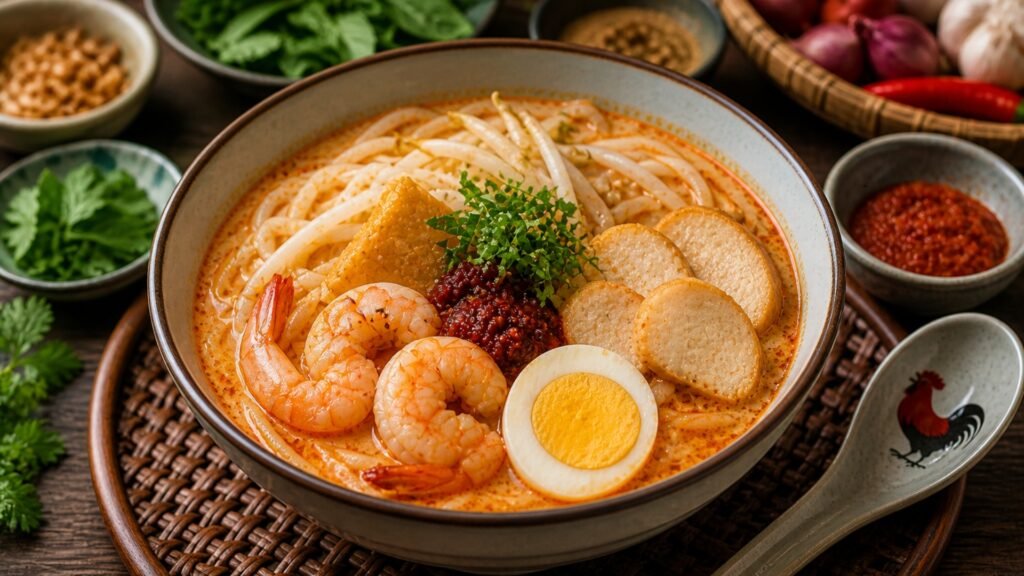
What is Singapore Laksa?
Alright so, authentic Singapore laksa — what actually is it? At its most basic, it’s a spiced noodle soup. But calling it “spiced noodle soup” is kind of like calling the Merlion a “water feature.” Technically accurate, completely misses the point.
The real thing is built on a coconut milk broth noodles base — rich, thick, deeply fragrant. The broth comes from a fried spice paste (called rempah), and it’s layered with cockles, tofu puffs, fish cake, and usually a fat prawn or two. It sits right at the centre of singapore food culture laksa — centuries of Peranakan history, migration, trade, and community cooking, all ending up in a single bowl you eat with a spoon at a plastic table at 9am on a Saturday. Which is honestly peak Singapore.
Well, and here’s the part that gets me — it’s not just food, right. Singapore’s national dish laksa carries something heavier than flavour. In 2020, UNESCO officially recognised Singapore’s hawker culture as an Intangible Cultural Heritage of Humanity. Laksa was front and centre in that recognition. You can’t separate the dish from the people who built it, or the communities who kept making it exactly the same way for generations. That matters. That’s what you’re actually tasting.
Origins of Laksa in Singapore
So way back — we’re talking the 15th and 16th centuries here — Chinese traders were settling across the Malay Archipelago. They married into local Malay communities. Their descendants, the Baba-Nyonya people, developed this completely unique cooking style. Chinese noodle traditions crashing into Malay spice knowledge. That collision? That’s where peranakan cuisine singapore came from. And laksa came out of it.
The katong district singapore food scene — specifically that stretch of East Coast Road — eventually became the spiritual home of the dish. By the mid-20th century, Katong was already Singapore’s unofficial laksa capital. It still is. For anyone who wants to dig into the deeper singapore food heritage roots here, the National Heritage Board Singapore is genuinely worth a browse.
What Makes Katong Laksa Unique
Here’s the thing most people don’t realise until they’re actually eating it.
The noodles are cut short. You eat the whole bowl with a spoon. No chopsticks. That’s not laziness — that’s the tradition. Everything works together in one spoonful.
And the broth. The lemongrass ginger spice paste (rempah) gets fried slow. Patient. Until the oil separates and the colour deepens into that burnt orange you’ve probably seen in a hundred Instagram photos but honestly cannot appreciate until you smell it in person. Then comes the coconut milk, the shrimp paste laksa flavor, the dried shrimp. The broth ends up thicker and richer than most regional variations you’d find anywhere else in Southeast Asia. This is what traditional peranakan laksa looks like when it’s done properly — no shortcuts, no compromises, no explanation needed.
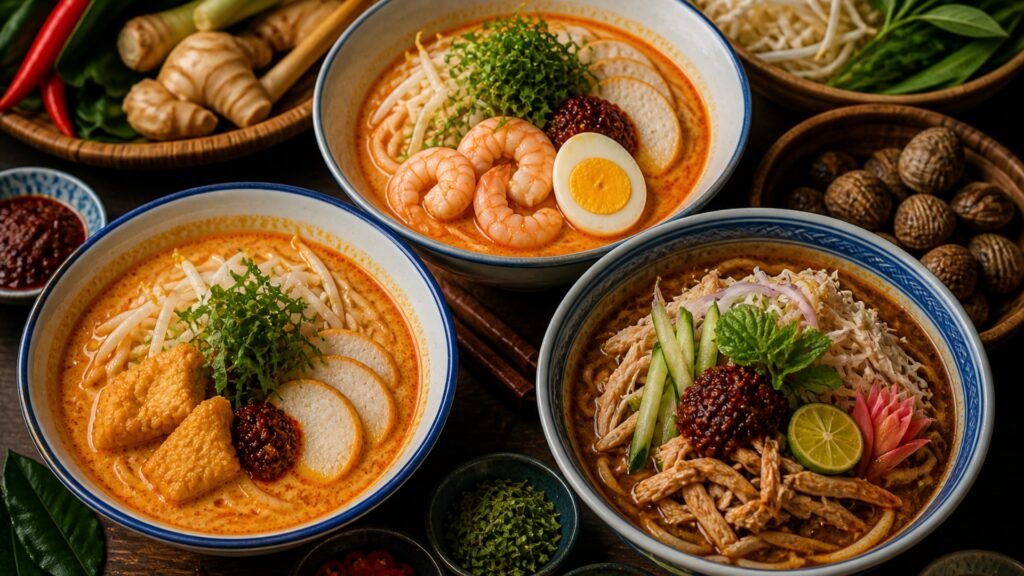
Types of Laksa You Must Try in Singapore
Not all laksa is the same. That’s the single most important thing to understand before you go anywhere. Singapore street food laksa exists on a genuinely wide spectrum. Thick creamy coconut versions. Tangy tamarind-based ones. Rare charcoal-cooked styles that are disappearing faster than anyone’s comfortable admitting.
Knowing the difference changes how you order. Changes what you appreciate. And honestly, it makes the whole exploration more interesting — because you’re not just eating the same bowl 15 times. You’re discovering why singapore culinary diversity is something people talk about with actual pride.
Try all three types. I mean it. Your understanding of what this city does with food will shift in ways you didn’t expect.
Katong Laksa
Okay so this is the one. The one that started the debates. The one that put Singapore on the global food map.
Coconut milk noodle soup Singapore at its most indulgent — that’s Katong laksa. The broth is orange-red, deeply spiced, finished with hae bi (dried shrimp) for that layered umami that kind of sneaks up on you. Bee hoon noodles laksa — thin rice vermicelli — cut short, eaten with a spoon. Cockles, fish cake, tau pok (tofu puffs that absorb broth like tiny sponges). The nyonya laksa recipe tradition behind this style is centuries old. You taste it in every properly made bowl — that weight of history, that accumulated knowledge of what works.
A good tau pok, by the way, should release a small flood of broth when you squeeze it. If it doesn’t, the broth wasn’t good enough to soak into it. Small test. Very telling.
Curry Laksa
Curry laksa Singapore is the everyday bowl. The one people grab without ceremony, without planning — just because it’s there and it’s good and they’ve been eating it since childhood.
It’s got a yellow curry base blended with coconut milk, creating something earthier and slightly milder than Katong-style. You’ll find it across laksa Singapore hawker centre stalls all over the island. Toppings vary more here — fish balls, long beans, bean sprouts, sometimes chicken. Always sambal on the side. Always.
It doesn’t have the legendary reputation of Katong-style. But it feeds more Singaporeans on more ordinary days than any other version. That’s a kind of quiet importance that I think doesn’t get enough credit.
Assam Laksa
Assam laksa Singapore is the wild card. Completely different from everything else on this list.
No coconut milk. None whatsoever. The broth is built entirely on tamarind — sour, punchy, tangy in a way that wakes you up completely. Shredded mackerel, laksa leaves vietnamese coriander, torch ginger flower (bunga kantan), thick rice noodles. It’s herbaceous and light and genuinely refreshing — total contrast to the richness of Katong-style.
The style is more associated with Penang than Singapore, sure. But Singapore has excellent renditions. And for anyone who finds coconut-heavy broths too intense — this is your laksa. Spicy noodle soup Southeast Asia tradition at its most vibrant and tangy.
15 Best Laksa in Singapore (Top Local Picks)
Right. This is what you actually came here for.
Finding the best laksa in Singapore is not as simple as walking up to any stall and pointing. The truly great bowls require something from you — sometimes an early morning, sometimes a sweaty queue, sometimes the willingness to go somewhere with no English signage and just trust the smell.
Every stall below was picked based on broth depth, noodle texture, topping quality, value for money, and what locals call “the feel” — that thing that’s hard to define but immediately obvious when it’s there. Some of these are michelin bib gourmand laksa recipients. Others are invisible to tourists but sacred to neighbourhood regulars. All of them are worth your time.
Here’s the 2026 list.
1. Janggut Katong Laksa – Legendary Original Taste
Janggut. The name comes up in every serious laksa conversation eventually.
Operating since the 1940s from East Coast Road, this stall carries decades of real history in every bowl. The broth is intensely rich — slightly sweet, deeply spiced — and the cockles arrive still glistening from freshness. This is authentic Singapore laksa without compromise. No modernisation, no rebrand, no Instagram angle. Just the recipe, made the way it’s always been made.
Janggut Katong Laksa doesn’t need to advertise. The queue does that.
Arrive before noon. It sells out — every single day, without fail. A bowl runs around $4 to $6, which feels almost dishonestly cheap for what you’re getting.
2. 328 Katong Laksa – Michelin-Recognised Favorite
328 Katong Laksa, 51 East Coast Road. Michelin Bib Gourmand laksa recognition, multiple years running. Internationally known. Locally beloved. The broth is that clean, bright orange. The prawns are fat and juicy. The bee hoon noodles laksa hits exactly the right texture — silky, yielding, not even slightly mushy.
Anthony Bourdain visited Singapore multiple times across his career. This Katong strip was always on his radar. That kind of endorsement doesn’t expire.
For anyone planning a Singapore food tour laksa itinerary, this is where to start. Not because it’s the only great bowl on East Coast Road — but because it gives you the benchmark. Everything else you eat after this, you’ll be comparing to it. Pay $5 to $7 per bowl. Worth every cent.
3. Depot Road Zhen Shan Mei Laksa – Rich & Creamy Broth
Depot Road Zhen Shan Mei Laksa, inside Alexandra Village Food Centre — this one is a legend in its own right.
The broth is, without exaggeration, one of the creamiest you will encounter anywhere in a hawker setting. Multiple Michelin Bib Gourmand laksa awards just confirmed what neighbourhood regulars already knew for years before any inspector showed up. The dried shrimp intensity is exceptional. You can smell the hae bi from three stalls away. I’m not being dramatic — ask anyone who’s walked through that food centre.
Queues run 20 to 30 minutes during peak hours. Budget $4 to $5. Add extra cockles. Don’t skip this one.
4. Sungei Road Laksa – Traditional Charcoal Style
Sungei Road Laksa, now at Jalan Berseh Food Centre after being displaced from its original location. One of the last charcoal-cooked laksa operations still going in Singapore.
The clay pot cooking adds a smokiness to the broth — faint, honest, genuine — that no gas flame has ever replicated convincingly. This is living Singapore food heritage, not behind museum glass but served in a paper cup with a plastic spoon at $3 to $4 a bowl.
Charcoal hawker stalls are disappearing from Singapore faster than most people realise. Visit this one soon. When it closes, that flavour goes with it. There won’t be a replacement. That’s not pessimism — that’s just how food history works.
5. Guang Fa Laksa – Hidden Local Gem
Guang Fa is what you’d call a famous laksa stalls Singapore insiders know about — but outsiders almost never find.
Zero tourist traffic. The clientele is entirely neighbourhood regulars who’ve been eating here since their school days. The broth runs spicier than mainstream versions. The handmade fish cake slices are fresh daily. The cockles are sourced with care.
Prices hover $3.50 to $5. Weekday mornings give you the freshest batch of the day. This is the kind of place that makes Singapore hawker food experience so special — no fanfare, no marketing, just exceptional food made for people who actually live nearby.
6. Lau Jiang Fishball Noodle – Unique Laksa Twist
This one’s genuinely unexpected and I think about it more than I probably should.
Lau Jiang started as a fishball noodle stall. But somewhere along the way, they developed a laksa variant that their regulars won’t stop talking about. Homemade fishballs added to a spicy laksa broth — sounds strange, works spectacularly. The textural contrast is something you simply won’t find at standard stalls.
Clementi area hawker centre. This stall represents something real about Singapore street food laksa culture — the willingness to bend tradition while keeping the soul of the dish completely intact. Seafood laksa Singapore lovers who appreciate creative thinking will find this especially worth a detour.
7. Famous Sungei Road Trishaw Laksa
Named after the trishaw riders who used to park outside and eat here after long shifts. Real community history, not manufactured nostalgia.
The broth runs slightly darker and smokier than most Katong versions. Important note: this is a different stall from the Sungei Road Laksa at Jalan Berseh. Two separate operations, overlapping names, overlapping reputations. Both deserve a visit. Don’t confuse one for the other when you’re recommending spots to friends — people will notice.
Prices around $3 to $4.50. Extraordinary value for the depth of flavour.
8. Roxy Laksa – Old-School Flavor
Near Roxy Square, Marine Parade area. Decades of doing exactly the same thing, quietly, consistently, without any interest in reinvention.
East Siders grew up eating this. The recipe hasn’t changed. The broth achieves that precise balance between spice and sweetness that only comes from years — maybe decades — of refinement. No gimmicks. No rebrand. and No social media presence worth mentioning. Just genuinely good traditional Peranakan laksa in its most neighbourhood form.
Around $4 to $5.50. Bring cash.
9. George’s Katong Laksa – Authentic Peranakan Taste
George’s carries real Peranakan cuisine Singapore credentials — family recipe, passed down properly.
The lemongrass ginger spice paste (rempah) is ground fresh every morning. No commercial paste. No shortcuts. The result is a broth that’s less sweet and more herbaceous than the competitors nearby. Complexity builds slowly as you eat. This is nyonya laksa recipe culture made real and served daily to whoever shows up early enough to get a seat.
Seating is genuinely limited. Arriving early becomes less of a suggestion and more of a requirement. Budget $5 to $6. Worth it completely.
10. Queensway Shopping Centre Laksa Stall
Tucked inside Queensway Shopping Centre’s food court — you know, the one everyone still goes to for sports shoes and not much else. Most people walk past this stall without noticing it.
That’s a mistake.
Loyal neighbourhood clientele who’ve been eating here for years without telling anyone online about it. That restraint is — honestly, admirable. At $3.50 to $4.50, this is exactly the kind of no-frills Singapore hawker food experience that’s getting rarer as rents push hawkers out. One of those places you tell one friend about and ask them not to share. Worth it just to say you’ve had good laksa Singapore hawker centre food in one of Singapore’s most nostalgic old malls.
11. Holland Village XO Laksa
Holland Village’s market draws a mixed crowd — expats, students, families, people who wandered in from the MRT. The XO Laksa stall here stands out for one specific reason.
XO sauce in the broth. Subtle but completely transformative — adds a layer of umami seafood depth that standard laksa broths don’t reach. Seafood laksa Singapore enthusiasts will find this deeply satisfying. Portions are generous. Toppings don’t disappoint. Pairing it with a side of otah makes for one of the more complete hawker meals you can put together anywhere on the island. Prices $5 to $7.
12. Old Airport Road Laksa
Old Airport Road Food Centre opened in 1973. Still going. Multiple laksa stalls operating simultaneously — healthy competition, consistently high quality.
This is one of the great Singapore food tour laksa destinations. You can buy from one stall, sit down, then walk back for a second bowl from the competitor three doors down for direct comparison. Authentic Singapore laksa across different styles, same roof, one trip. Prices $4 to $6. The variety here makes it essential for anyone who wants to understand the full range of what this dish looks like in a hawker setting.
13. Bedok Laksa Specialist
Bedok’s laksa scene has always sat in the shadow of Katong’s fame. That’s genuinely unfair.
The Bedok Laksa Specialist does one thing and executes it exceptionally. Three generations of Bedok families eat here. The broth is made fresh every morning and doesn’t survive to afternoon — which tells you everything about demand and freshness without needing any marketing. Saturday mornings, broth at its best. Prices $3.50 to $5. The trip east from anywhere in Singapore is completely worth it.
14. Katong Laksa (East Coast Classic)
The East Coast Road stretch of Katong is honestly something else.
Multiple competing stalls, all within walking distance, each with passionate loyalists who will argue — genuinely argue — that their specific stall is definitively superior. This is katong district Singapore food culture at its most alive. The best Katong laksa Singapore 2026 debate is ongoing and unsettled. Maybe that’s the point. Maybe the debate is part of the experience.
Budget $4 to $6 per bowl and spend a weekend morning eating through the strip. No single stall wins objectively. The entire stretch does.
15. Beach Road Laksa
Slightly off the main tourist trail. Near Arab Street and Haji Lane. Locals have always liked it here for exactly that reason.
The broth carries a distinct prawn-forward sweetness — different from the coconut-heavy Katong versions, different from the XO depth at Holland Village. The outdoor seating gives the whole meal that breezy, unhurried, old-Singapore quality you can’t manufacture. Singapore food culture laksa in this part of the city feels relaxed and unselfconscious. Prices around $4 to $5. Worth a spontaneous visit whenever you’re already in the area and your stomach starts making suggestions.
Where to Find the Best Laksa in Singapore (Locations Guide)
Okay so Singapore’s laksa geography makes more sense once you understand the city’s layout. The East — Katong, Bedok, East Coast — is where traditional Peranakan laksa runs deepest. Central Singapore around Jalan Berseh and Old Airport Road carries the old hawker centre legacy. The West — Queensway, Holland Village — offers more accessible neighbourhood versions. Knowing which area matches what you’re after saves time and prevents the particular heartbreak of arriving somewhere at 2pm when the broth ran out at 12.30.
Genuinely practical advice before going anywhere: verify hours. Famous laksa stalls Singapore operate on hawker time — early mornings, sold out by early afternoon, closed on days not always posted online. Check Burpple or HungryGoWhere for real-time updates. Google Maps reviews from the last week are your best friend. Showing up late and finding a closed shutter teaches you to plan better next time — but better to avoid the lesson altogether.
Best Laksa in Katong Area
Katong is the undisputed capital. No debate needed on that front.
East Coast Road and the Joo Chiat stretch represent what food culture looks like when a community genuinely cares about one dish across multiple generations. Janggut Katong Laksa, 328 Katong Laksa, George’s, and Roxy — all walkable from each other. Weekend mornings before 10am are the sweet spot. Fresh broth, manageable queues, the whole neighbourhood smelling like spiced coconut milk.
If this guide could only send you to one area, it’d be Katong. Everything else is worthwhile — but Katong is essential.
Best Laksa in Hawker Centres
Laksa Singapore hawker centre culture is where the real depth of the dish lives. The best centres in 2026: Alexandra Village Food Centre, Jalan Berseh, Old Airport Road, Bedok 85 Fengshan, and Holland Village Market. Each offers something slightly different. The general rule — more local foot traffic equals better quality. Empty tables, no queue? Walk past. The locals always know.
| Hawker Centre | Signature Stall | Price Range | Best Time |
|---|---|---|---|
| Alexandra Village Food Centre | Depot Road Zhen Shan Mei | $4 – $5 | Weekday mornings |
| Jalan Berseh Food Centre | Sungei Road Laksa | $3 – $4.50 | Early morning only |
| Old Airport Road Food Centre | Multiple Stalls | $4 – $6 | Weekend mornings |
| Bedok 85 Fengshan Centre | Bedok Laksa Specialist | $3.50 – $5 | Saturday mornings |
| Holland Village Market | XO Laksa Stall | $5 – $7 | Lunch hours |
Budget-Friendly Laksa Spots
Cheap laksa Singapore hawker options genuinely still exist in 2026. Which, given how much everything else has gone up, is pretty remarkable.
Sungei Road Laksa at Jalan Berseh comes in around $3. Bedok Laksa Specialist starts at $3.50. Queensway holds at $3.50 to $4.50. Simple rule: avoid Orchard Road, Marina Bay, and anything marketing itself as “artisanal heritage hawker.” Prices double, authenticity doesn’t follow. Where to eat laksa in Singapore on a real budget? Head to the heartlands. That’s where the actual stuff has always been.
How Much Does Laksa Cost in Singapore?
The Singapore laksa price guide is something a lot of people get wrong before they arrive. The idea that hawker food is always under $3 hasn’t matched reality for a while now. In 2026, a standard bowl runs $3 to $6 at hawker centres, with michelin bib gourmand laksa spots sitting at the higher end of that without apology. Restaurant laksa — full Peranakan cuisine Singapore dining — pushes past $15 comfortably. Wide spectrum. Good to know before you’re standing at a stall doing mental maths.
Post-COVID ingredient costs hit the industry hard. Coconut milk, fresh cockles, quality prawns — all significantly more expensive than 2019 levels. Most hawker stallholders absorbed this quietly rather than slapping a big price increase sign on the menu. And still, even at $6, a bowl of authentic Singapore laksa represents extraordinary global value. A Michelin Bib Gourmand laksa bowl for $5 at a Singapore hawker centre might honestly be the best food deal available anywhere in the world right now. I mean that literally.
Average Price Range
| Category | Price Range | What You Get |
|---|---|---|
| Budget Hawker Stall | $3.00 – $4.50 | Classic bowl, traditional toppings |
| Mid-Range Kopitiam | $4.50 – $6.50 | Generous portions, fresh ingredients |
| Casual Restaurant | $8.00 – $12.00 | Table service, premium toppings |
| Upscale Peranakan Dining | $14.00 – $22.00 | Elevated recipes, full dining context |
Cheap vs Premium Laksa
Here’s the honest truth — a $3.50 charcoal-cooked hawker bowl will frequently beat a $16 hotel restaurant version on pure flavour authenticity. No tablecloth compensates for commercial paste in the broth. Premium laksa adds lobster, soft-shell crab, tableside service. It’s a dining experience, not necessarily a better bowl.
That said — National Kitchen Violet Oon does an elevated nyonya laksa recipe that genuinely justifies its price. Heritage cooking executed with real restaurant precision. For everyday eating, chase the hawker stall every single time. For a special occasion where the full Peranakan dining experience matters, Violet Oon is worth the booking.
Tips for Choosing the Best Laksa
Knowing where to go covers half the challenge. Knowing what to look for when you get there covers the other half.
The best laksa in Singapore isn’t always the most famous, the most reviewed, or the one with the longest queue of people holding phones sideways. Sometimes it’s the stall with no English signage, a loyal line of regulars who all know each other’s names, and a stallholder who’s been making the same paste recipe since the 1980s without once considering changing it.
A few signals. A few things to check before you commit to a bowl.
The broth colour matters most. Deep, burnt orange-red means the lemongrass ginger spice paste (rempah) was fried properly — slowly, patiently. Pale orange or washed-out yellow suggests a rushed rempah or, worse, a commercial paste from a bag. Ask the stallholder directly if they make their paste from scratch. Good ones answer immediately and without hesitation. The ones who dodge the question are answering you anyway — just differently.
What Locals Look For
Singaporeans assess laksa quality quickly. Instinctively. Years of eating Singapore street food laksa trains you that way.
Broth colour first — deep orange-red confirms properly fried rempah. Cockles second — plump, slightly translucent, freshly opened, not grey or rubbery from sitting in water. The bee hoon noodles laksa should separate cleanly when stirred. Tau pok should release a flood of broth when squeezed. And the aroma — a properly made spicy laksa broth should hit you from three stalls away. If it doesn’t, the rempah wasn’t fried long enough. The bowl will confirm this when you taste it.
Spice Level Guide
| Spice Level | What to Say | What to Expect |
|---|---|---|
| No Chilli | “No sambal please” | Mild, creamy, coconut-forward |
| Standard | Just order normally | Moderate heat, the default level |
| Extra Spicy | “Add more sambal” | Real heat, still manageable |
| Maximum Spicy | “Extra pedas, maximum” | For serious chilli people only |
The spicy noodle soup Southeast Asia tradition means some warmth is always present, even in mild versions. The coconut milk buffers the heat — that’s part of the dish’s genius, not an accident. Even a “mild” laksa carries warmth from the rempah itself. Spice-sensitive? Ask for sambal on the side and control your own heat level. Stallholders handle this request without any fuss.
Final Thoughts – Which Laksa Should You Try First?
Okay. If you’re genuinely new to all of this — first visit to Singapore, first encounter with laksa, no idea where to begin — here’s the direct advice.
Start at 328 Katong Laksa. Michelin-recognised, queue moves at a reasonable pace, bowl is exceptional. It gives you a real benchmark. Then walk down to Janggut for comparison — different character, equally essential. Then, a separate day, make the trip to Depot Road Zhen Shan Mei for something completely different in creaminess and broth depth. That’s your three-bowl laksa education right there. Roughly $15 total, across two or three mornings. Most educational food spend you’ll make in this city.
Authentic Singapore laksa rewards curiosity and return visits. No single bowl tells the whole story. The charcoal tradition at Sungei Road speaks to a different chapter than the Peranakan family heritage at George’s. The XO innovation at Holland Village reflects a different impulse than the quiet old-school consistency at Roxy. Singapore’s best laksa in Singapore scene in 2026 is alive, diverse, fiercely local, and worth exploring across multiple visits and multiple bowls. Drop your favourite in the comments. The debate never really ends. That’s honestly the best thing about it.
FAQs About Singapore Laksa
What is the most famous laksa in Singapore?
Most serious conversations lead to two names: 328 Katong Laksa and Janggut Katong Laksa. 328 Katong Laksa has the Michelin Bib Gourmand laksa distinction and international name recognition. Janggut has the heritage crown — operating since the 1940s, arguably the stall that started the Katong tradition in the first place. Depot Road Zhen Shan Mei Laksa is the third name that comes up consistently, particularly for its extraordinary coconut milk broth noodles depth in a hawker setting. All three are famous for slightly different reasons. All three deserve a visit before you form a strong opinion either way.
Is laksa very spicy?
Not overwhelmingly — no. Standard spicy laksa broth in Singapore sits at a moderate heat level that most adults handle without difficulty. The shrimp paste laksa flavor contributes more to umami depth than to actual heat. Real spice comes from sambal chilli added at the end — which you control entirely. Ask for “less spicy” or “no sambal” and you get a bowl that’s warm and fragrant without genuine burn. Assam laksa Singapore is actually the mildest of the three main types — no coconut milk, tamarind-based, quite light overall. Spice-cautious people should order sambal on the side and add it themselves. Stallholders will not mind one bit.
Where do locals eat laksa in Singapore?
Locals skip restaurants. Full stop. Famous hawker laksa Singapore destinations are where you’ll find Singaporeans queuing Saturday mornings before 10am, before the heat gets serious. The Katong strip on East Coast Road, Jalan Berseh Food Centre, Old Airport Road Food Centre, Bedok 85 Fengshan — those are the heartland spots. Singapore hawker food experience at its most real looks like this: plastic stool, $4 bowl, kopi-o kosong to wash it down, no one checking their phone because the food has their full attention. That’s where to eat laksa in Singapore if you want to eat the way the city actually eats — not the way it performs eating for an audience.