

Helix Bridge Photoshoot – The Honest, Slightly Chaotic Guide You Actually Need for Singapore
Okay so… I’ll be real with you. The first time I showed up at Helix Bridge Singapore for a photoshoot, I had no idea what I was doing. Like, zero plan. I rocked up at noon — noon! — with a mirrorless camera, sweating through my shirt, wondering why every photo looked completely washed out and terrible.
Well. Turns out there’s a lot to know about this place.
And nobody really tells you the important stuff. Most guides are like, “visit during golden hour!” Cool, thanks. Super helpful. But when exactly? Which side of the bridge? Which platform? What settings? What do you do when forty tourists suddenly walk into your 6-second exposure?
That’s what this guide is actually for.
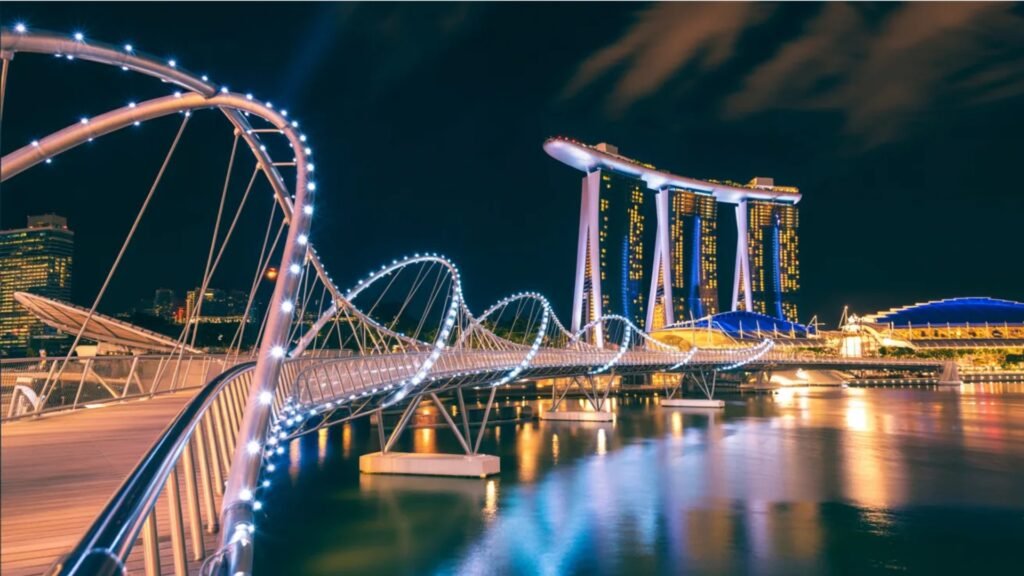
What is Helix Bridge Singapore?
So first — what even is this thing? Because if you haven’t seen it in person, photos honestly don’t do it justice. It’s a 280-metre pedestrian bridge that crosses the Singapore River in Marina Bay. Opened in April 2010. And it looks… well, it looks like someone took a strand of DNA and just built a bridge out of it.
Which, actually, is exactly what they did.
The DNA bridge Singapore design concept came from a 2006 international competition — 36 entries, and this wild stainless steel double-helix design won. The team behind it? Cox Architecture from Australia, local firm Architects 61, and engineering legends Arup. Together they built something that honestly shouldn’t work as a bridge but somehow does. Brilliantly.
It cost SGD $82.9 million. Took about six years to complete. And it uses five times less steel than a conventional box-girder bridge. I mean… that’s genuinely insane when you think about it. Five times less. And it holds up to 10,000 people simultaneously.
Anyway. The point is — if you’re planning a helix bridge photoshoot and you don’t understand what you’re photographing, you’ll miss half the story. And the story is wild.
Overview and Location Near Marina Bay Sands
Right, so location-wise — it’s basically impossible to miss. The bridge connects Bayfront Avenue to the Esplanade waterfront, sitting right next to Marina Bay Sands. You know that hotel. The one with the boat on top. Yeah. That one.
There are four viewing platforms cantilevered off the sides of the bridge. Each holds about 100 people. They stick out over the water at different angles, giving you completely different views of the Singapore night skyline. The platforms are free. Always open. No booking required.
Why It’s One of Singapore’s Most Iconic Landmarks
CNN Travel called it “an architectural marvel and engineering feat” when it opened. It’s appeared in Westworld Season 3. It’s literally a track in Mario Kart. And it earned a spot in — I’m not making this up — The Left-Handed DNA Hall of Fame 2010.
Because the helix curves left. Natural DNA curves right. Someone noticed. Someone gave it an award for that. Singapore, man.
For any travel photographer Singapore-bound and planning their shot list, this bridge is non-negotiable. Full stop.
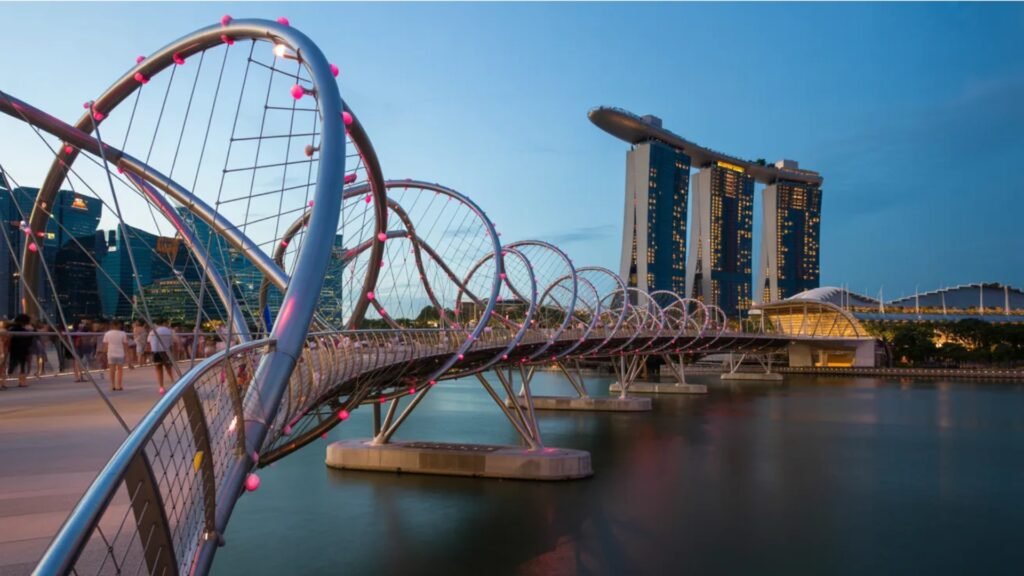
Unique Architecture of Helix Bridge
Here’s where it gets genuinely interesting, even if you’re not a nerdy architecture person (I wasn’t, and now I kind of am, which is embarrassing but whatever).
The Helix Bridge architecture uses two interlocking steel spirals that wrap around a central pedestrian corridor. Together they act as a tubular truss — meaning the structure distributes weight through the spirals themselves rather than through a traditional beam underneath. It’s elegant. It’s counterintuitive. And when you’re walking through it, especially at night, it feels like being inside something alive.
The canopy overhead is made of fritted glass and perforated steel mesh. It filters the harsh Singapore sun during the day. At night the Helix Bridge light show illuminates that same canopy from inside — turning it into this shimmering, glowing membrane above your head. Honestly? The first time I saw it properly lit up I just… stood there for a bit. Just stood there. My camera was in my hand and I forgot to use it.
| Specification | Detail |
|---|---|
| Official Name | The Helix |
| Length | 280 metres |
| Primary Material | Grade 2205 Duplex Stainless Steel |
| Total Steel Weight | 650+ tonnes |
| Opened | 24 April 2010 (partial) / 18 July 2010 (full) |
| Construction Cost | SGD $82.9 million |
| Viewing Platforms | 4 (capacity ~100 each) |
| Max Load Capacity | 10,000–16,000 people at once |
| Design Team | Cox Architecture + Architects 61 + Arup |
DNA-Inspired Design Concept
So the DNA bridge Singapore design thing goes deeper than just the shape. Walk across the bridge at night. Look down. You’ll see illuminated letters — C, G, A, T — glowing in red and green from the ground level. Those are the four DNA base pairs: cytosine, guanine, adenine, thymine. Someone actually embedded the genetic code into the lighting design.
It’s the kind of detail you walk past and almost miss. Then you catch it and you’re like… wait. Wait. Did they really?
They really did.
Materials and Engineering Behind the Structure
Every tube in the frame measures 273 mm in diameter. That sounds chunky until you realise how long and thin those spans are. Grade 2205 Duplex Stainless Steel was chosen specifically for Singapore’s climate — hot, humid, and coastal. It resists corrosion extremely well, which matters when your bridge is essentially suspended over saltwater.
Before actual construction started, the entire bridge was mocked up in mild steel. The entire thing. That mock-up alone took one year. It was built to catch fabrication errors before they became multi-million-dollar on-site problems. That kind of rigour is why Helix Bridge architecture still looks as precise today as it did in 2010.
Awards and Recognition
World’s Best Transport Building — World Architecture Festival Awards, 2010. BCA Design and Engineering Safety Excellence Award, 2011. Left-Handed DNA Hall of Fame, 2010 (yes, still funny). The bridge also earned official approval from Singapore’s Feng Shui Committee, which — look, I know that sounds unusual — but it’s actually a meaningful part of how Singapore develops major public infrastructure. The bridge’s lightness, luminosity, and natural ventilation apparently scored very well. Good vibes, architecturally speaking.
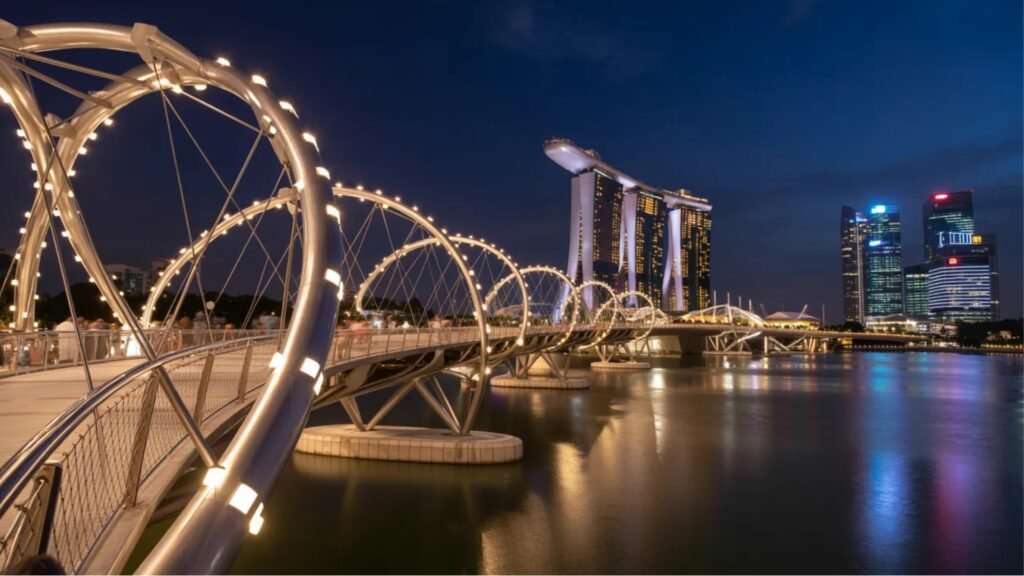
Best Time to Visit Helix Bridge
Okay real talk. This is the section most guides get wrong. Or at least… vague. They say “golden hour” like that’s enough information. It’s not.
So here’s what actually happens across a day at this bridge, and when you want to be there for a helix bridge photoshoot that delivers results.
Morning — like 6 to 8 AM — the bridge is almost empty. Like, eerily empty. The low angle light catches the steel geometry beautifully and you get long, dramatic shadows across the canopy. Great for architectural shots. Almost nobody else is there. The tradeoff? The Helix Bridge light show is obviously off. So you’re shooting pure structure in natural light.
Midday? Don’t bother. Seriously. Overhead sun just bleaches everything. Harsh shadows, blown-out highlights. I made this mistake once. The photos were borderline unusable.
The real window — the window every Singapore travel photography guide worth reading will point you toward — is 6:00 PM to about 7:45 PM. That’s your golden-to-blue-hour transition. The LED system kicks in. The sky goes through these extraordinary colour shifts. The Singapore city lights photography around the bay starts activating. And the water starts mirroring everything perfectly.
That 90-minute window is genuinely the best 90 minutes in urban photography Singapore.
| Time Slot | Light Quality | Crowd Level | Best For |
|---|---|---|---|
| 6:00 – 8:00 AM | Soft, directional | Very light | Architecture + structure detail |
| 10:00 AM – 3:00 PM | Harsh, flat | Moderate | Avoid for serious photography |
| 5:30 – 6:30 PM | Warm golden | Building | Portraits, wide-angle warmth |
| 6:30 – 7:45 PM | Blue hour gradient | Moderate-heavy | Blue hour photography Singapore |
| 8:00 – 10:30 PM | Full LED illumination | Heavy | Night skyline, long exposure |
| After 10:30 PM | Deep night | Light | Long exposure, near-empty bridge |
Day vs Night Experience
Daytime shows you the engineering. It’s a more intellectual, almost clinical kind of beauty — the lattice, the shadows through the mesh, the geometry. You start to understand how it was built.
Night shows you the soul of the thing. The Helix Bridge light show completely transforms the structure. LED ribbons trace every curve. The DNA letters glow from below. Visiting Helix Bridge at night for the first time is… it’s one of those moments. You know the ones. Where a place is better than you expected and you’re just kind of quietly glad you came.
Best Time for Photography
Blue hour photography Singapore peaks between 7:15 and 7:45 PM at this location, broadly speaking. The sky holds deep cobalt, the city is fully lit, and the bridge’s LEDs are running at full brightness. You get natural high dynamic range (HDR) conditions — the sky isn’t completely black, so there’s texture and detail in the upper third of your frame. It’s genuinely the best natural situation for Singapore skyline photography in the entire precinct.
Arrive by 6:30 PM to claim a good spot on the platform. Don’t arrive at 7:15. All the good spots will be gone and you’ll be shooting over someone’s shoulder.
Weather Tips for Visitors
Singapore’s weather is… a personality. It does what it wants. November through January is Northeast Monsoon season — heavy rain, often in the late afternoon or evening. February through April is your best window. Drier, cleaner skies, better visibility across the bay.
The bridge’s fritted glass canopy does provide some shelter. But the viewing platforms? Exposed. Completely open. Always, always bring a compact umbrella. I’ve had a photoshoot session end in about four minutes flat because I ignored this advice. Four minutes. Packed up soaking wet and retreated to a café. Not ideal.
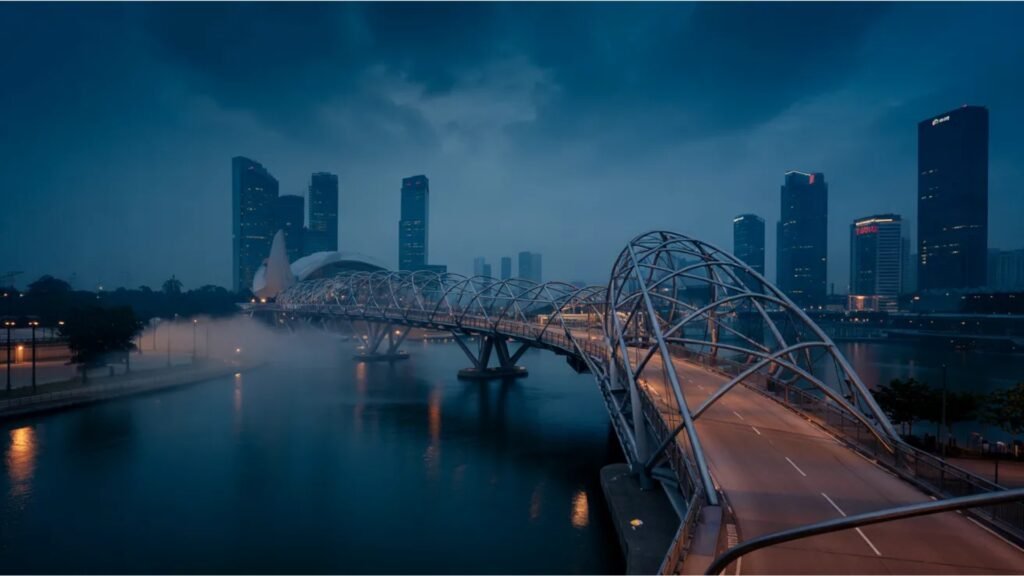
Helix Bridge Night Photography Guide
Alright, this is the section you actually came for. Let’s get into it properly.
Long exposure photography bridge shooting at the Helix requires a bit of planning. Not a lot. But a bit. The LED lighting is bright and directional. The surrounding skyline creates multiple competing light sources — Marina Bay Sands, the Singapore Flyer, the Esplanade domes, the skyscrapers along the CBD. They all pull at your exposure in different ways.
And then there’s the water. On calm nights — genuinely calm, no passing vessels, no wind — the Singapore city lights photography reflection in Marina Bay is extraordinary. The whole city just… doubles itself in the water. It’s one of those compositions that feels almost unfair to photograph, because the scene is doing 90% of the work for you.
Every professional travel photographer who’s spent real time here will tell you the same thing. Your first visit is recon. Walk every platform. Note the angles. Watch how the crowds move. Come back the next night with a plan. That’s the photography career experience approach. That’s how the great shots get made.
Camera Settings for Night Shots
So camera settings for night photography at the Helix. Real numbers. No vague advice.
Start here: ISO 800, aperture f/8, shutter speed 3–5 seconds. Use a tripod for long exposure — no exceptions, no improvising. A 2-second self-timer or a remote shutter release eliminates camera shake from pressing the button. Manual focus, locked on the nearest helix element in your frame. And shoot in RAW. Always RAW. The RAW file editing workflow in Adobe Lightroom gives you enormous recovery latitude on both the shadow detail in the steel and the highlight detail in the LED lighting.
| Setting | Starting Point | Adjust When |
|---|---|---|
| ISO | 800 | Raise to 1600 if underexposed |
| Aperture | f/8 | Open to f/5.6 for less depth |
| Shutter Speed | 3–5 seconds | Longer for light trails on water |
| White Balance | 3800K | Warmer if steel looks too blue |
| Focus | Manual | Lock on nearest structural element |
| Format | RAW | Non-negotiable for editing |
The enhance details Lightroom feature is your best friend in post-processing workflow for these shots. It recovers incredible micro-detail from the steel lattice that standard sharpening just can’t match. And when you’re pulling highlights down in Adobe Lightroom editing to recover the LED glow, that RAW file will hold the data you need. JPEG will not.
Best Angles and Spots
Best Helix Bridge photo spots at night — okay so here are the ones that actually work.
The northern approach from Marina Bay Sands gives you the bridge curving away from you into the distance. Classic. The leading lines photography here are natural — the twin helix spirals draw the eye through the entire frame. The eastern viewing platform puts the ArtScience Museum in your background — that lotus-shaped building glowing white against the dark bay is a genuinely striking compositional anchor.
For reflections — and honestly this is my personal favourite shot from this entire precinct — crouch low at the Bayfront waterfront edge, just south of the bridge entrance. If the water is calm, you get the bridge reflected in full, with the city behind it. The composition techniques write themselves. It’s almost cheating.
Mobile Photography Tips
No tripod? No mirrorless body? and No problem, actually.
Helix Bridge photography tips for beginners with just a phone: enable Night Mode, brace the phone against the railing or a post, and shoot with the 3x telephoto lens. It compresses the spiral geometry in a really interesting way. Google Pixel 7+ and iPhone 15 Pro handle this scene well in auto mode — better than you’d expect. Photography editing techniques using Snapseed’s selective brush let you lift shadow detail on the steel and gently reduce highlights on the LEDs without destroying the overall exposure.
The result won’t look like a professional travel photographer shot it. But it’ll look really, really good for a phone image. Especially at blue hour photography Singapore timing.
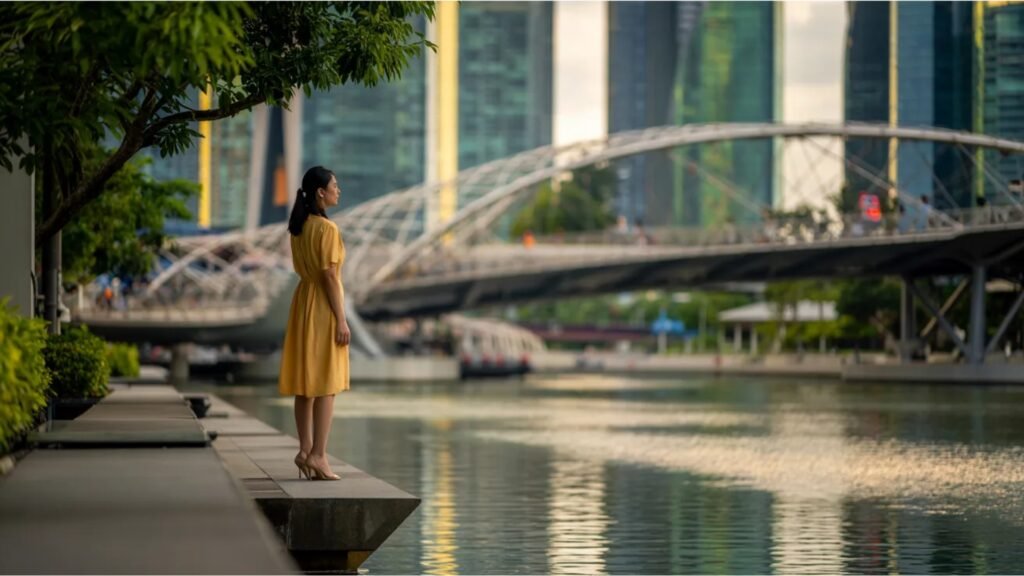
Top Photo Spots Near Helix Bridge
Okay so here’s something most Singapore travel photography guide content misses: the bridge itself is only part of the story. The best shots in this precinct sometimes happen near the bridge, not on it.
Singapore skyline photography from Marina Bay is a full ecosystem. Every angle within 500 metres delivers something different and genuinely compelling. A walking tour Marina Bay that starts at Bayfront MRT, crosses the bridge, circles the ArtScience Museum waterfront, moves past the Esplanade, and loops back via Fullerton Bay covers every major best photo spots Singapore position in about 90 minutes. Do it at dusk and the light changes dramatically three times during that loop.
I’ve done that loop maybe a dozen times now. It never gets old. Genuinely.
Marina Bay Sands Viewpoint
Marina Bay Sands photography from the elevated walkway connecting MBS to the bridge gives you something rare — a bird’s-eye view of the entire 280-metre curve of the Helix below. From ground level you can’t see the whole plan. From up here it’s all visible in one frame. Shoot looking south during blue hour photography Singapore timing. The Singapore night skyline spreads out behind the bridge in every direction. It’s the defining shot of this location.
Singapore Flyer Background Shots
Stand on the western edge of the bridge. The Singapore Flyer — 165 metres tall, one of the world’s biggest observation wheels — slots into the upper right of your composition. The foreground geometry of the helix spirals against the Flyer’s vast circular form creates a shot that layers Helix Bridge architecture detail against large-scale urban infrastructure beautifully. It’s one of the genuinely great iconic landmarks Singapore two-for-one compositions.
Skyline Reflections from the Bridge
Still water nights — Wednesday or Thursday, mid-week, lower boat traffic — are when this works best. Walk to the bridge’s midpoint. Lean slightly over. Shoot straight down. The reflected Singapore city lights photography below you is doubled, shimmering, and somehow more vivid in reflection than in reality. Storytelling through images is easy when the scene looks like this. The city does the work.
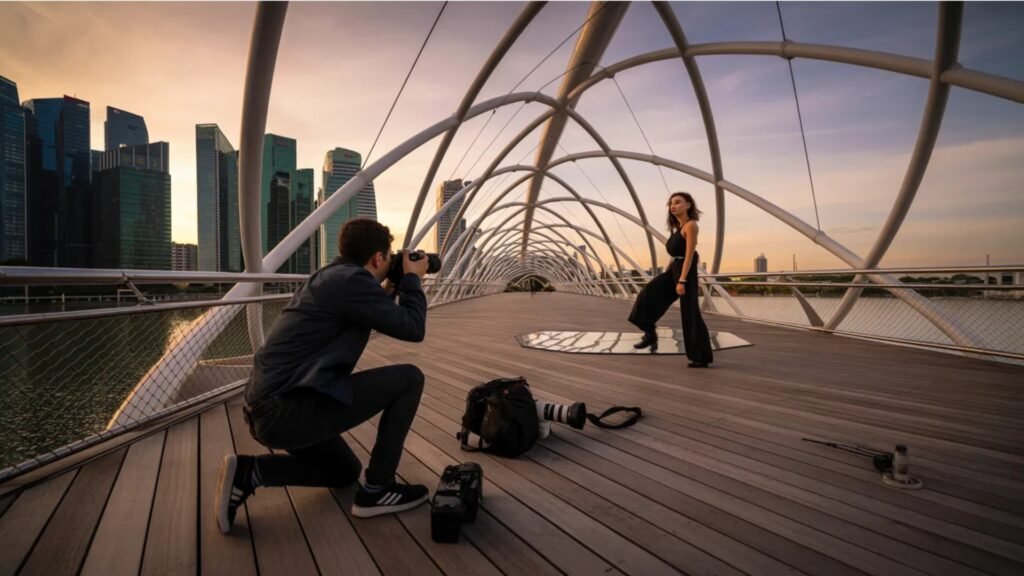
Things to Do at Helix Bridge
Look, a helix bridge photoshoot is one reason to be here. But it’s not the only one. Not even close.
People use this bridge as a running route. As an evening walk. As the world’s most atmospheric shortcut between Marina Bay Sands and the Esplanade. Families come for the viewing platforms. Couples come for the vibe. Architecture nerds come and just… stand there staring upward at the steel for twenty minutes. I’ve been that person. No shame.
The things to do in Marina Bay that orbit this bridge are genuinely world-class. And since it’s free, open 24 hours, and accessible in five minutes from Bayfront MRT — there’s basically no reason not to factor it into any Singapore city exploration itinerary.
Walking Experience and Viewing Platforms
Four cantilevered platforms. Four different angles. Each holds about 100 people, though they feel most comfortable at around 40–50. The walk across takes 10–15 minutes at a relaxed pace. Moments in time photography thrives here — the bridge is always occupied, always moving, always providing natural human scale against the architectural geometry. Great for behind the scenes photography content too, if that’s your thing.
Light Shows and Night Ambience
After sunset, the Helix Bridge light show fully activates. Outward-facing LEDs trace the helix tubes. Inward-facing lights create that shimmering membrane effect on the glass canopy above you. The DNA base pair letters — red and green, C G A T — glow from below. On National Day eve or New Year’s Eve, this entire waterfront becomes something else entirely. The bridge is part of a bigger spectacle that covers the whole of Marina Bay. If you can time a visit for one of those nights… do it. Just arrive very early.
Nearby Attractions to Explore
After the bridge: ArtScience Museum is three minutes on foot. Gardens by the Bay is five. The full waterfront promenade loop to the Esplanade and back takes 90 minutes. Every step of that walk is fresh material for Singapore travel photography guide content. Tourist attractions near Marina Bay Sands are almost embarrassingly concentrated in this small area. A single afternoon-evening itinerary can hit all of them without a single taxi ride.
How to Get to Helix Bridge
One of the easiest journeys in Singapore. Which is saying something, because Singapore’s entire transport system is already excellent.
No car needed. No rideshare required. The MRT gets you to Bayfront in minutes from almost anywhere in the central area. And then the bridge is a five-minute walk from the station exit. Even on your first visit to Singapore, you won’t get lost getting here. The glowing helix structure is visible from 500 metres away and basically guides you in on its own.
MRT Stations and Public Transport
Circle Line or Downtown Line to Bayfront MRT (CE1/DT16). Exit via Underpass B. Follow the Marina Bay signs. Five minutes on foot and you’re at the southern entrance. From Raffles Place, the train ride takes roughly three minutes. Buses 97, 97e, 97G, and 106 also stop within a short walk. For best time to visit Singapore timing, catching the train around 6:15 PM puts you on the bridge right at the start of golden hour.
Walking Routes from Marina Bay Area
From Raffles Place MRT, cross Cavenagh Bridge, follow the Singapore River promenade heading east, and you’ll hit the Helix in about 20 minutes. You pass Anderson Bridge, the Fullerton Hotel, the Arts House — all genuinely worth stopping at. From the Esplanade it’s eight minutes along the waterfront. This whole route is a fantastic walking tour Marina Bay experience in itself, not just a way to get somewhere.
Travel Tips for Tourists
Stay near Bayfront, City Hall, or Promenade MRT stations for easy access. The bridge is open 24 hours with no last entry, ever. It’s safe at all hours. Do watch the glass floor panels on the viewing platforms after rain though — they look beautiful and they are genuinely slippery. Wear shoes with grip. Especially important during any helix bridge photoshoot session where you’re moving around on wet platforms in the dark carrying gear.
Tips for Visitors
First-timers always underestimate how long they’ll stay. A planned 15-minute crossing routinely becomes an hour-long session and nobody quite understands why they’re still there. The bridge is just… compelling in person. The Singapore night skyline surrounding it doesn’t hurt either.
Real practical advice: the best time to visit Singapore for this kind of experience is February through April. Lowest rainfall, clearest skies, best visibility across the bay. That’s when Singapore city lights photography conditions are at their peak and the long exposure photography bridge shots benefit most from clean, still air over the water.
Safety and Crowd Tips
The bridge is extremely safe. It’s well-lit, well-maintained, and there are people around at almost all hours. Peak crowd time is Friday and Saturday evenings between 7:00 and 9:30 PM. Keep camera gear for travel photography strapped down in those crowds — not because of theft, honestly, but because bumping into someone mid-setup is annoying and potentially expensive. The structural capacity is 10,000+ people simultaneously, so nobody needs to worry about that.
Best Time to Avoid Crowds
Tuesday and Wednesday evenings, 7:30–9:00 PM. That’s the sweet spot for light foot traffic. New Year’s Eve and National Day (9 August) bring absolutely massive crowds and spectacular light displays — worth experiencing once, but not ideal for a controlled helix bridge photoshoot. Photography challenges on those event nights are real. People walk through your 6-second exposures constantly. Weekday mornings before 8:00 AM are another option — virtually empty bridge, beautiful soft light.
What to Bring for the Visit
Tripod for long exposure — essential. Portable power bank — essential. Compact umbrella — essential. Moisture-wicking clothing — strongly recommended. A lens for night photography, ideally 24–70mm f/2.8 or a wider prime, gives you the most compositional flexibility on the bridge. Water. Always water. Singapore at night is still 28°C with high humidity. You will sweat. Your phone needs juice. Your battery grip needs backup cells. Pack properly and the helix bridge photoshoot experience is comfortable and creatively productive.
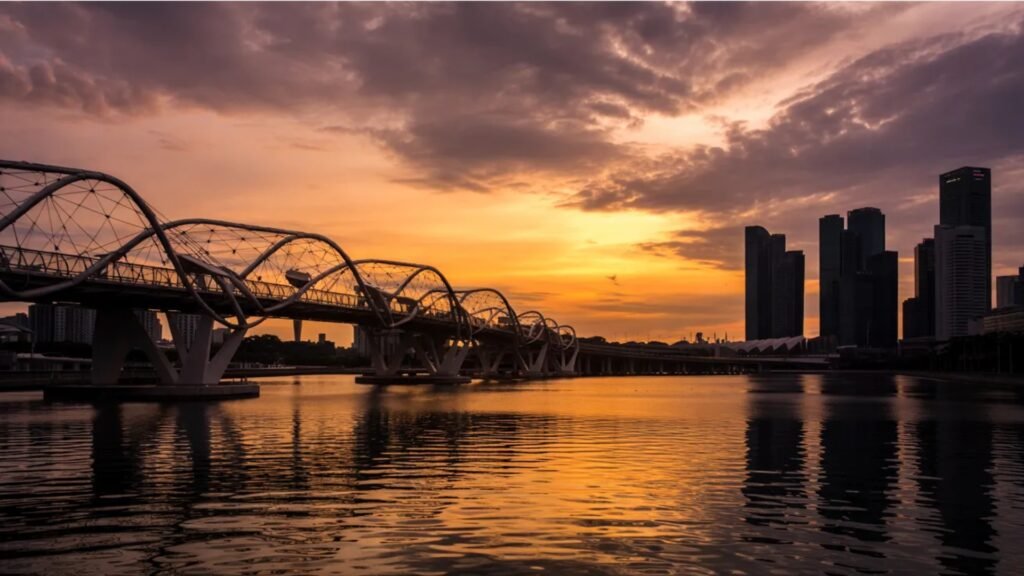
Nearby Attractions You Shouldn’t Miss
The Marina Bay precinct is genuinely one of the most rewarding areas for Singapore city exploration on earth. No exaggeration. The density of extraordinary experiences per square kilometre here is almost unmatched.
Storytelling through images in this precinct is almost too easy. Every attraction within walking distance of the bridge adds a distinct layer to the visual narrative of modern Singapore — its ambition, its artistry, the way it uses public space. Walk slowly. Look at everything. Resist the urge to rush to the next attraction. The light here changes constantly and the rewards come to those who wait.
Marina Bay Sands
Marina Bay Sands — three towers, 200-metre SkyPark, the iconic silhouette visible from half the island. The SkyPark Observation Deck at marinabaysands.com delivers the definitive aerial view of the Helix below. The nightly Wonder Full light-and-water show transforms the waterfront into a full-scale projection canvas. Any Marina Bay Sands skyline photography guide worthy of the name starts here. The MBS exterior itself at night is a major subject for Singapore city lights photography.
ArtScience Museum
The ArtScience Museum is three minutes on foot from the bridge. Shaped like an open lotus flower. Genuinely iconic in its own right. The permanent Future World exhibition is fully immersive digital art — it’s a space where urban photography Singapore meets fine art installation. Book timed entry ahead at marinabaysands.com/museum. The exterior at dusk, viewed from the waterfront edge directly south, is one of the most underrated best photo spots Singapore in the entire precinct.
Gardens by the Bay
Five minutes on foot from the bridge. The Supertree Grove lights up during Garden Rhapsody at 7:45 PM and 8:45 PM nightly — free to watch from the outdoor plaza. Eighteen Supertrees ranging from 25 to 50 metres. Colour, sound, and motion every evening. Combine this with your helix bridge photoshoot for a double feature of Singapore’s most theatrical outdoor illuminations. Doing both in one evening — bridge first, then Gardens — is one of the best time to shoot Singapore skyline itineraries possible for any visiting travel photographer Singapore.
FAQs About Helix Bridge Singapore
Okay, wrapping up with the questions people actually type into search. Because yes, these are important — and honestly, the answers are mostly good news.
Is Helix Bridge free to visit?
Completely free. No entry fee, no ticketing, no reservation, no nothing. Open 24 hours, 365 days, including public holidays. All four viewing platforms free. The Helix Bridge light show is free to watch every night. You only spend money if you choose to eat somewhere or visit a paid attraction nearby. Budget travellers love this bridge for exactly that reason. It delivers a genuinely world-class iconic landmarks Singapore experience at absolutely zero cost.
How long does it take to explore?
The crossing itself is 10–15 minutes, easy pace. Add 20–30 minutes for the platforms and photography stops. Include the surrounding waterfront and you’re comfortably at 60–90 minutes. Most people on a helix bridge photoshoot mission end up spending two to three hours in the precinct overall. Not because they planned to. Just because leaving feels wrong when everything around you is still this good.
Is it good for photography?
It’s one of the best photo spots Singapore offers — absolutely, without question. Helix Bridge architecture, dynamic LED illumination, water reflections, the complete Singapore night skyline surrounding it — this location rewards every skill level. Long exposure photography Helix Bridge with a tripod produces stunning portfolio work. A smartphone on Night Mode produces genuinely impressive results. Helix Bridge photography tips for beginners work here because the scene is so inherently photogenic that almost any composition reads well.
For camera settings for Singapore night photography, start with ISO 800, f/8, 3–5 seconds and adjust from there. For Marina Bay Sands skyline photography guide content that includes the bridge in frame, the MBS elevated walkway is your best position. And if you want the full Singapore travel photography guide experience — bridge, Flyer, ArtScience Museum, Gardens by the Bay, waterfront reflections — plan a full evening starting at 6:00 PM and don’t leave before 9:30 PM.
You won’t regret staying.