

Hiking Trails Singapore: Top Scenic Walks, Parks & Nature Adventures
Most people land in Singapore, head straight to Marina Bay Sands, eat some chilli crab, maybe walk around Orchard Road — and they completely miss what I personally think is the most underrated side of this city. The green side. The wild, sweaty, surprisingly beautiful hiking trails in Singapore that sit just minutes away from one of Asia’s most dazzling skylines.
I’ll be honest with you. When I first heard about hiking trails Singapore, I pictured boring flat paths. Short loops. Nothing to write home about. I was wrong — completely wrong — and the trails here have genuinely surprised me every single time.
In 2026, Singapore’s nature parks cover more than 7,800 hectares of protected green space. The National Parks Board (NParks) manages over 300 kilometres of trails, park connectors, and nature reserves accessible to the public. A growing number of Singaporeans — and international visitors — are trading mall afternoons for muddy shoes and canopy walks. And honestly? Good for them.
This guide covers everything. The best hiking trails in Singapore for beginners. The hidden ones most people miss. Family-friendly options. Wildlife hotspots. What to pack, when to go, and where to eat after. Whether you live here or you’re visiting for a week, this is the only Singapore hiking guide you’ll need.
Why Hiking in Singapore Is More Popular Than Ever
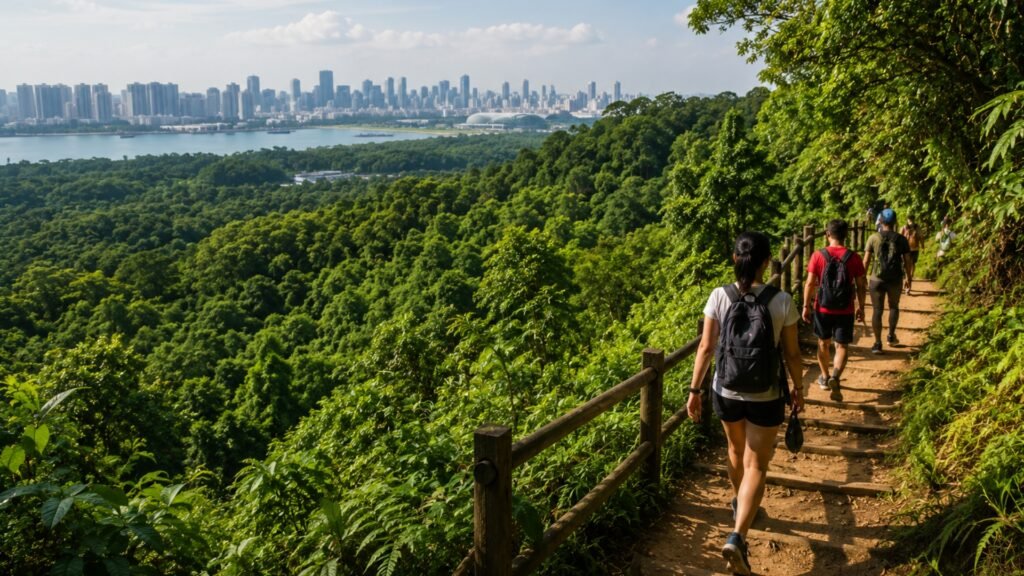
Something shifted in Singapore’s outdoor culture after 2020. It’s hard to pinpoint exactly when it happened, but if you try to book a hiking group on Meetup.com now, spots fill within hours. The Singapore outdoor adventures scene has exploded — and it makes complete sense when you think about it.
Living in one of the world’s most densely packed cities creates a kind of quiet pressure. Everywhere you look there’s concrete, air-conditioning, and screen time. So when people discover that a 20-minute MRT ride drops them into actual Singapore rainforest — thick canopy, bird calls, the earthy smell of wet laterite — it feels almost shocking. Good-shocking. The kind that keeps you coming back every weekend.
In March 2026, the government launched Walking Trails @ CDC (Heritage Edition), a partnership between Singapore’s five Community Development Councils, GovTech, and the National Heritage Board — blending physical walking trails with digital heritage checkpoints that unlock cultural stories and earn you real rewards through the CrowdTaskSG platform. That’s not a niche initiative. That’s the government recognising that outdoor activities Singapore residents want are growing into a mainstream cultural movement.
Singapore’s Unique Urban Jungle Experience
Here’s what makes Singapore trekking spots genuinely different from anywhere else in Asia — or the world, actually. You finish a hike through dense Singapore rainforest, step back onto tarmac, and you’re at an MRT station within ten minutes. It’s absurd. In the best possible way. The Central Catchment Nature Reserve holds more biodiversity per square kilometre than many European national parks — and it sits in the geographic centre of a city-state of 6 million people.
That collision of wild and urban is the whole point. You’re not “escaping” Singapore when you hike here. You’re seeing a completely different version of the same city — elevated, shaded, slower, and far more alive than the shopping centre version tourists usually get.
Best Nature Reserves and Scenic Walking Routes
If you’re asking where to start with Singapore nature parks, the answer depends on what you want. Big wildlife? Head to MacRitchie Reservoir or Sungei Buloh Wetland Reserve. Scenic coastal drama? The Southern Ridges and Labrador Nature Reserve deliver views you won’t forget. Heritage and history? Fort Canning Park sits on one of the island’s most culturally layered hilltops, used by Malay royalty, British colonisers, and WWII commanders in sequence.
What ties them all together is quality. Singapore maintains its Singapore green spaces and nature trails to an almost obsessive standard. Signage is clear. Rest points appear regularly. Toilets exist. For hikers used to rougher terrain elsewhere in Southeast Asia, this can feel almost too easy — until the humidity wraps around you and reminds you that tropical Singapore doesn’t mess around.
Is Singapore Good for Hiking Beginners?
Short answer: yes, absolutely. Longer answer: Singapore might actually be the ideal destination for someone doing their first proper trail walk. Most easy hikes in Singapore are well-paved, well-lit, and designed with accessibility in mind.my honest experience The gradient is rarely severe. Distances are manageable. And nothing on the island is more than a 40-minute drive from a hospital, just to put your mind at ease.
The real challenge for beginners isn’t the terrain. It’s the tropical climate. Singapore sits just 1.3 degrees north of the equator. Average temperatures hover between 26°C and 34°C year-round, with humidity around 70–90%. That combination can flatten even reasonably fit people if they haven’t prepared. Hydration, early starts, and sun protection matter more here than trail difficulty level. Get those three right, and you’ll find beginner hiking trails Singapore genuinely enjoyable.
Best Hiking Trails in Singapore for Every Level
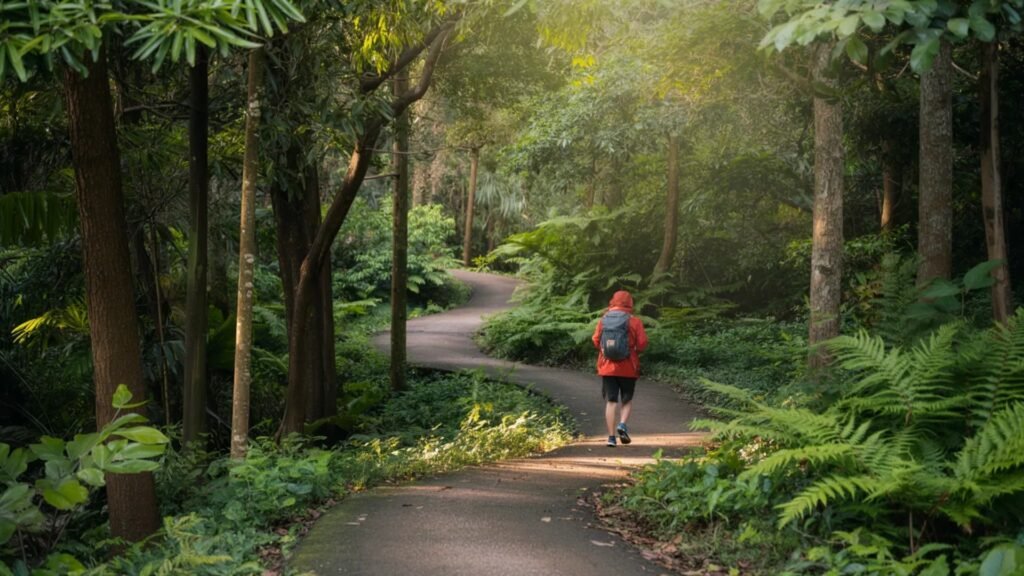
Let me walk you through the trails that matter most. I’ve organised these by location and character — not just difficulty — because the best trail for you depends on what you’re actually hoping to experience.
Southern Ridges Walk
The Southern Ridges is probably the most talked-about best scenic trail Singapore on the island, and for good reason. What struck me as so incredible when I first saw it was that this This 10-kilometre linear trail connects Mount Faber Park, Telok Blangah Hill Park, HortPark, and Kent Ridge Park through a continuous green spine that somehow manages to feel wild even as Singapore’s harbour glitters through the trees below.
The centrepiece is the Henderson Waves Bridge — an architectural achievement that most people underestimate until they’re standing on it. Standing 36 meters above Alexandra Road, it’s Singapore’s highest pedestrian bridge, designed as a series of interconnected wooden ribs that sway like a wave in motion. I was too scared to climb up to swing the bridge. At golden hour, around 6:30 PM, the light hits those wooden curves and the whole structure turns amber.
Trail details at a glance:
| Category | Details |
|---|---|
| Distance | 10 km (linear) |
| Difficulty | Easy to Moderate |
| Duration | 3–5 hours |
| Start MRT | HarbourFront (Circle/North-East Line) |
| End MRT | Kent Ridge or Labrador Park (Circle Line) |
| Best Time | Early morning or evening (5:30–7:30 PM for sunset) |
| Entry Fee | Free |
| Highlights | Henderson Waves, Forest Walk canopy walkway, Alkaff Mansion, HortPark |
You’ll also pass the elevated Forest Walk — a series of connected canopy walkways that put you above the treeline with views across southern Singapore. The 1930s-era Alkaff Mansion appears about halfway through, a colonial-era heritage building that once hosted Singapore’s high society parties and now operates as a restaurant. Worth a stop, worth a coffee.
The trail is well-marked throughout. Stairs are the main challenge — there are a lot of them — so wear supportive shoes with grip. Allow a full 4 hours if you want to actually enjoy it rather than power through.
MacRitchie Reservoir TreeTop Walk
If I had to pick one trail that captures why hiking trails Singapore is genuinely special, it would be MacRitchie Reservoir and the TreeTop Walk Singapore. This is Singapore’s oldest and largest nature reserve — first gazetted in 1883 — and it shows. The trees here are enormous. The canopy is dense. The biodiversity is staggering.
The TreeTop Walk is a 250-metre freestanding suspension bridge — the first of its kind in Singapore — connecting the two highest points in the Central Catchment Nature Reserve, with panoramic views over the waters of Upper Peirce Reservoir stretching below. The bridge sits 25 metres above the forest floor. It sways. It’s narrow. It’s completely thrilling if you’re not afraid of heights, and a character-building experience if you are.
Trail details at a glance:
| Category | Details |
|---|---|
| Distance | 3–11 km depending on loop |
| Difficulty | Moderate |
| Duration | 2–4 hours |
| Nearest MRT | Caldecott (Circle Line), then bus or taxi |
| Entry Fee | Free (timed entry for TreeTop Walk — book via NParks) |
| Best Time | Before 9 AM |
| Wildlife | Macaques, colugos, monitor lizards, otters, pit vipers |
Wildlife sightings here are genuinely impressive. Long-tailed macaques are practically guaranteed. Colugos — those extraordinary gliding mammals that look like flying blankets — inhabit the upper canopy and appear if you look carefully at dusk. Monitor lizards sun themselves on the reservoir banks. Smooth-coated otters have been spotted in family groups near the water’s edge. And yes, occasionally, a king cobra or Wagler’s pit viper crosses the trail. Keep your distance. Admire from afar. Don’t be the person who tries to take a selfie.
The MacRitchie Reservoir loop offers both easy boardwalk sections for those who want a gentle Singapore reservoir walks experience, and demanding forest loops with rooted, uneven terrain for those who want to feel they’ve actually hiked. Mix and match sections depending on energy levels.
Bukit Timah Nature Reserve Trail
Bukit Timah Nature Reserve is a name every Singaporean knows, and it carries weight for good reason. At 163.63 metres, Bukit Timah Hill is Singapore’s highest natural point. The reserve covers just 163 hectares — smaller than many golf courses — yet it harbours more plant species than the entire North American continent, according to researchers who’ve studied its extraordinary biodiversity.
As Singapore’s first forest reserve, Bukit Timah Nature Reserve houses one of the few remaining patches of primary rainforest on the island — and it’s home to over 840 flowering plant species and more than 500 animal species. Walking through it feels nothing like other Singapore parks. The trees are older, taller, and stranger. Roots erupt from the ground in every direction. Birdsong completely replaces traffic noise within the first 100 metres.
Trail details at a glance:
| Category | Details |
|---|---|
| Distance | 1.6–6 km (multiple loops) |
| Difficulty | Moderate to Hard |
| Duration | 1–3 hours |
| Nearest MRT | Beauty World or King Albert Park (Downtown Line) |
| Booking | Timed entry required at nparks.gov.sg |
| Entry Fee | Free |
| Best Combo | Pair with Dairy Farm Nature Park for a half-day outing |
Take the Summit Road route up — it’s paved, steep in sections, and manageable for most fitness levels. Return via the Jungle Fall Trail for contrast: uneven, rooted, beautifully atmospheric. The bamboo grove on the descent is one of those quietly spectacular moments that sticks with you days later.
For the genuinely ambitious, the back route off Rifle Range Road replicates the steep rocky steps of Mount Kinabalu. Local mountaineering groups use it for training. It’s unmarked, demanding, and excellent preparation if you’re planning a bigger climb elsewhere in Southeast Asia.
Sungei Buloh Wetland Reserve
Well — Sungei Buloh Wetland Reserve is in a completely different category from the other hiking trails in Singapore on this list. It’s not about elevation or distance. It’s about encountering an ecosystem that feels genuinely wild. This is Singapore’s first ASEAN Heritage Park and a critical stopover on the East Asian-Australasian Flyway — one of the world’s major migratory bird routes.
For an immersive nature experience, Sungei Buloh Wetland Reserve’s peaceful trails and extraordinary array of flora and fauna include animals like monitor lizards, estuarine crocodiles, and smooth-coated otters. The 1.95 km Migratory Bird Trail lets you spot herons, kingfishers, and sunbirds, while the 3 km Mangrove Boardwalk offers sightings of mudskippers, mud lobsters, and crabs.
Trail details at a glance:
| Category | Details |
|---|---|
| Main Trail Distance | 1.3–3 km |
| Difficulty | Easy |
| Duration | 1–2 hours |
| Nearest MRT | Kranji (North-South Line), then Bus 925 |
| Entry Fee | Free |
| Best Season | September to March (migratory bird season) |
| Key Highlight | Eagle Point lookout — panoramic view across the Strait of Johor to Malaysia |
Sungei Buloh is unbeatable if your goal is spotting Singapore’s “Big Three” — otters, monitor lizards, and crocodiles. The 1.3 km Coastal Trail is completely flat and paved with high-quality boardwalks, making it accessible for everyone from solo hikers to families with strollers.
Arrive at sunrise during migratory season (September through March) and you will witness something remarkable. Hundreds of birds descend on the wetlands at dawn. Common greenshanks, Pacific golden plovers, and the occasional marsh harrier cross overhead. Bring binoculars. An 8×42 pair works beautifully in Singapore’s soft morning light.
The Green Corridor Rail Corridor
The Rail Corridor Singapore is a 24-kilometre greenway created from sections of the former Singapore–Kranji Railway that once linked the island to Peninsular Malaysia. Walking it is one of the most atmospheric Singapore outdoor adventures you can have without leaving the city. You’re literally following the ghost of a railway line — one that once carried passengers between Singapore and Kuala Lumpur.
The two black steel truss bridges along the route are genuinely striking — industrial, photogenic, and unlike anything else you’ll find on Singapore’s trail network. The Rail Corridor also includes the conserved Bukit Timah Railway Station, which now serves as a heritage gallery and community hub where some of the old tracks remain. Walk through it slowly. Read the interpretive panels. The history of this corridor is quietly fascinating.
Trail details at a glance:
| Category | Details |
|---|---|
| Distance | 24 km (full); multiple entry/exit points for partial walks |
| Difficulty | Easy |
| Duration | Flexible — 1 hour to full day |
| Surface | Mix of gravel, grass, and paved sections |
| Highlights | Truss bridges, Bukit Timah Railway Station, Singapore Quarry nearby |
| Not Suitable For | Midday walks — minimal shade on open sections |
| Nearest Entry Points | Hillview, Bukit Timah, Holland Village areas |
Most people walk 4–8 km sections rather than the full 24 km. The stretch from Greenleaf Walk to Bukit Timah Railway Station has the best combination of scenery, heritage, and shade. Combine it with a detour into Dairy Farm Nature Park for a rich half-day of Singapore weekend walks.
Thomson Nature Park Trails
i am Honestly saying, Thomson Nature Park might be my personal favourite hidden recommendation for anyone serious about Singapore hiking experience. It’s small. It’s weird. It is wonderful. And almost nobody outside the local hiking community talks about it. This former Hainanese village was abandoned decades ago — and the forest didn’t just grow back, it completely consumed the place.
Thomson Nature Park is what some describe as Singapore’s Angkor Wat — a spot where the forest has reclaimed human structures entirely. This used to be home to over 100 families living in a Hainanese village, and when they moved out, the forest took over their houses. Walking through the trail today means walking past vine-draped walls, root-cracked foundations, and mossy staircases descending into nothing. It’s genuinely eerie, genuinely beautiful.
The park also supports a population of Raffles’ banded langurs — critically endangered primates found in very few places in Singapore. If you see a flash of black-and-white movement high in the canopy, look carefully. You might be watching one of Singapore’s rarest mammals.
Trail details at a glance:
| Category | Details |
|---|---|
| Distance | 2.7 km (main loop) |
| Difficulty | Easy to Moderate |
| Duration | 1–2 hours |
| Nearest MRT | Upper Thomson (Thomson-East Coast Line) |
| Entry Fee | Free |
| Best Combo | Pair with Lower Peirce Reservoir walk next door |
Fort Canning Park Heritage Walk
Fort Canning Park sits atop Bukit Larangan — “Forbidden Hill” in Malay — and the layers of history compressed into this one hilltop are almost comically dense. Malay royalty lived here in the 14th century. Sir Stamford Raffles built his bungalow here in 1822. The British used it as a military command centre. And in February 1942, the decision to surrender Singapore to Japanese forces was made in a bunker 9 metres underground, right here on this hill.
Walking the heritage trail Singapore loop here is a completely different experience from the forested nature trails. This is urban hiking Singapore at its most historically loaded. The trails are fully paved and shaded, which makes Fort Canning an excellent option for midday walks or post-rain outings when the jungle trails are dangerously slippery.
Trail details at a glance:
| Category | Details |
|---|---|
| Distance | 3.2 km (main loop) |
| Difficulty | Easy |
| Duration | 1.5–2 hours |
| Nearest MRT | Fort Canning or Dhoby Ghaut (Downtown/North-East Line) |
| Entry Fee | Free (park); ticketed for the Battlebox WWII museum |
| Highlights | WWII Battlebox, nine historical gardens, Spice Garden, Arts Garden |
Nine thematic gardens are scattered across the hill — a Spice Garden, an Arts Garden, an archaeological excavation site where 14th-century gold ornaments were unearthed. The WWII Battlebox underground command centre is ticketed but absolutely worth the entry fee. It’s one of Singapore’s most genuinely moving historical experiences.
Labrador Nature Reserve Coastal Trail
Labrador Nature Reserve is the kind of place that makes you stop and say — wait, this is in Singapore? It holds the only rocky sea cliff on Singapore’s mainland, complete with intact WWII-era coastal gun emplacements overlooking the Straits of Singapore. Walk the coastal path here and you’re simultaneously a nature hiker and a history explorer.
The coastal trail Singapore section runs along the cliff face with the sea immediately below. At low tide, you can spot seahorses and reef fish in the intertidal zone. The WWII fortifications — built by the British to defend the sea approach to Singapore — stand largely intact, thick concrete and rusted metal slowly being consumed by tropical vegetation. It’s a powerful visual.
Trail details at a glance:
| Category | Details |
|---|---|
| Distance | 2–3 km |
| Difficulty | Easy |
| Duration | 1–1.5 hours |
| Nearest MRT | Labrador Park (Circle Line) |
| Entry Fee | Free |
| Best Combo | Connect directly to Southern Ridges for a longer route |
Coney Island Nature Trail
Coney Island Singapore is one of those places that feels genuinely unbelievable given its location. This is a real island — accessible on foot or by bicycle from Punggol — with sandy paths, casuarina trees, and a wild, undeveloped northern shore that looks nothing like the polished green spaces of central Singapore. Wild boar roam here. Sea eagles circle overhead. The island has a small herd of cattle that occasionally wanders onto the trail.
If you’re looking for Singapore hidden nature spots that feel like actual wilderness rather than manicured parkland, Coney Island delivers. Go early — the island gets warm quickly and there are no food or water facilities on the island at all. Pack everything you need before crossing.
Trail details at a glance:
| Category | Details |
|---|---|
| Distance | 6 km (full perimeter) |
| Difficulty | Easy |
| Duration | 2–3 hours |
| Nearest MRT | Punggol (North-East Line), then walk/cycle via park connector |
| Entry Fee | Free |
| Pro Tip | Rent bikes at Punggol for a combined cycling/hiking experience |
Sentosa Nature Discovery Walk
Most visitors to Sentosa go straight to Universal Studios or the beach. Understandable — but you’re missing something genuinely good. The Imbiah Nature Trail cuts through a pocket of Sentosa nature trails forest that supports a surprisingly intact bird community, including Malabar pied hornbills, paradise flycatchers, and flying lizards.
It’s short. It’s free. It is completely overlooked. And for families visiting Sentosa who want to add something educational and peaceful between the resort attractions, this Singapore eco trail is exactly that.
Trail details at a glance:
| Category | Details |
|---|---|
| Distance | 1.5–3 km |
| Difficulty | Easy |
| Duration | 1–2 hours |
| Nearest MRT | HarbourFront, then Sentosa Express |
| Entry Fee | Free |
| Best For | Families, birdwatchers, low-energy exploration days |
Easy Nature Walks in Singapore for Families
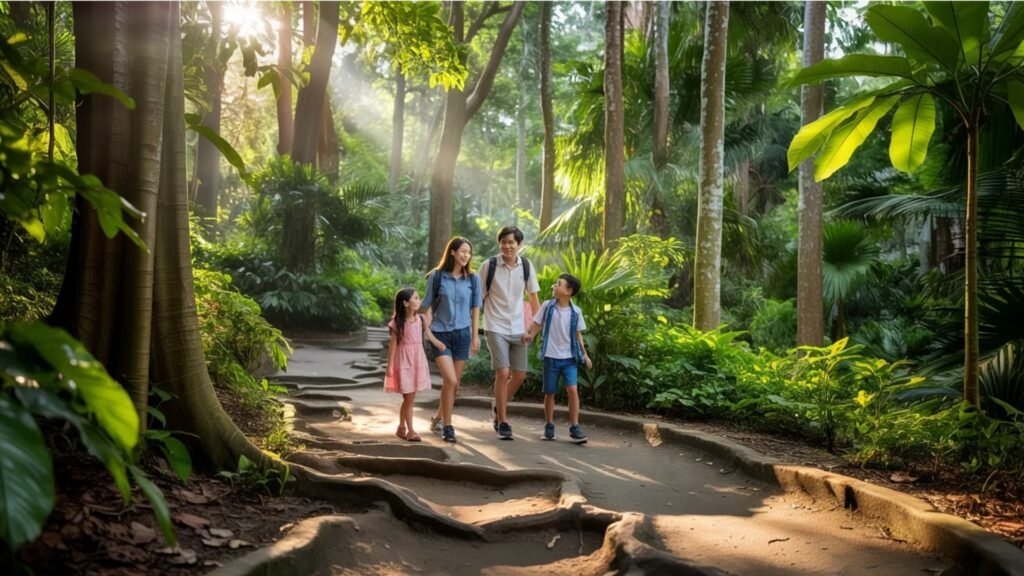
Singapore has genuinely done exceptional work designing Singapore family-friendly hikes that work for all ages — from toddlers in strollers to grandparents who haven’t walked more than 3 km in a decade. The key is knowing which parks have the right combination of paved surfaces, toilets, rest areas, and wildlife encounters that keep kids engaged.
The short answer on what makes a trail actually family-friendly in Singapore: shade, flat ground, toilets every 1–2 km, and something interesting to look at. Monitor lizards are, in my experience, the most reliable child-engagement tool on any Singapore park connector trails walk. Spot one and suddenly every child is a wildlife enthusiast.
Best Kid-Friendly Hiking Trails
For families with children under 10, the sweet spot is 3–5 km with multiple rest points. The Southern Ridges between HarbourFront and Henderson Waves ticks every box — paved, scenic, and short enough to keep energy levels manageable. Sungei Buloh Wetland Reserve’s Coastal Trail is completely flat with boardwalk surfaces and almost guaranteed animal sightings. The Singapore Botanic Gardens loop works beautifully for very young children — zero gradient, lush greenery, Swan Lake with terrapins and fish, and a fantastic playground near the Bukit Timah Gate entrance.
Launched in March 2026, the Walking Trails @ CDC (Heritage Edition) introduced five “phygital” heritage trails through Kampong Glam, Tampines, Woodlands, Bedok, and Jurong — using the CrowdTaskSG platform via SingPass, where completing checkpoints earns up to $75 in RedeemSG vouchers. For families with older children who respond well to gamification, this is genuinely motivating. Kids compete to hit the next checkpoint. They learn local history. Everyone wins.
Top family trail picks:
| Trail | Distance | Why Kids Love It |
|---|---|---|
| Southern Ridges (partial) | 3–5 km | Henderson Waves bridge, great views |
| Sungei Buloh Coastal Trail | 1.3 km | Crocodiles, otters, mudskippers |
| Singapore Botanic Gardens | 2–4 km | Swan Lake, playgrounds, National Orchid Garden |
| Coney Island | 6 km | Wild animals, beach feel, cycling option |
| Fort Canning Park | 3.2 km | WWII stories, nine themed gardens |
Stroller-Friendly Parks and Boardwalks
Singapore Botanic Gardens — the island’s first and only UNESCO World Heritage Site — is the gold standard for stroller-friendly Singapore weekend walks. Every path is paved. Gradients are gentle. The main loop around Swan Lake is completely flat. The National Orchid Garden is ticketed (S$5 for adults, free for children under 12) but the rest of the gardens are completely free.
The enhanced Keppel Coastal Trail — a 2.2 km walk that can be completed in about 45 minutes — serves as a vital link between Labrador Nature Reserve and the Southern Ridges. It’s mostly paved, relatively flat, and makes a perfect pre-dinner stroll that’s entirely stroller-manageable. Lorong Halus Wetland in the east and Bishan-Ang Mo Kio Park’s riverside sections are excellent alternatives for families in those parts of the island.
Free Outdoor Activities for Families
Here’s something important: free things to do in Singapore outdoors are more plentiful than most visitors realise. The vast majority of Singapore’s nature parks charge zero entry fee. The Botanic Gardens main grounds are free. All the coastal and forest trails listed in this guide cost nothing beyond transportation.
The NParks Flora Fauna Web app lets children log wildlife sightings and earn digital badges — a genuinely effective way to turn a walk into an adventure. Singapore green spaces like Bishan-Ang Mo Kio Park have natural-looking river play areas where children can safely wade. East Coast Park offers free beach access with rental-only facilities (bikes, BBQ pits by reservation).
Free family outdoor options:
| Location | Free Activity |
|---|---|
| Singapore Botanic Gardens | Garden walk, Swan Lake, playground |
| Bishan-Ang Mo Kio Park | River play area, picnic lawns |
| East Coast Park | Beach access, cycling path |
| Fort Canning Park | Heritage garden walk |
| Coney Island | Wildlife trail, cycling |
| Sungei Buloh | Wetland boardwalk, bird hides |
Moderate Hiking Trails for Adventure Seekers
So you’ve done the easy stuff. You want to feel it in your legs the morning after. You want to come home genuinely tired rather than just slightly warm. These Singapore outdoor adventures trails step up the game without requiring any specialist equipment or serious mountaineering fitness.
Singapore doesn’t have mountains. Anyone telling you otherwise is being generous with geography. But what these moderate hiking trails lack in elevation they compensate for with heat, humidity, terrain variety, and sheer distance. Finishing the full Coast-to-Coast Trail in a day is a genuine accomplishment. Don’t let anyone tell you otherwise.
Bukit Timah Summit Hike
The Bukit Timah summit hike is the closest thing Singapore has to a proper mountain trail. Take the Summit Road up — paved, steep, achievable — and return via the Jungle Fall Trail through rooted, dark-canopy forest. The contrast between the two routes on a single loop is striking.
Wildlife sightings on Bukit Timah Nature Reserve trails can include pangolins (rare but present), flying squirrels gliding between trees at dusk, pit vipers coiled on trailside roots, and reticulated pythons on the lower slopes. It sounds intimidating. It’s actually thrilling. Stick to the marked path, look where you step, and you’ll be completely fine.
Key tip: Timed entry is mandatory. Book via nparks.gov.sg before you arrive. Walk-ins are turned away during peak periods.I went to the place by accident and forgot to book online, so I had to face problems.
Dairy Farm Nature Park Trails
Dairy Farm Nature Park sits adjacent to Bukit Timah and is served directly by Hillview MRT on the Downtown Line — the park entrance is literally next to the station exit. That accessibility makes it one of the most convenient outdoor activities Singapore moderate options on the island.
The moment you step onto the shaded paths of Dairy Farm Nature Park, the air turns thick with humidity and the earthy scent of leaf litter. The Wallace Trail descent is the star experience — a steady journey down gravel slopes where within minutes your shirt clings and your pace slows. The cave trail network — cool, dim, with dripping echoes and limestone textures — feels far removed from the city.
The Wallace Trail celebrates Alfred Russel Wallace, who co-developed the theory of evolution alongside Darwin and conducted significant field research in this very region. Interpretive panels along the route explain his work. The Singapore Quarry nearby offers wetland birdwatching. Combine Dairy Farm with Bukit Timah for a serious half-day tropical hiking Singapore circuit.
Chestnut Nature Park Loop
Chestnut Nature Park is Singapore’s largest nature park and genuinely undervisited by people outside the dedicated hiking community. The North section has the most rewarding rainforest trails Singapore character — unpaved, rooted, with a canopy observation tower that rises above the treeline for 360-degree views across the Central Catchment Nature Reserve.
The South section is more accessible, with boardwalk sections and gentler gradients suitable for mixed-ability groups. Both sections connect to Bukit Timah and Dairy Farm, making Chestnut the central node of a trail network that serious hikers can spend an entire day exploring.
Distance range: 6–13 km (North and South combined) | Duration: 2–5 hours | Nearest MRT: Choa Chu Kang (North-South Line), then bus
Coast-to-Coast Trail Experience
The Coast-to-Coast Trail (Central) is a 36 km trail spanning Singapore, linking nature areas, parks, and park connectors from Jurong Lake Gardens in the west, through the Lornie Nature Corridor, to Coney Island Park in the northeast.
This is Singapore’s ultimate Singapore hiking experience for distance enthusiasts. Thirty-six kilometres. Ten checkpoints. Up to 11 hours if you push the full route in one go. Most people split it across two or three weekend segments — and there’s absolutely no shame in that approach. The trail passes through MacRitchie Reservoir, Bishan-Ang Mo Kio Park, and several park connector sections that transition smoothly between nature and urban landscape.
“The C2C Trail isn’t about conquering Singapore. It’s about discovering how interconnected the whole island actually is when you travel it on foot.” — Common reflection among Singapore hiking community members
Download the dedicated C2C Trail mobile app for navigation, checkpoint tracking, and wildlife information en route.
Hidden Nature Trails Most Tourists Miss
Right, so this is the section most hiking guides skip — because the trails here are either unmarked, under-publicised, or just genuinely obscure. These are Singapore hidden nature spots that local hikers guard with quiet possessiveness. I’m sharing them because good trails deserve to be walked.
Windsor Nature Park
Windsor Nature Park sits between Thomson Nature Park and MacRitchie Reservoir and is missed by most people because it doesn’t stand out on a map. It connects seamlessly to both neighbours, so many hikers pass through it without registering it as a distinct place.
That’s a mistake. Windsor holds some of the oldest Tembusu and Seraya trees in Singapore’s nature reserve network — ancient specimens with canopies that create a cathedral-like atmosphere. Documented wildlife includes banded leaf monkeys and the critically endangered Raffles’ banded langur. Pair Windsor with Thomson Nature Park for a combined 5–7 km half-day route. Nearest MRT: Upper Thomson (Thomson-East Coast Line).
Clementi Forest Adventure Trail
Clementi Forest is about as unofficial as Singapore trails get. It’s unmanaged secondary forest sandwiched between Clementi Road and the Rail Corridor — not a gazetted nature park, not officially maintained, not on the NParks app. Trails are unmarked. After rain, sections become genuinely muddy.
And yet. The towering Albizia trees here create one of the most atmospheric forest experiences on the island. Red-crowned barbets call from the canopy. Concrete ruins from an earlier land use peek through the undergrowth. It feels raw in a way that Singapore’s maintained parks simply don’t. Go with someone who knows the route, use an offline map app, and check for any NParks updates before visiting — development pressure in this area means access conditions can change.
Kranji Marshes Wildlife Walk
Kranji Marshes is 30 minutes from the city centre and practically unknown outside the birdwatching community. It’s Singapore’s largest freshwater marsh — open, expansive, and genuinely spectacular at dawn during migratory season. Kranji Marshes has a short trail leading to a Raptor Tower providing sweeping views over the marshlands — a hidden gem among hiking places in Singapore.
Purple herons, yellow bitterns, and rare Javan pond herons have all been recorded here. Visit at dawn between September and March and you might see species that professional ornithologists travel specifically to Singapore to find. The trail is short (1.5 km), flat, and completely free. Nearest MRT: Kranji (North-South Line), short bus ride.
Mandai T15 Hiking Trail
The Mandai T15 trail sits adjacent to the Mandai Wildlife Reserve precinct and is almost completely absent from mainstream Singapore hiking guides. It runs through dense secondary forest with quarry remnants and high wildlife activity — monitor lizards, wild boar, and occasionally otters near the water sources.
Access conditions change periodically due to proximity to the wildlife reserve. Always check NParks before visiting. This is not a trail for solo first-timers — bring company, carry sufficient water, and go prepared for unmarked terrain.
Best Places to See Wildlife While Hiking in Singapore
Singapore wildlife is genuinely impressive for a city-state this size. You don’t need to book a guided tour or pay entry to a zoo. The wildlife walks Singapore experience here is free, frequent, and often surprising.
Monkey Spotting at MacRitchie Reservoir
Long-tailed macaques at MacRitchie Reservoir are social, bold, and perpetually interesting to watch. Family troops with infants, territorial males, juveniles chasing each other through the canopy — there’s always something happening. A strict rule applies: do not feed them. The fine is S$5,000 and the reasoning is sound — feeding changes macaque behaviour, makes them aggressive toward other visitors, and ultimately harms the animals.
Also watch for colugos gliding between trees (look for the stretched membrane between their limbs), monitor lizards up to two metres long basking on rocks, and smooth-coated otters in family groups near the reservoir edge. MacRitchie Reservoir is, without question, the richest wildlife-watching environment on the Singapore mainland.
Birdwatching at Sungei Buloh
Over 170 bird species have been recorded at Sungei Buloh Wetland Reserve — a number that rivals much larger nature areas across Southeast Asia. The reserve functions as a critical fuelling stop for migratory species crossing the East Asian-Australasian Flyway between Siberia and Australia. During peak migration (October–November and March–April), the bird density here is genuinely extraordinary.
Bird hides are positioned at key vantage points along the trails. The Raptor Watch event, held annually, brings birdwatchers from across Asia. Year-round residents include collared kingfishers, purple herons, white-bellied sea eagles, and several species of wading birds on the mudflats.
Recommended gear:
| Item | Specification | Why It Matters |
|---|---|---|
| Binoculars | 8×42 or 10×42 | Optimal for Singapore’s light conditions |
| Field Guide | Birds of the Malay Peninsula | Covers all Singapore species |
| Mosquito Repellent | DEET-based | Wetland mosquitoes are persistent |
| Clothing | Muted colours (brown, green, grey) | Avoid startling birds |
Rare Plants in Singapore Botanic Gardens
The Singapore Botanic Gardens was inscribed as Singapore’s first UNESCO World Heritage Site in 2015 — a recognition of its significance as a living museum of tropical botany. The National Orchid Garden within the grounds houses over 1,000 orchid species and 2,000 hybrids, making it the largest orchid display in the world.
Beyond the orchids, the Rainforest section shelters trees over 100 years old with canopies that create genuine deep-forest atmosphere despite being surrounded by Napier Road traffic. The Heritage Trees programme has documented several exceptional specimens — including a 150-year-old Tembusu tree near the Shaw Foundation Symphony Stage that has become one of Singapore’s most photographed natural landmarks.
Entry to the main gardens is completely free. The National Orchid Garden costs S$5 for adults. Children under 12 enter free.
Best Time for Hiking in Singapore
Timing genuinely matters more in Singapore than most other hiking destinations. This isn’t a place where you can roll out of bed at 11 AM, lace up your shoes, and have a good time on the trail. The equatorial climate doesn’t forgive poor planning.
Morning vs Evening Hikes
After going there, I realized that the best time to hike in Singapore is undoubtedly from 6:30 AM to 9:00 AM. Temperatures are 2–4 degrees cooler than midday. Wildlife is most active. Light is beautiful for photography. Trails are quieter. Every single element works in your favour.
when i am walking in the Evening walks — from around 5:00 PM to 7:15 PM — are the excellent second option. The afternoon thunderstorm (when it comes) cools the air dramatically. Sunset light on the Southern Ridges between 6:30 and 7:00 PM is among the most beautiful experiences Singapore offers.
Avoid 11 AM to 3 PM on any exposed trail. Singapore’s UV index during this window regularly reaches 11 or above — classified as “Extreme” by WHO standards. Heat exhaustion is a real risk, not a theoretical one.
Weather and Humidity Tips
Singapore’s climate is consistent year-round in ways that are both reassuring and challenging. You will sweat. There is no version of this where you don’t sweat. The goal isn’t to avoid sweating — it’s to manage it intelligently.
Wear moisture-wicking synthetic fabric (polyester or bamboo blend) rather than cotton. Cotton absorbs sweat, stays wet, and causes chafing over longer distances. Apply SPF 50+ sunscreen even when hiking under forest canopy — UV penetrates through foliage at equatorial latitudes more than most people expect. Carry a minimum of 1.5 litres of water per person for trails up to 8 km, and 2 litres for anything longer.
Hydration guide:
| Trail Duration | Water Volume (per person) | Additional |
|---|---|---|
| Under 1 hour | 500 ml | Standard water bottle sufficient |
| 1–2 hours | 750 ml – 1 L | Consider electrolyte drink |
| 2–4 hours | 1.5 L | Electrolyte sachets recommended |
| 4+ hours | 2 L | Pack food; electrolytes essential |
Rainy Season Hiking Advice
Singapore receives roughly 2,340 mm of rainfall annually — one of the highest totals of any city in the world. Two monsoon seasons shape the calendar: the Northeast Monsoon (November through January) and the Southwest Monsoon (June through August). Both bring increased rainfall, but neither makes hiking impossible or even particularly unpleasant if you’re prepared.
Rain cools the air significantly. It also makes the forest smell extraordinary — petrichor mixed with tropical vegetation is one of the most pleasant sensory experiences these trails offer. What changes: dirt and laterite paths become genuinely slippery. Stick to paved parks (Southern Ridges, Fort Canning, Botanic Gardens) during and immediately after heavy rain.
A lightweight packable rain jacket weighs nothing in a daypack and transforms a sudden afternoon downpour from a trail-ending event to a brief pause. Waterproof trail shoes or hiking sandals with ankle grip are worth the investment if you plan to hike regularly here.
Essential Singapore Hiking Tips for Beginners
You’ve picked your trail. You’ve checked the weather. Now let’s make sure you’re actually ready. These tips come from hard-won experience on hiking trails Singapore routes — some of it my own, some of it collected from the local hiking community.
What to Pack for Singapore Trails
| Item | Why It Matters |
|---|---|
| Water (1.5–2 L minimum) | Dehydration risk is high in humid heat |
| Moisture-wicking clothing | Cotton stays wet and causes chafing |
| Sunscreen SPF 50+ | Equatorial UV is intense even in shade |
| Insect repellent (DEET-based) | Dengue mosquitoes are active in forested areas |
| Trail shoes or grip sneakers | Wet laterite soil is extremely slippery |
| Fully charged phone | GPS navigation; NParks app works offline |
| Light snack | Energy dip hits hard after 90+ minutes |
| Small first-aid kit | Plasters, antiseptic wipes, antihistamine tablet |
| Rain jacket (packable) | Afternoon storms are common and fast-moving |
| Cash or PayNow | Some trailhead hawker stalls don’t take cards |
Safety Tips for Tropical Hiking
Tell someone your plan before heading out. Name the trail, your expected return time, and an emergency contact number. This is basic but frequently skipped.
Download the myResponder app by Singapore Civil Defence Force — it connects directly to SCDF and shares your GPS location in emergencies. The app is free and takes two minutes to install.
Never hike solo on unmarked trails. Clementi Forest and the Mandai T15 route specifically fall into this category. King cobras and Wagler’s pit vipers are present in Singapore’s nature reserves — not in large numbers, but present. The protocol if you encounter either: stop moving, give the animal space, wait for it to leave the path. Do not attempt to move it, photograph it from close range, or chase it.
Wild boar are common on trails like Coney Island and Mandai. They look alarming but rarely charge unless cornered or protecting young. Give them space. Avoid direct eye contact. Slowly back away.
MRT Stations Near Popular Hiking Trails
Singapore nature trails near MRT access is one of the island’s most underrated outdoor advantages. No car required for any trail on this list.
| Trail | Nearest MRT Station | Line |
|---|---|---|
| Southern Ridges | HarbourFront | Circle / North-East |
| MacRitchie TreeTop Walk | Caldecott | Circle |
| Bukit Timah Nature Reserve | Beauty World | Downtown |
| Dairy Farm Nature Park | Hillview | Downtown |
| Rail Corridor Singapore | Hillview / Bukit Timah | Downtown |
| Fort Canning Park | Fort Canning | Downtown |
| Labrador Nature Reserve | Labrador Park | Circle |
| Coney Island | Punggol | North-East |
| Sungei Buloh | Kranji (+ Bus 925) | North-South |
| Thomson Nature Park | Upper Thomson | Thomson-East Coast |
| Singapore Botanic Gardens | Botanic Gardens | Circle / Downtown |
Hiking Etiquette and Park Rules
Keep left on shared paths — cyclists use many of the same routes and appreciate the predictability. Take your rubbish out entirely — NParks enforces litter rules and fines apply. No feeding wildlife, anywhere, ever. Stay on marked trails; off-trail movement damages root systems and destabilises the forest floor. Photography is encouraged but no drones without NParks permits, and never photograph wildlife in distress or deliberately disturbed for a better shot. Keep your voice down in forest sections — noise disrupts animal behaviour and ruins other hikers’ experience.
Best Scenic Walks in Singapore for Instagram Photos
Best Instagram-worthy walks in Singapore is a legitimate category — because these trails genuinely deliver the kind of images that stop the scroll.
Henderson Waves Bridge
The Henderson Waves Bridge is architecturally extraordinary and extraordinarily photogenic. The key shot is a low-angle view along the undulating timber ribs at golden hour — approximately 6:30 to 7:15 PM when the light turns amber and the curves of the bridge create natural leading lines across the frame. Arrive 30 minutes before sunset. Tripods are permitted. Avoid midday shooting when harsh overhead light flattens the structure’s depth completely.
TreeTop Walk Views
The TreeTop Walk Singapore bridge offers a specific and unforgettable photograph: standing at the bridge’s midpoint looking east over an unbroken rainforest canopy, with Upper Peirce Reservoir glimpsed through the trees below. The best time is 7:00 to 8:00 AM — soft light, occasional mist in the canopy, and far fewer visitors than later in the day. The bridge sways noticeably with foot traffic, so keep your ISO elevated and use burst mode for sharp images.
Changi Boardwalk Sunset Spots
The Changi Bay Park Connector, part of the Round Island Route’s eastern corridor, faces west across the bay. At dusk, the silhouetted mangroves against an orange and pink sky — occasionally with a Changi Airport departure aircraft crossing the upper frame — creates compositions that are uniquely, unmistakably Singapore. No other city on Earth offers this particular juxtaposition.
Singapore Botanic Gardens Photography Spots
Swan Lake at 7:00 AM before the crowds: mirror-still water, terrapins on rocks, Sarus cranes wading at the bank’s edge. The National Orchid Garden offers controlled lighting, vivid macro opportunities, and colour contrasts that print beautifully. The Heritage Trees section near the Tanglin Gate gives you massive Tembusu specimens with cathedral canopies. The Eco-Garden looks wild and textured despite being a managed space — excellent for environmental portrait photography.
What to Do After Your Hike in Singapore
The post-hike ritual in Singapore has become its own cultural institution. There’s a specific pleasure in arriving at a hawker centre or coffee shop still slightly sweaty, ordering something cold, and letting the air-conditioning do its work.
Best Cafes Near Popular Trails
| Trail | Recommended Cafe | What to Order |
|---|---|---|
| Southern Ridges | Arbora @ Mount Faber Peak | Brunch with cable car and harbour views |
| Rail Corridor | Colbar (near Portsdown Road) | Curry puff and iced Milo — operating since 1953 |
| Dairy Farm / Bukit Timah | The Bire Cafe (Hillview) | Specialty coffee, excellent post-hike pastries |
| MacRitchie | Springleaf Prata Place (Upper Thomson) | Crispy prata and teh tarik |
| Fort Canning | The Summerhouse, Dempsey | Garden dining in a colonial black-and-white bungalow |
| Sungei Buloh | Kranji Farm area hawker stalls | Simple, fresh, inexpensive local food |
Cooling Down at Singapore’s Nature Parks
HortPark along the Southern Ridges has shaded garden areas with water features and benches perfectly positioned for a slow recovery. Bishan-Ang Mo Kio Park’s naturalised river play areas let children (and adults, honestly) wade safely in a stream designed to look genuinely wild. East Coast Park provides direct beach access — a post-hike swim in the Singapore Strait is restorative in a way that no coffee shop can replicate. Singapore Botanic Gardens lawns near the Shaw Foundation Symphony Stage host free weekend evening concerts, which makes them an excellent slow-down destination after a morning trail.
Nearby Attractions Worth Visiting
The hiking and the broader Singapore experience pair together better than most itineraries acknowledge. After Southern Ridges, the Mount Faber cable car to Sentosa is immediately accessible from the trail’s starting point. After MacRitchie, Upper Thomson food street offers one of the island’s best concentrations of traditional local restaurants within walking distance. and Bukit Timah, the Hindhede Quarry viewpoint — five minutes’ walk from the nature reserve entrance — offers a beautiful, peaceful scene that most visitors drive straight past. also Sungei Buloh, the Kranji War Memorial (five minutes by taxi) provides a moving historical counterpoint to the wetland experience — 4,500 Commonwealth soldiers are buried there, and the silence is profound.
Frequently Asked Questions About Hiking in Singapore
What Is the Best Hiking Trail in Singapore?
The Southern Ridges wins for most visitors seeking the best combination of scenery, architecture, accessibility, and distance. It connects Mount Faber Park through Henderson Waves Bridge to Kent Ridge Park via 10 kilometres of well-maintained trail with excellent MRT access at both ends. For pure nature immersion, MacRitchie Reservoir with the TreeTop Walk Singapore is the most ecologically rich experience on the island. The right answer genuinely depends on whether you prioritise views, wildlife, heritage, or physical challenge.
Are Singapore Hiking Trails Free?
The vast majority of hiking trails in Singapore are completely free to access. NParks manages most trails and nature parks at no charge. Exceptions include the National Orchid Garden within Singapore Botanic Gardens (S$5 for adults, free for children under 12), the Battlebox at Fort Canning Park (ticketed separately), and certain paid guided experiences. The TreeTop Walk Singapore at MacRitchie Reservoir is free but requires advance timed-entry registration through the NParks website.
Is Hiking in Singapore Safe for Tourists?
Singapore trails are among the safest in all of Southeast Asia. Trails are well-marked, well-maintained, and supported by excellent emergency infrastructure. The main risks are heat-related illness and slippery terrain during or after rain. Both are entirely manageable with basic preparation — adequate water, early start times, appropriate footwear, and sun protection. Venomous snakes are present but encounters are uncommon and bites are extremely rare. Standard protocol: give wildlife space and never attempt to handle or approach it.
How Long Does the Southern Ridges Walk Take?
The full 10 km Southern Ridges from HarbourFront to Kent Ridge takes 3 to 5 hours at a comfortable pace, including stops at Henderson Waves Bridge, the Forest Walk, and HortPark. Moving steadily without extended stops, the route takes approximately 2.5 hours. Most walkers enjoy 4 hours to properly experience the highlights. The trail is linear with MRT access at both ends, making it easy to start or finish at either point depending on your schedule.
Can Beginners Hike Bukit Timah Nature Reserve?
Yes — with some important context. The main Summit Road route from the visitor centre to the hilltop is paved and manageable for reasonably fit beginners, though it’s steep enough to raise the heart rate significantly. The forest loop trails involve uneven, rooted terrain that becomes genuinely challenging when wet. Book timed entry in advance via NParks (walk-ins during peak periods are turned away). Wear shoes with proper grip. Carry at least 1 litre of water. It’s challenging but absolutely achievable for someone with basic fitness and the right preparation.
Which Singapore Trail Has the Best Wildlife?
MacRitchie Reservoir and Sungei Buloh Wetland Reserve share this title between them, specialising in different wildlife categories. MacRitchie delivers the richest mammal and reptile variety on the island — macaques, colugos, monitor lizards, smooth-coated otters, and occasionally pangolins and pythons. Sungei Buloh is unmatched for birdwatching Singapore, with 170+ species recorded, and it’s the only place in Singapore with confirmed regular sightings of estuarine crocodiles in their natural habitat. For the “Big Three” — otters, monitor lizards, crocodiles — Sungei Buloh in a single morning visit is unbeatable.
Final Thoughts on Hiking and Nature Walks in Singapore
Here’s what I want you to take away from all of this. Singapore surprises people. It surprises them with its food, with its cultural complexity, with its efficiency — and now, increasingly, with its trails. The best hiking trails in Singapore aren’t world-famous the way Borneo’s rainforests are, or Vietnam’s peaks are. They’re quieter than that. More modest in their ambitions. But they’re real.
You don’t need a full day. You don’t need specialist gear. and You do not need a guide. What you need is an early alarm, a good pair of shoes, enough water, and the willingness to step off the air-conditioned comfort of Singapore’s urban machine for a few hours. The nature walks Singapore offers will give you back something you didn’t know you’d lost — a pace, a quiet, a reminder that the island was forest long before it was city.
Start with the Southern Ridges at sunset. Or MacRitchie on a Saturday morning. Or Sungei Buloh in migratory season if birds are your thing. Pick one, go, and see what happens. Every single trail on this list has converted sceptics into regulars. Singapore weekend walks have a way of becoming habits — the genuinely good kind.
Bookmark this guide, share it with someone who thinks Singapore is just malls and hawker food, and drop into the comments below to tell us which trail you’re hitting first. The forest is right there. It’s waiting.
Quick Reference: Complete Singapore Hiking Trail Summary
| Trail | Distance | Difficulty | Duration | MRT Access | Best For | Free? |
|---|---|---|---|---|---|---|
| Southern Ridges | 10 km | Easy–Moderate | 3–5 hrs | HarbourFront | Scenic views, sunsets | Yes |
| MacRitchie TreeTop Walk | 3–11 km | Moderate | 2–4 hrs | Caldecott | Wildlife, rainforest | Yes |
| Bukit Timah Nature Reserve | 1.6–6 km | Moderate–Hard | 1–3 hrs | Beauty World | Primary rainforest, summit | Yes |
| Sungei Buloh Wetland Reserve | 1.3–3 km | Easy | 1–2 hrs | Kranji | Birdwatching, crocodiles | Yes |
| Rail Corridor Singapore | Up to 24 km | Easy | Flexible | Hillview | Heritage, photography | Yes |
| Thomson Nature Park | 2.7 km | Easy–Moderate | 1–2 hrs | Upper Thomson | Ruins, rare langurs | Yes |
| Fort Canning Park | 3.2 km | Easy | 1.5–2 hrs | Fort Canning | WWII history, families | Yes* |
| Labrador Nature Reserve | 2–3 km | Easy | 1–1.5 hrs | Labrador Park | Coastal, WWII ruins | Yes |
| Coney Island | 6 km | Easy | 2–3 hrs | Punggol | Wild feel, wildlife | Yes |
| Sentosa Nature Discovery | 1.5–3 km | Easy | 1–2 hrs | HarbourFront | Families, birdwatching | Yes |
| Chestnut Nature Park | 6–13 km | Moderate | 2–5 hrs | Choa Chu Kang | Observation tower, loops | Yes |
| Coast-to-Coast Trail | 36 km | Moderate–Hard | 7–11 hrs | Multiple | Epic distance challenge | Yes |
| Dairy Farm Nature Park | 4–8 km | Easy–Moderate | 1.5–3 hrs | Hillview | Cave trail, Wallace Trail | Yes |
| Windsor Nature Park | 2–5 km | Easy–Moderate | 1–2 hrs | Upper Thomson | Ancient trees, langurs | Yes |
| Kranji Marshes | 1.5 km | Easy | Under 1 hr | Kranji | Rare birdwatching | Yes |
Fort Canning park entry free; Battlebox museum ticketed separately