
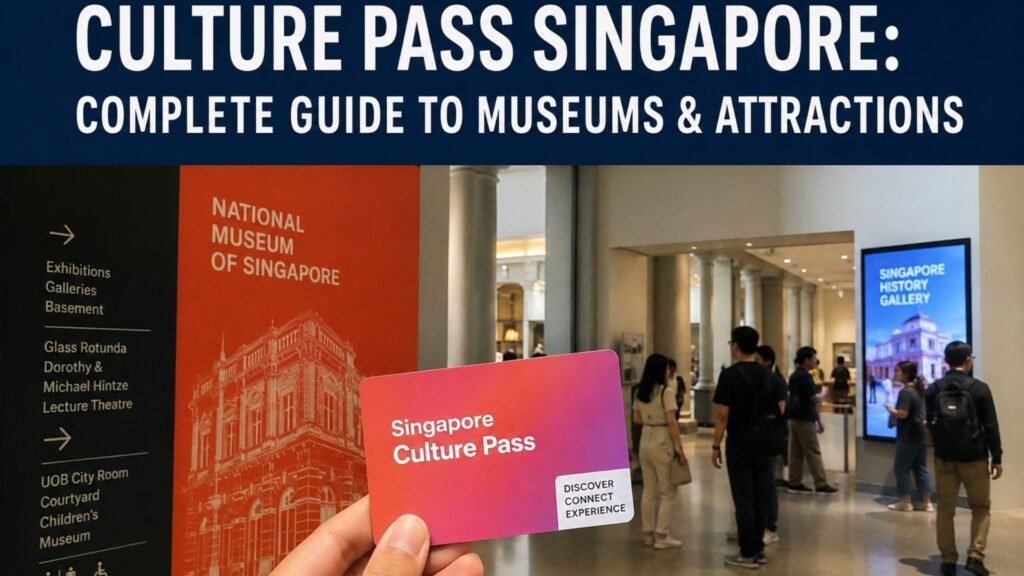
Culture Pass Singapore: Complete Guide to Museums & Attractions
“I thought I knew Singapore. Lived here three years. Then someone took me to The Intan and I realised I’d been walking past the real city the entire time.”
— A British expat, now on her sixth Peranakan beading class.
Here’s the honest truth.
Most people land in Singapore, grab chicken rice somewhere near Lau Pa Sat, snap the Marina Bay skyline, and tick the box. Done. Cultural experience complete. And I get it — I really do. The skyline is stunning. The chicken rice is genuinely great. But that version of Singapore? It’s maybe 4% of what’s actually here.
The real stuff is different. Way different.
It smells like three things simultaneously — incense from a Taoist temple, jasmine from a Tamil flower garland seller two doors down, and kaya toast from the kopitiam on the corner that’s been there since your grandfather’s grandfather was young. It sounds like Hokkien opera bleeding out of a void deck speaker at 8 PM on a Thursday. and It tastes like ang ku kueh that a 70-year-old woman has been making the exact same way since… well, she doesn’t remember exactly when she started. A long time ago. Before all this.
That’s Singapore local culture. That’s what this guide is about.
And look — if you’re here because you want the culture pass Singapore breakdown specifically, I’ve got you. Scroll down to the complete section. But honestly? Read the whole thing first. Because the pass only makes sense once you know what you’d actually be spending it on.
What Makes Singapore Cultural Experiences So Unique?
Well… where do you even start.
733 square kilometres. Four official languages. About a dozen active religious traditions operating simultaneously. And somehow — somehow — it works. You can walk from a Chinese clan association temple to an Indian spice market to a Malay royal heritage district to a Peranakan shophouse row in under 45 minutes. On foot. Without planning it.
Singapore cultural attractions pull millions of visitors every year and the reason — when you strip away all the marketing language — is genuinely simple. Nothing here is performed for tourists. The old uncles still play chess outside the clan associations on Saturday mornings. The temple priests still conduct the same rituals they’ve conducted for a hundred and thirty years. The hawker uncle at Maxwell has been selling the same plate of chicken rice for something like thirty-five years and he has absolutely no interest in making it Instagram-friendly. It just tastes the way it’s supposed to taste.
That’s what separates Singapore from cities that curate their heritage behind velvet ropes.
So yeah. Cultural tourism Singapore is growing fast — and for good reason.
The Blend of Chinese, Malay, Indian & Peranakan Cultures
Here’s a rough map. Helpful if you’re trying to figure out where to actually go.
Chinatown heritage Singapore — southwest of the city. Clan houses, Taoist temples, pre-war shophouses, medicine halls, and the Buddha Tooth Relic Temple which is worth an hour of anybody’s time. Little India cultural tour territory runs through Serangoon Road — you’ll know you’re there from the marigold smell alone, honestly. Kampong Glam attractions sit north of the city centre — Sultan Mosque, the Malay Heritage Centre, Haji Lane for the boutiques. And then there’s Joo Chiat and Katong, which is Peranakan culture Singapore in full bloom.
The Peranakans are… okay, this needs explaining because a lot of people are fuzzy on it. Straits Chinese. Descendants of early Chinese settlers — Hokkien and Teochew mostly — who married local Malay women. Their culture fuses Hokkien Chinese tradition with Malay aesthetics and it produced food, fashion, architecture, and craft that exists nowhere else in exactly this form. Like, you can find influences elsewhere. But the specific combination? Only here. Only in Singapore, Malacca, and Penang. And Singapore’s version has its own particular flavour.
It’s genuinely worth a dedicated visit. Actually several.
| Cultural Community | Primary District | Key Landmark |
|---|---|---|
| Chinese | Chinatown | Buddha Tooth Relic Temple |
| Malay | Kampong Glam | Sultan Mosque |
| Indian | Little India | Sri Veeramakaliamman Temple |
| Peranakan / Straits Chinese | Joo Chiat & Katong | Koon Seng Road Shophouses |
| Eurasian | Waterloo Street area | Eurasian Community House |
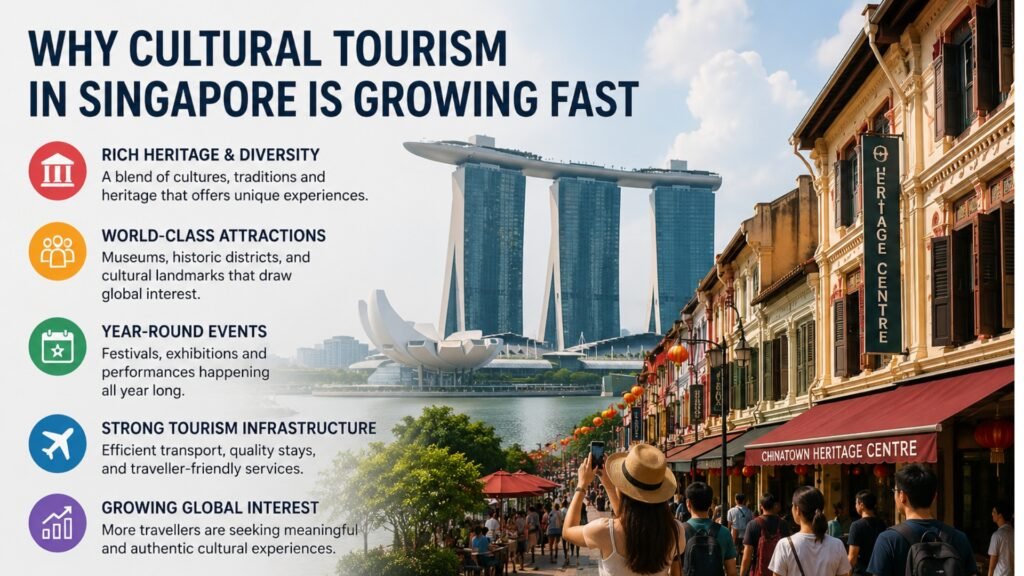
Why Cultural Tourism in Singapore Is Growing Fast
Post-2023 the numbers shifted. The Singapore Tourism Board’s data on heritage and cultural experiences ranked them in the top three motivations for international visitors in 2024–2025. And honestly… it makes total sense. People are tired of passive tourism. They don’t want to stand in front of a thing and photograph it. They want to do something. Make something. Eat something that took three generations to perfect.
The government read this correctly. That’s partly why the culture pass Singapore scheme got expanded — to make traditional Singapore experiences genuinely reachable, not just for tourists with cash to burn, but for ordinary residents who walk past these experiences every single day and somehow never step inside.
Which is more common than you’d think, by the way. Ask a Singaporean when they last visited the Chinatown Heritage Centre. Go on. Ask them.
Best Time to Explore Singapore’s Cultural Scene
Technically? Any time. It’s year-round here, obviously.
But — and this is important — January to February is something else entirely. Chinese New Year turns Chinatown into a sort of organised beautiful chaos. Lanterns everywhere. Lion dances appearing at 6 AM outside temples. The smell of bak kwa drifting from approximately every third shop on the block. Then October–November brings Deepavali’s light-up in Little India (genuinely one of the most visually spectacular things this city does) and the Singapore Night Festival, which projects internationally commissioned light art onto colonial heritage buildings until 2 AM.
If you hate crowds — and some people really, really do — March, April, and September are your months. Quieter. Still culturally rich. Workshop bookings are far easier to secure. The neighbourhoods feel more like themselves.
| Month | Best Cultural Event | District to Focus |
|---|---|---|
| Jan–Feb | Chinese New Year, Chingay Parade | Chinatown, Marina Bay |
| Mar–Apr | Singapore Art Week fringe events | Bras Basah, Bugis |
| May | Vesak Day temple ceremonies | Chinatown, Little India |
| Jul–Aug | Singapore Night Festival | Bras Basah–Bugis |
| Oct | Deepavali light-up | Little India, Geylang |
| Nov | Singapore Writers Festival | City Hall precinct |
| Dec | Mid-Autumn lantern installations | Chinatown, Gardens by the Bay |
Best Cultural Experiences in Singapore You Must Try
Here’s the thing about visiting a culture versus actually doing something inside it.
Watching a batik demonstration is fine. Standing behind a rope watching someone else drag hot wax across cotton — okay, sure, it’s informative. But sitting down yourself, picking up a tjanting tool, feeling the wax cool wrong the first three times you try — that’s a completely different relationship with the thing.
Singapore art workshops have grown massively since about 2022 and the quality is genuinely impressive now. We’re not talking tourist-facing activity centres with laminated instructions. We’re talking real practitioners — people who’ve spent decades on a craft, some of them among the last in Singapore doing it in the traditional way.
That weight changes how the experience feels. It really does.
Traditional Batik Painting Workshops
Okay so a batik painting workshop Singapore is probably the most accessible entry point into Malay heritage Singapore for someone with zero craft background. Batik is wax-resist fabric dyeing — Javanese in origin, adopted and transformed by Malay artisans across the Straits over centuries. You apply hot wax to cotton using a tjanting (small pen-like tool with a reservoir for the wax), then dye the fabric. Where there’s wax, the dye can’t penetrate. That’s the pattern.
Sessions run two to three hours. You leave with a finished piece you designed yourself. Most workshops at Haji Lane studios are beginner-friendly — no experience required, just patience and a mild tolerance for hot wax occasionally doing something unexpected.
Worth booking three to four days ahead.
Peranakan Beading & Craft Classes
Right. So this one. Kasut manek — hand-beaded Peranakan slippers — are made using hundreds of tiny glass beads, each one placed individually with a needle through a backing fabric. To do a single panel properly takes days. Some master beaders spend weeks on one pair.
You will not finish a pair of slippers in one session. Nobody does. That’s not the point. The point is that you sit with it, feel the weight of the needle, understand in your hands why this craft takes the time it takes. Peranakan heritage experience at its most intimate. Some sessions at The Intan in Joo Chiat include a Nonya tea and kueh tasting alongside the beadwork. Do that version if it’s available.
Chinese Calligraphy Experiences
Chinese heritage Singapore runs deep, and calligraphy is one of its most meditative expressions. Getting the brush hold right takes about twenty minutes. Making a mark worth looking at takes considerably longer — but that’s entirely the point, and most instructors will tell you that in the first five minutes.
Studios along Telok Ayer Street and at the Chinatown Heritage Centre run regular beginner sessions. You practice on newsprint until the instructor trusts you with rice paper. At the end, you leave with a personalised scroll — your name, or a chosen character. It’s… honestly a bit moving? More than I expected the first time.
Pottery & Ceramic Art Workshops
Pottery classes Singapore exploded after about 2022 and there are now decent options across the island. Mud Rock Ceramics in Tiong Bahru and The Ceramic Studio in Jalan Besar are the most established.
What makes this culturally interesting specifically in Singapore — beyond the standard wheel-throwing session — is the option to incorporate traditional Straits Chinese ceramic motifs into your designs. Phoenix patterns, lotus flowers, the kind of blue-and-white visual language you see on antique Peranakan tableware. Ask your instructor if that’s something you can explore. Not every session offers it but it elevates the whole thing from craft class to actual Singapore cultural immersion.
Singaporean Cooking Classes With Local Chefs
Honestly? This might be the single best use of three hours in Singapore. No contest.
Singapore cooking classes with real local cooks — not culinary school instructors, not hotel F&B staff, but actual home cooks and hawker practitioners — decode the culture faster than any heritage tour. A rempah cooking class at Cookery Magic in Katong starts with building the spice paste from scratch. Fresh galangal, lemongrass, turmeric, candlenut — you bruise it, blend it, fry it in a hot wok until the oil separates and the kitchen smells like something ancient and very good.
Kueh making class Singapore workshops — specifically the Ang Ku Kueh workshop for those little red tortoise-shaped glutinous rice cakes — teach techniques that are genuinely disappearing with each passing generation. The ang ku kueh carries more cultural symbolism than its small size suggests (longevity, luck, offerings to deities) and learning to make one properly gives you a completely different relationship with what’s otherwise just a sweet snack.
| Workshop Type | Duration | Avg. Cost | Best Venue |
|---|---|---|---|
| Batik Painting | 2–3 hrs | $60–$90 | Batik Boutique, Haji Lane |
| Peranakan Beading | 2 hrs | $70–$100 | The Intan, Joo Chiat |
| Chinese Calligraphy | 1.5–2 hrs | $45–$70 | Chinatown Heritage Centre |
| Pottery | 2–3 hrs | $75–$120 | Mud Rock Ceramics, Tiong Bahru |
| Rempah Cooking | 3 hrs | $80–$130 | Cookery Magic, Katong |
| Kueh Making | 2 hrs | $55–$85 | Various community kitchens |
Best Heritage Tours in Singapore for First-Time Visitors
Singapore heritage trails and guided walking tours are — and I’ll say this clearly — massively underrated. Most first-timers do the plug-in-earphones-open-Google-Maps wandering and come away thinking they’ve done the neighbourhood. They’ve done the surface of the neighbourhood.
A good guide changes everything. The blank wall of a Chinatown shophouse becomes a story about 1930s clan rivalries and the families who slept twelve to a single room behind that wall. Same street. Completely transformed. Same amount of walking.
The National Heritage Board (nhb.gov.sg) certifies Singapore guides and publishes downloadable trail maps for self-guided exploration if budget’s tight. But for a first visit — pay for a guide. Worth it.
Chinatown Heritage Walking Tour
Singapore walking tours don’t get more foundational than this one. Start at the Chinatown Heritage Centre on Pagoda Street — it reconstructs a 1950s shophouse interior room by room. Down to the cramped sleeping spaces, the shared cookfire, the handwritten rental agreements tacked to the wall. It’s visceral in a way that abstract history never quite manages.
Then Sri Mariamman Temple (yes — a Hindu temple in the middle of Chinese Chinatown; yes, that’s exactly right, and yes it’s been there since 1827). Then Buddha Tooth Relic Temple on South Bridge Road, then up Ann Siang Hill where the old clan associations still operate. Do the dawn version if you can possibly manage it. Before the souvenir stalls open, before the tour buses arrive. The quiet Chinatown is something else.
Little India Cultural Trail
Little India cultural tour hits completely differently on a Sunday evening. That’s when the South Asian migrant worker community gathers along Serangoon Road and the neighbourhood becomes fully, loudly, vibrantly itself.
Weekday mornings are for the food market. Tekka Market opens before 6 AM. The wet market section is a textbook of Singapore heritage food — if you can decode it, which is easier with a guide.
Key stops: Sri Veeramakaliamman Temple (arrive during a puja ritual if possible — the bells and camphor smoke are overwhelming in the best way), the Mustafa Centre for full sensory overload, and Dunlop Street for flower garland shops. The marigold and jasmine smell on that street. I mean, you just remember it.
Indian heritage Singapore is alive in Little India in a way that no museum — however good — fully replicates.
Kampong Glam & Arab Street Experience
Two eras in one walk, basically. The Malay royal history (pre-colonial, 18th century, the Malay Heritage Centre on Kandahar Street covers it beautifully) and the contemporary Muslim arts district of today — Haji Lane, Baghdad Street, the indie boutiques and Yemeni coffee houses that have colonised the area since about 2010.
The Sultan Mosque. Its golden dome is visible from three streets away. Here’s the detail most tour guides include but is worth repeating because it’s genuinely moving: the base of the dome is made from glass bottles. Donated by Muslim community members who couldn’t afford the full construction costs but wanted to contribute something. That detail, for a lot of people, changes the whole building.
Malay heritage Singapore deserves more time than most itineraries give it. Seriously.
Joo Chiat & Katong Peranakan Tour
Koon Seng Road. If you’ve seen one photograph of Singaporean Peranakan architecture, it was probably taken here. Two rows of terrace houses in seafoam green, dusty rose, warm ochre — decorated with ceramic tiles and stucco floral reliefs and painted shutters — facing each other across a narrow residential lane.
Peranakan culture Singapore at its visual peak.
Walk Joo Chiat Road for the mosaic tile shopfront facades. Find Guan Hoe Soon restaurant (open since 1953, still doing it the old way). Stop at Kim Choo Kueh Chang for pandan-wrapped Nonya rice dumplings. End with laksa at 328 Katong Laksa — the broth is a thirty-year-old recipe and you can taste the time in it. Explore Singapore neighbourhoods at this pace and you start to understand why people who move here never quite leave.
Civic District Historical Tour
The Padang. National Gallery. Victoria Theatre. Asian Civilisations Museum. The Civic District holds Singapore’s entire arc — colonial administration, national awakening, independence and identity — in a walkable radius around City Hall MRT. Singapore cultural landmarks here are dense, significant, and weirdly undervisited by tourists who somehow always end up at Sentosa instead.
The National Gallery alone houses the world’s largest public collection of Southeast Asian art. It also has free access days. Seriously worth checking before you pay full price.
Hidden Cultural Gems Most Tourists Miss
Here’s the real list. The places that don’t make the standard Top 10 articles. The ones locals actually know and often don’t mention because, honestly, it’s nicer when they’re not packed.
But look — this is a genuine advice guide and you deserve the full picture. Hidden places in Singapore reward the traveller who deliberately slows down. Almost always free or nearly free. Almost never on the standard tourist circuit. And they carry stories that polished, ticketed attractions sometimes smooth over in the process of becoming polished and ticketed.
Haw Par Villa
Okay. So. Haw Par Villa.
It’s free. It’s in Pasir Panjang. It was built in 1937 by the brothers who made Tiger Balm. And it contains over 1,000 dioramas depicting Chinese mythology, moral tales, and scenes from classic literature, rendered in painted concrete and plaster, some of them the size of a small room.
The Ten Courts of Hell exhibit shows — in graphic sculptural detail — what awaits various categories of sinners in the afterlife. It is colourful. It is instructive about traditional Chinese cosmology. and It is genuinely slightly unsettling. Children either love it or are traumatised. Hard to predict which.
It’s one of the most extraordinary places in Singapore and it gets almost no attention compared to the waterfront attractions. Free entry. Just go.
The Intan Heritage Home Museum
By appointment only. Inside a Joo Chiat terrace house. Hosted by Alvin Yapp — a Peranakan collector who has spent decades assembling one of the most extraordinary private collections of Nonya artefacts in existence.
Antique porcelain. Embroidered textiles. Peranakan jewellery. Beaded slippers. Family photographs going back generations. All displayed inside a home that functions as a living museum of Peranakan heritage experience. And Alvin doesn’t just show you the objects. He tells you their stories. Where they came from. What family owned them. What they meant at the time of their making.
Heritage storytelling tours at their most personal and most irreplaceable.
Traditional Coffee Roasting Experiences
You probably didn’t know Singapore had a coffee culture older and stranger than anything on Orchard Road.
Traditional Singapore experiences around kopi go back to the early 20th century — Hainanese immigrants, Robusta beans, roasted in a charcoal-fired wok with butter and sugar, brewed through a cotton sock filter. The result is dark, slightly sweet, with a texture that’s nothing like espresso and everything like something that’s been doing the same job without apology for eighty years.
A handful of third-generation roasteries in Chinatown and Toa Payoh still do it this way. Watch the wok-roasting — the smell of caramelising sugar, the beans crackling — and then drink a cup. It costs about $1.20. Nothing about it makes commercial sense in 2026. That’s precisely why it’s worth seeking out.
Local Wet Markets & Hawker Culture Tours
Hawker centre food tour experiences are well documented — everybody covers those. The wet market tour is different. Rawer. More revealing.
Tekka Market in Little India, Geylang Serai Market, Tiong Bahru Market — all open before 6 AM. That pre-dawn hour is when Singapore hawker culture operates at its most honest. No performance. No tourists. Just the actual daily commerce of the neighbourhood.
Guided wet market tours decode what you’re looking at: the different pork cuts a Teochew butcher lays out versus a Cantonese one, the specific kangkong a Malay cook will choose for sambal versus generic stir-fry, the fresh tofu varieties that mean different things to different kitchens. Singapore heritage food rewards this kind of close attention. The tours are where that attention gets context.
Best Food Experiences To Understand Singapore Culture
Food in Singapore is not entertainment. It is not decoration. It is the primary language through which every community here expresses who it is, where it came from, and what it has kept worth keeping.
Singapore hawker culture — the system of open-air cooked food stalls feeding millions of people daily at prices that would embarrass a McDonald’s — was inscribed on UNESCO’s Intangible Cultural Heritage list in 2020. That designation means something. It recognises that the hawker centre is a cultural institution, not just a cheap canteen.
Authentic local food Singapore lives in hawker centres, kopitiams, wet market stalls. It does not — with a few notable exceptions — live in mall food courts or hotel restaurants.
Hawker Centre Food Tours
Maxwell Food Centre, Old Airport Road, Lau Pa Sat. The three pillars of hawker tourism, each with a distinct personality.
Maxwell is compact, efficient, home to Tian Tian Chicken Rice — yes, the Gordon Ramsay queue one. Old Airport Road is larger, older, more local in character. Lau Pa Sat is architecturally beautiful — a Victorian cast-iron market structure, 1894, still functioning as a food centre — and its satay alley at night is something genuinely atmospheric.
A guided hawker centre food tour transforms these visits. You learn why the queue at a specific stall is worth 45 minutes. You hear the dialect-group history behind each dish. and You understand why two char kway teow stalls can taste completely different depending on whether the cook is Hokkien or Teochew. That’s not trivia. That’s the actual story of what you’re eating.
Authentic Laksa Cooking Classes
Laksa is Singapore’s most contested dish. Katong-style versus Curry Laksa. The debate is real and people hold positions on it with a fervour that seems disproportionate until you actually try both and then you completely understand.
A rempah cooking class focused on laksa — as offered by Cookery Magic in Katong and several Peranakan home-cook instructors in the area — starts with the paste. Dried shrimp, galangal, lemongrass, blue ginger, candlenut, dried chilli. Pound it. Fry it. Watch it change colour and smell as the oil separates. Build the broth from there. Eat what you made. It rewires how you think about the dish in a way that just eating laksa never does.
Peranakan Cuisine Experiences
Peranakan culture Singapore produced one of Southeast Asia’s most complex and labour-intensive cuisines. Nonya cooking fuses Hokkien Chinese technique — braising, stewing, fermentation — with Malay aromatics. The results include babi ponteh (pork braised in fermented soybean paste), ayam buah keluak (chicken with a nut from Borneo that is technically toxic until processed correctly), and kueh pie tee (crisp pastry cups filled with turnip and prawn).
Candlenut restaurant in Dempsey Hill holds a Michelin Bib Gourmand for its modern take on this cuisine. Worth going. But for the home-style experience — less refined, more instructive — book a Nonya cooking class with a Peranakan family cook in Joo Chiat. Different register entirely.
Michelin Hawker Food Trails
Here’s a Singapore distinction: Michelin-starred street food. Hawker Chan on Smith Street (soya sauce chicken rice starting from $2.80 a plate) and Hill Street Tai Hwa Pork Noodle on Crawford Lane both hold Michelin stars. The inspectors queued like everyone else. That’s the only way to understand what makes each stall earn the recognition.
A structured Michelin hawker trail — available via licensed tour operators — creates a curated eating itinerary across these and other recognised vendors. Singapore sightseeing tours through the stomach. It works extraordinarily well.
Traditional Tea Appreciation Sessions
Chinese tea ceremony culture in Singapore connects directly to Hokkien, Teochew, and Cantonese immigrant traditions — specifically gong fu cha, the attentive brewing style that emphasises slow preparation to draw maximum flavour from high-quality leaf.
Tea Chapter on Neil Road is the most established venue. A session runs ninety minutes or more — warming the clay teapot, the proper pour height, the smell test before the taste. Singapore lifestyle experiences rarely get quieter or more centring than this. It’s a welcome counterpoint to the pace of the city outside.
Complete Culture Pass Singapore Guide 2026
Right. Here we go.
The culture pass Singapore scheme — officially the SG Culture Pass — sounds dry when you describe it. Government initiative. Credit scheme. Qualifying activities. But in practice it’s actually genuinely useful, and most eligible people are either not using it or not using it fully.
Administered jointly by the National Arts Council and the National Heritage Board, the SG Culture Pass gives Singapore Citizens and Permanent Residents annual credits to spend on qualifying arts, heritage, and cultural activities. Think of it as a cultural allowance — money that exists specifically to remove cost as a barrier between you and Singapore’s best experiences.
Over 200 participating partners. Heritage tours, theatre shows, museum admissions, craft workshops, cooking classes, music performances. The scope is legitimately broad.
Official portal: culturalpass.sg
What Is the SG Culture Pass?
Simply: free money for culture.
The government loads credits into your account annually — the exact amount varies by scheme year and age bracket. Log in, browse qualifying activities, book what you want, credits deduct at checkout. No cash out of pocket for fully covered bookings. Some activities are partially covered; you pay the balance by PayNow or card. The platform is clear about this before you confirm.
Who Is Eligible for SG Culture Pass Credits?
Singapore Citizens and Permanent Residents aged 18 and above. No application needed — credits are distributed automatically via Singpass.
Senior citizens aged 60 and above may receive enhanced credit amounts. Specific figures for 2026 should be verified directly at culturalpass.sg — amounts are updated annually.
How To Redeem SG Culture Pass Credits
Log in at culturalpass.sg using Singpass. Browse by category — arts, heritage, food, workshops, music. Select your activity, choose session time, proceed to checkout. Credits apply automatically. That’s it.
The only friction in the system is remembering to actually use it. Set a calendar reminder if needed. Credits that expire unused are credits wasted.
Where You Can Use Your SG Culture Pass
| Category | Examples | Typical Credit Range |
|---|---|---|
| Heritage Tours | NHB-certified district walking tours | $20–$45 |
| Arts & Theatre | Esplanade, Singapore Repertory Theatre, Wild Rice | $40–$120 |
| Cultural Workshops | Batik, calligraphy, pottery, Peranakan beading | $35–$100 |
| Museum Admissions | National Museum, ACM, Peranakan Museum | $10–$25 |
| Food & Culinary | Cooking classes, hawker tours, tea appreciation | $40–$100 |
| Music Performances | Singapore Symphony Orchestra, chamber concerts | $30–$90 |
Best Activities To Book With SG Culture Pass Credits
Here’s the honest answer on where your culture pass Singapore credits go furthest in 2026.
Heritage Tours — typically $20–$45 per session with NHB-certified guides. Chinatown and Kampong Glam tours are consistently highly rated on the platform. Strong credit value.
Arts & Theatre Shows — biggest absolute saving here. A premium Esplanade seat can run $80–$120 at the box office. Credits cover a significant portion, sometimes all of it depending on the production tier. Best SG Culture Pass activities for pure dollar value are in this category.
Cultural Workshops — batik, Peranakan beading, calligraphy, pottery — normally $60–$120. Credits make them effectively free or close to it. For residents who’ve been meaning to try a workshop “someday”, the pass removes the only remaining excuse.
Culinary & Food Experiences — Singapore food tours and Singapore cooking classes bookable via the pass are among the most consistently meaningful credits spent. People come back to these.
Best SG Culture Pass Activities Worth Your Credits
With 200+ options it can feel overwhelming. So here’s the curated shortlist — experiences that deliver genuine cultural depth, strong credit value, and the kind of memory that doesn’t fade.
Singapore cultural immersion is the goal. Not box-ticking. Not content. Actual connection.
Singapore Symphony Orchestra Performances
The SSO performs at the Esplanade Concert Hall — acoustically one of the finest spaces in Asia. Programming mixes Western classical repertoire with commissioned works by Southeast Asian composers that you simply won’t hear anywhere else. Selected public concerts qualify for SG Culture Pass credits.
Worth knowing: the Esplanade also runs free outdoor performances on the waterfront terrace most weekends. No credits needed, no tickets. Just show up.
Singapore Writers Festival
Every November. Bras Basah–Bugis arts precinct. One of the best literary festivals in Asia, run across multiple venues in English, Mandarin, Malay, and Tamil simultaneously. Internationally recognised authors alongside local voices. Cultural events Singapore don’t come much richer.
Many events are free. Premium sessions and workshops bookable via SG Culture Pass. The atmosphere is warm, cerebral, multilingual, and very specifically Singaporean in a way that’s hard to explain and immediately recognisable when you’re in it.
Visual Arts Workshops
Singapore Art Museum and partner community art spaces run workshops across the spectrum — traditional Chinese ink painting, batik, contemporary mixed-media. Singapore art workshops qualifying for culture pass credits lean toward the traditional end, which is where the cultural value tends to run deepest anyway.
Instructors are practising artists. Not hobbyist teachers. You work with proper materials. You leave with something real.
Traditional Opera & Cultural Shows
Wayang — Chinese street opera — is one of Singapore’s fastest-disappearing art forms. If you encounter one by accident on a street corner during festival season, stop and watch regardless of whatever else you had planned. For ticketed traditional performances, the Esplanade and Victoria Theatre programme them regularly.
Bharatanatyam classical Indian dance, Malay dikir barat group singing, lion dance showcases — all available through the SG Culture Pass platform at various partner venues throughout the year.
Interactive Museum Experiences
Singapore museums and heritage institutions invested heavily in interactivity from 2022 onward. The National Museum’s permanent galleries use immersive projection, soundscapes, and tactile elements. The Peranakan Museum — reopened 2021 after major renovation — is arguably the best museum in Southeast Asia for the depth and care of its presentation. The Asian Civilisations Museum covers the broader regional heritage of the civilisations that formed Singapore’s population.
All three qualify for culture pass Singapore credits.
Local’s Guide To Exploring Singapore Neighbourhoods
Tourists see the skyline. Locals live in the lanes. The void decks. The five-foot ways between shophouses where the old men sit every morning with their kopi and their newspapers.
Singapore neighbourhood guide territory — the texture of actual daily life — is where Singapore cultural experiences stop being curated and start being real. Explore Singapore neighbourhoods on foot, always. MRT gets you to the district. Your legs do the actual discovering.
Best Cultural Streets in Chinatown
Smith Street was once the Night Market of Chinatown. Quieter now but still anchored by genuine businesses — herbal medicine halls, incense shops, traditional pastry makers who don’t care whether you photograph their window display or not. Pagoda Street runs the souvenir gauntlet but if you look up — actually above the stall awnings, at the shophouse facades at second-floor level — the architecture is largely original.
Ann Siang Hill is the elevated, quieter version. Clan associations, boutique bars in conserved shophouses, one of the better views over the district’s rooftop line. Chinatown heritage Singapore lives most authentically here, away from the ground-floor tourist economy. Tong Heng on South Bridge Road (since 1940) — egg tarts, wife cakes, flaky diamond-shaped pastry — obligatory stop. Non-negotiable.
Hidden Cafes in Kampong Glam
Beyond Haji Lane’s documented Instagram corridor — and look, Haji Lane is fine, it’s just not the whole story — Kampong Glam has a quieter, more interesting layer. Baghdad Street has Yemeni coffee houses serving qahwa (cardamom coffee) in small handleless cups with dates. North Bridge Road has Malay bakeries selling traditional kuih lapis that neighbourhood regulars have been buying for decades, who have absolutely no idea the café next door has a 4.8 rating on Google.
Singapore cultural hotspots tourists miss in Kampong Glam include the Malay Heritage Centre’s archive reading room, the few remaining traditional songket (gold-threaded Malay weaving) shops operating quietly behind the visible retail strip. Blink and you’d walk straight past them.
Traditional Shops in Little India
Indian heritage Singapore commerce on Dunlop Street and Serangoon Road hasn’t changed much in four decades. Sari shops with fabric spilling onto the pavement. Goldsmith rows where wedding jewellery gets bought by weight. Ayurvedic medicine halls with wooden drawers of dried bark and root that smell like something from a century ago.
Komala Vilas restaurant on Serangoon Road — open since 1947, pure vegetarian South Indian food on banana leaves — is living culinary heritage. The flower garland vendors at Tekka Market before 9 AM. The smell of that market — wet concrete and fresh jasmine and turmeric and incense — is one of those smell-memories that comes back to you unexpectedly years later, when you’re somewhere completely different and you catch a fragment of it in the air.
Singapore traditions live in those kinds of sensory details as much as anywhere else.
Best Photo Spots in Joo Chiat
Koon Seng Road at golden hour. Two rows of Peranakan terraces facing each other across a narrow lane. Shoot between 6 and 7 PM when the low light hits the plasterwork warm and the tile details get depth from the shadows. That’s the famous one. Everyone knows about it.
For something less photographed: the stretch of shophouses around Tembeling Road, or the cluster along Frankel Avenue toward Siglap. Singapore cultural districts in Joo Chiat are still largely residential — which means laundry on the lines and resident cats in the frame and the woman sweeping her five-foot way at 7 AM who looks at you with mild curiosity and goes back to sweeping.
Family-Friendly Cultural Activities in Singapore
Singapore is one of the most logistically forgiving cities on Earth for families. Full stop. Strollers fit everywhere. Air conditioning is everywhere. Hawker centres have high chairs. MRT stations have lifts on every platform. And the cultural scene — this is the less-known part — is genuinely designed to include children.
Family-friendly activities Singapore in the cultural space have expanded dramatically since 2021. Museums added junior trails and digital interactive zones. Workshop providers created family-format sessions. Festival programming consistently includes children’s activities now. Singapore travel experiences for families are richer than they’ve ever been, honestly.
Kid-Friendly Museums
The National Museum of Singapore’s Story of the Forest installation — 69 animated species from an 1820s natural history collection projected across a curved gallery wall — is genuinely magical for children. The Mint Museum of Toys on Seah Street, holding over 50,000 vintage toys from the 1840s to 1980s across six floors, delights every age including adults who grew up in the 1980s and find themselves a bit emotional on the third floor.
Children under 6 enter the Asian Civilisations Museum free. NHB regularly programmes school holiday activities at heritage centres that make Singapore history tour content accessible to kids through storytelling and hands-on reproductions.
Interactive Heritage Trails
Roots.sg platform. Free. Downloadable. Works offline once you’ve pulled the trail. Families navigate using a smartphone — children scan QR codes at heritage markers, solve district-based puzzles, earn digital badges at completion.
Singapore heritage trails via Roots.sg cover Chinatown, Kampong Glam, Little India, Civic District, and Joo Chiat. Suitable for children aged 8 and above with family. Free. Did I mention free?
→ roots.sg
Family Cooking Workshops
Kueh making class Singapore sessions for families — the kind where children get their own station and their own ingredients — are available at Cookery Magic in Katong and community kitchen spaces in Toa Payoh and Clementi. Children aged 6 and above participate without issues.
The kitchen teaches something beyond technique. It teaches why ang ku kueh is red (auspiciousness, luck). Why pineapple tarts appear specifically at Chinese New Year. Why kueh salat is green (pandan, which is its own whole story). Food as story. It always was.
Cultural Festivals for Families
Chinese New Year in Chinatown. Deepavali in Little India. Hari Raya along Geylang Serai. Mid-Autumn lantern walks at Gardens by the Bay. Singapore festival experiences are almost universally child-friendly — open air, pedestrian, free, filled with colour and sound and food at every corner.
The Chingay Parade after Chinese New Year is Singapore’s largest street parade — multicultural, spectacular, free to watch from the sidelines. Cultural events Singapore at festival time are the easiest entry point for families arriving new to the city.
Free & Budget-Friendly Cultural Experiences in Singapore
Singapore’s expensive reputation is partly earned. Hotels, yes. Some restaurant categories, definitely. But that reputation is deeply unfair when applied to cultural access. Affordable cultural activities Singapore are genuinely abundant — you just have to know where to look and not assume that everything worth doing costs what Marina Bay Sands costs.
Layer in your SG Culture Pass credits on top of the free options and the value equation becomes genuinely extraordinary. You could have a deeply rich cultural week in Singapore without spending much at all.
Free Museums & Heritage Centres
National Museum of Singapore’s permanent galleries — free for all. No booking. Just show up. Malay Heritage Centre, Indian Heritage Centre, and Chinese Heritage Centre all have free-entry days or permanently free gallery tiers. Asian Civilisations Museum does Friday evening free access (6–9 PM). Singapore museums and heritage institutions publish these schedules on the NHB portal.
Check before visiting. Schedules shift occasionally around national holidays and special exhibitions.
Self-Guided Walking Tours
Singapore walking tours don’t require a guide or a fee. NHB’s Roots.sg and the STB’s Visit Singapore app both offer downloadable self-guided trails with audio commentary for major cultural districts. All free. All written by historians and heritage professionals — not tourist-brochure shallow.
Download the trail before you go, use it offline in the district, take as long as you want. No group to keep pace with. No rushed schedule. Singapore neighbourhood guide content on these platforms is genuinely good.
Affordable Cultural Workshops
Singapore craft workshops through the People’s Association Community Club network are the city’s best-kept budget secret. CCs islandwide offer classes in batik, calligraphy, traditional dance, pottery, and more at subsidised rates — typically $10–$30 per session for Singapore residents.
The quality varies. But the best CC workshops are run by the same qualified instructors who charge $80+ at private studios. Worth checking the PA schedule before booking the pricier private option.
Best Free Festivals & Events
Singapore Night Festival in August — completely free, world-class, international light artists, colonial heritage buildings as canvases, programming until 2 AM at peak nights. The Esplanade’s Huayi Chinese Festival of Arts (February) and Kalaa Utsavam Indian Festival of Arts (November) — both free, both genuinely significant cultural events.
Singapore travel guide 2026 note: these festivals transform public spaces into outdoor cultural venues that rival anything ticketed. They’re also singularly good for photography, for spontaneous encounters, and for understanding what Singapore looks like when it’s celebrating itself with real feeling.
Singapore Cultural Festivals You Shouldn’t Miss
The festival calendar is relentless here — in the absolute best way. Barely a month passes without a major cultural event transforming at least one neighbourhood into something other than its everyday self. Singapore festival experiences range from intimate temple rituals (open to respectful visitors) to national-scale street parties drawing hundreds of thousands of people.
Planning around even one major festival changes the entire texture of a Singapore visit. The food stalls that suddenly appear. The decorations on every lamp post. The particular sound of a neighbourhood at celebration. Singapore traditions are most visible and most joyful during these windows.
Chinese New Year Celebrations
The Chinatown CNY light-up — running typically from three weeks before Lunar New Year through the 15th day — transforms South Bridge Road and New Bridge Road into a tunnel of lanterns. Hundreds of thousands of lights. Red everywhere. Bak kwa smoke from vendor stalls drifting the full length of the street.
Show up at a temple at 6 AM on the first day of the new year. Watch what happens. That version of Chinese New Year — before the crowds, before the day gets going — is something you remember.
Deepavali in Little India
Little India’s Deepavali light-up is the most visually spectacular neighbourhood transformation Singapore does. From early October through mid-November, Serangoon Road becomes a corridor of gold and colour. Thousands of LED installations. Kolam — traditional rice flour artwork — on the pavements. Cultural performances outdoors every evening.
Go after sunset. Walk slowly. Stop often. Indian heritage Singapore is at its most generous and celebratory during this window. The food during Deepavali season — murukku freshly fried, sweet pongal, mithai that appears only for this period — is worth the journey alone.
Hari Raya Festivities
The Geylang Serai Ramadan Bazaar — running through the fasting month before Hari Raya Puasa — is arguably Singapore’s most extraordinary regular food event. Hundreds of stalls. Traditional Malay dishes, contemporary fusion, Middle Eastern and South Asian products, artisan goods. Singapore hawker culture amplified into a nocturnal community ecosystem.
The beduk beaten to signal the end of the daily fast. The queue for ramly burgers at midnight. The particular energy of a community breaking fast together in the open air. This runs almost entirely outside the tourist itinerary circuit. Which is, honestly, part of what makes it so good.
Mid-Autumn Festival Events
Chinatown, Gardens by the Bay, and the Chinese Garden in Jurong West each September–October. Children carry handmade lanterns. Mooncake stalls on every block — lotus paste, salted egg yolk, durian varieties, snowskin innovations that have no connection to tradition and are delicious anyway.
Some Chinatown clan associations still run traditional lantern riddle-guessing competitions. Paper lanterns strung between trees with Chinese characters. The riddle is written on the lantern. You guess the answer. It’s been running for generations. Almost nobody mentions it in travel guides.
Singapore Night Festival
Every August. Bras Basah–Bugis precinct. Free. International projection artists mapping the facades of heritage colonial buildings with animated installations. The National Museum’s grand neoclassical front elevation covered in light. CHIJMES transformed. The Singapore Art Museum grounds populated with unexpected art objects.
Late programming until 2 AM Friday and Saturday nights. Outdoor performances. Pop-up food. Art in unexpected corners of buildings you’ve walked past fifty times. Singapore cultural hotspots don’t get more immersive than this. It’s proof that the investment in arts infrastructure here produces genuine value for everyone who lives — or visits — in August.
Tips for Planning the Perfect Singapore Cultural Trip
Preparation separates a pleasant Singapore visit from a genuinely transformative one.
The MRT connects every major cultural district efficiently and cheaply. Buy an EZ-Link card at Changi Airport arrivals. Load $20. It covers more transport than you’ll use in a day. That’s the logistics baseline handled. Now the cultural specifics.
How To Save Money on Cultural Attractions
Use SG Culture Pass credits first — before paying cash for any qualifying activity. Book workshops through Community Clubs where the same quality is available at half the price. Visit museums on free-entry days (check each institution’s website). Time your visit to free festivals rather than ticketed shows where the content is equivalent.
The Singapore Tourist Pass (1–3 day unlimited MRT and bus travel) is worth it if you’re jumping between Chinatown, Joo Chiat, Little India, and Kampong Glam in single days. The transport savings add up faster than expected when you’re doing multi-district best Singapore neighbourhoods to explore itineraries.
Best Areas To Stay for Cultural Exploration
Chinatown, Bugis, and Little India. Those three. Boutique hotels in the Chinatown conservation area — Duxton Hill, Ann Siang Hill — place you literally inside the district. Joo Chiat has small guesthouses and serviced apartments offering a genuinely residential Peranakan neighbourhood experience.
Marina Bay for cultural exploration is logistically inconvenient. The taxi and Grab costs from there to the heritage districts accumulate quickly. Beautiful place to be. Inefficient base for what this guide covers.
What To Wear During Cultural Visits
Covered shoulders and knees for temples, mosques, and most heritage centres. A light cotton scarf handles both modesty requirements and the inevitable sweating, because Singapore is equatorial and it will be warm regardless of what you think your heat tolerance is.
Flat comfortable shoes. Non-negotiable. Singapore walking tours and heritage trail distances add up. Chinatown’s five-foot ways are narrow, uneven, and absolutely not compatible with anything with a heel. Dress for walking. Not for photographs.
Essential Apps & Travel Tips
Download before arrival: Visit Singapore (STB official — guided trails, event listings), Roots.sg (NHB heritage trails, offline capable), Singpass (for culture pass Singapore access), Google Maps (MRT navigation — accurate, fast). WhatsApp for direct workshop bookings — most local providers respond faster there than via website contact form or email. Don’t be shy about messaging directly.
Best local tours in Singapore are bookable via Klook, Airbnb Experiences, and directly through NHB’s heritage programme. Booking direct is often cheaper. Always ask.
Frequently Asked Questions (AEO: People Also Ask)
What are the best cultural experiences in Singapore? The best Singapore cultural experiences combine hands-on workshops — batik painting, Chinese calligraphy, Peranakan beading, cooking classes — with guided heritage tours of Chinatown, Kampong Glam, Little India, and Joo Chiat. Food-based immersion via hawker tours and cooking classes rounds out the picture. The culture pass Singapore makes many of these significantly more affordable.
Is SG Culture Pass worth it? Yes. Straightforwardly yes. The culture pass Singapore scheme provides annual credits at no cost to eligible residents. Using credits on workshops, theatre shows, or heritage tours you’d otherwise pay full price for is pure savings. The only scenario where it isn’t worth it: you forget to use the credits before they expire. Set a reminder. Use them.
How do I use SG Culture Pass credits? Log in at culturalpass.sg via Singpass. Browse activities. Book. Credits deduct automatically at checkout. Balance topped up annually. Some activities are partially covered — you pay the difference via PayNow or card.
What cultural workshops can I try in Singapore? Singapore craft workshops available to the public include batik painting workshop Singapore, pottery classes Singapore, Chinese calligraphy, Peranakan beading, kueh making class Singapore, Ang Ku Kueh workshop, traditional dance introductions, and ceramic arts. Many qualify for SG Culture Pass credits.
What are the hidden gems in Singapore? Haw Par Villa (free, extraordinary, go immediately), The Intan heritage home museum (Joo Chiat, by appointment), third-generation kopi roasteries in Chinatown, and the pre-dawn wet market at Tekka Market are the four hidden places in Singapore that standard itineraries most consistently miss.
Final Thoughts on Singapore Cultural Experiences
Few cities do what Singapore does.
Four distinct living cultures — Chinese heritage Singapore, Indian heritage Singapore, Malay heritage Singapore, Eurasian culture Singapore, and the synthesised Peranakan culture Singapore — coexisting, interacting, remaining genuinely vital within 733 square kilometres. It’s not preserved for tourism. It’s not performed for visitors. It is Tuesday morning at a wet market and Thursday night at a temple and the particular argument between two uncles at a kopitiam about which hawker makes better carrot cake, black or white.
Singapore cultural experiences in 2026 are more accessible than they’ve ever been. The culture pass Singapore scheme, the expanded heritage trail infrastructure, the quality of guided tours, the growth of artisan workshop culture, and the genuine commitment of institutions like NHB and NAC to making all of this reachable across income levels. Whether you have two days or two months, there’s no real excuse — or reason — to stay on the surface.
Best Experiences for First-Time Visitors
Guided heritage tour of Chinatown or Kampong Glam. One hands-on workshop — batik if you want accessible, calligraphy if you want meditative, cooking class if you want the most to take home. Hawker centre meals for the first three days minimum. Maxwell, Old Airport Road, Tekka Market. Use SG Culture Pass credits on something that feels like a splurge. Walk Koon Seng Road at golden hour. Sit inside a temple for ten minutes without photographing anything.
That combination rewires how you see this city.
Hidden Gems Worth Exploring Again
The Intan. Haw Par Villa. A 6 AM wet market. A kopi roastery. A void deck wayang during Hungry Ghost Festival. These places don’t exhaust themselves. They reveal new detail every visit. Heritage conservation Singapore protects the physical fabric. What fills that fabric — the people, the practice, the living continuation of tradition — is what makes returning worthwhile.
Why Singapore Is One of Asia’s Best Cultural Destinations
Singapore offers multicultural depth without cultural dilution. Urban efficiency without heritage erasure. And an accessibility infrastructure — transport, language, digital tools, and the culture pass Singapore scheme — that removes almost every practical barrier between a curious visitor and a genuinely meaningful encounter with living culture.
Come curious. Move slowly. Eat everything. Talk to the uncle at the stall. Sit with something that confuses you until it stops being confusing. That’s cultural tourism Singapore at its actual best. That’s what this city is built for.