
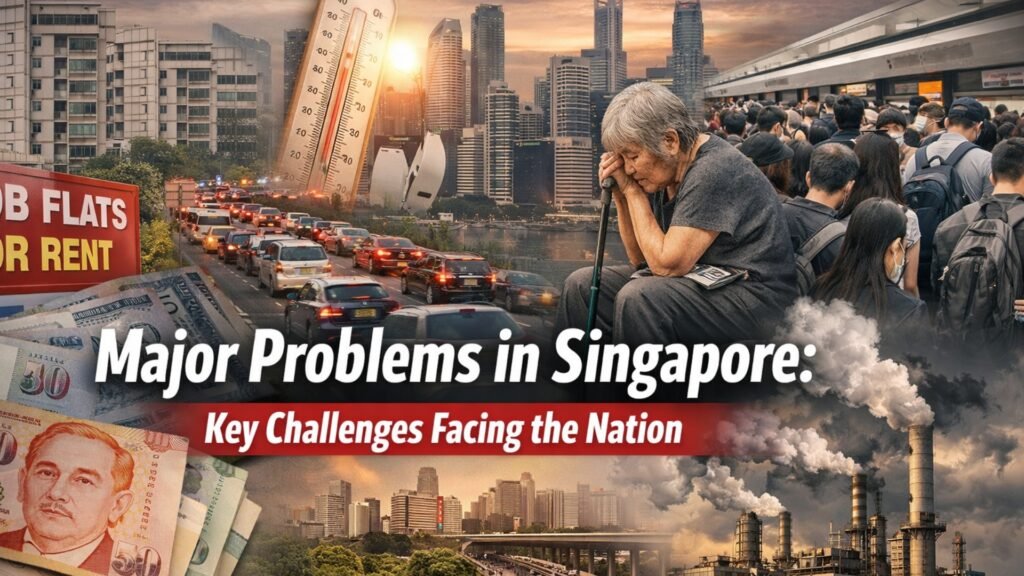
Major Problems in Singapore: Key Challenges Facing the Nation Today
Singapore is stunning. Honestly, few places on Earth match its cleanliness, order, and efficiency. Gleaming towers, spotless streets, and one of the safest environments in all of Southeast Asia — it’s easy to see why millions want to live here. But here’s the thing. Behind that polished exterior, real and growing challenges are quietly piling up for everyday Singapore residents.
The biggest problems in Singapore today aren’t always visible to tourists taking photos at Marina Bay Sands. They show up in a young couple’s bank account when they check flat prices. They show up in a student’s anxiety before PSLE results. and They show up in a worker’s silence when asked if they feel financially secure. These are the social and economic issues in Singapore that genuinely matter and deserve an honest, open conversation.
This article digs deep into what’s really happening across the island. From the high cost of living Singapore residents face daily, to cyber security threats Singapore is battling digitally, every major challenge gets examined here. No sugarcoating. No panic either. Just a clear, grounded look at the problems faced by Singapore citizens — and what the future might hold.

Rising Cost of Living in Singapore
Let’s be blunt here. Singapore is expensive. Like, genuinely jaw-dropping expensive if you’re not earning well. The high cost of living Singapore has become one of the most talked-about frustrations among locals, expats, and even long-time permanent residents who’ve watched prices climb year after year. According to the Mercer Cost of Living Survey 2023, Singapore consistently ranks among the top three most expensive cities on the planet. That’s not a badge anyone asked for.
What makes this especially painful is that prices aren’t rising in just one area. It’s everywhere at once. Rising inflation Singapore has hit groceries, utilities, dining, childcare, and healthcare simultaneously. Middle-class families feel this the most. They earn too much to qualify for government assistance but not enough to absorb costs comfortably. The squeeze is real and it’s getting tighter every year.
Why Singapore Is One of the Most Expensive Cities
Singapore imports over 90% of its food. That single fact explains a lot. When global supply chains shake — and they did dramatically during COVID-19 — the cost of food Singapore residents pay spikes almost immediately. There’s no local agricultural buffer. Every egg, every vegetable, every grain of rice travels to this island from somewhere else, and that journey costs money that eventually lands on your supermarket receipt.
Land scarcity drives up business rents. Business rents drive up product prices. It’s a chain reaction that never fully stops. Small restaurant owners in hawker centres have openly shared that their operating costs have risen by 20–30% in recent years, yet they struggle to raise prices because customers are already stretched. It’s a brutal squeeze from both ends.
| Cost Item | Approximate Monthly Cost (SGD) |
|---|---|
| 1-Bedroom Private Rental | S$2,800 – S$4,500 |
| Family Grocery Bill | S$600 – S$1,200 |
| Childcare (1 child) | S$1,200 – S$2,000 |
| Utilities | S$150 – S$300 |
| Transport (Monthly Pass) | S$120 – S$160 |
| Eating Out (Daily, 1 person) | S$10 – S$20 per meal |
Housing Prices and Rental Crisis
The expensive housing Singapore situation has gone from concerning to genuinely alarming. In 2023, HDB resale flat transactions broke records, with multiple units crossing the S$1 million mark in towns that were once considered affordable. Bishan, Toa Payoh, Queenstown — these aren’t luxury districts. Yet million-dollar flats are appearing there like it’s completely normal. It isn’t.
Rental prices Singapore exploded post-pandemic. Private rental rates surged by more than 30% between 2021 and 2023, driven by foreign professionals returning to the island and a construction backlog that slowed new housing supply. Young professionals who can’t yet buy found themselves paying rents that wiped out a huge chunk of their take-home pay. The housing crisis became impossible to ignore when even comfortable earners started sharing apartments well into their thirties.
“We were paying S$3,800 a month for a two-bedroom flat in Tampines. That’s more than my first year of mortgage will cost once we finally get our BTO. The waiting is the hard part.” — Anonymous Singapore resident, Reddit r/singapore
Impact of Inflation on Daily Life
Go to a hawker centre today. A plate of chicken rice that cost S$3.50 five years ago might now cost you S$5.50 or more. That doesn’t sound dramatic on paper. But multiply that across three meals a day, a family of four, and 365 days a year. Suddenly, the rising inflation Singapore numbers stop being abstract and start feeling very real in your wallet.
Economic pressure has pushed many lower-income households into genuine hardship. Families are choosing between fresh produce and other essentials. Elderly residents on fixed incomes are cutting back on meals. The healthcare system Singapore provides subsidies, yes — but getting to a polyclinic, waiting hours, and managing chronic conditions still costs money that stretched families don’t always have. Inflation isn’t just an economic indicator. For real people, it’s a daily decision about what you can and cannot afford.
Social Issues in Singapore Society
Singapore works hard on its social harmony. And it genuinely achieves a lot — racial integration policies, multilingualism, community programs. But social problems in Singapore have been building quietly beneath the surface. The kind that don’t show up in tourism brochures but very much shape the daily lived experience of ordinary people on this island.
The pressures are layered. Demographic change, mental health struggles, and an education system that produces world-class results but also serious anxiety — these are serious issues that Singapore is starting to face with greater honesty than before. The conversation is getting louder. That’s actually a good sign.
Aging Population and Low Birth Rates
Singapore’s fertility rate hit a historic low of 0.97 in 2023. That number matters enormously. A rate below 2.1 means a population can’t replace itself naturally. Singapore is far, far below that line. The aging population Singapore challenge and low birth rate Singapore crisis are two sides of the same coin — and together they represent a slow-moving demographic earthquake.
By 2030, roughly 1 in 4 Singaporeans will be aged 65 or older. The elderly population will need healthcare, housing support, and social care — all funded by a shrinking pool of working-age residents. The government has tried Baby Bonus schemes, childcare subsidies, and pro-family policies. People appreciate the support. But they still aren’t having more kids. The reasons are layered: expensive housing, demanding careers, long working hours, and genuine uncertainty about the future.
| Year | Total Fertility Rate (Singapore) |
|---|---|
| 2000 | 1.60 |
| 2010 | 1.15 |
| 2015 | 1.24 |
| 2020 | 1.10 |
| 2023 | 0.97 |
Source: Singapore Department of Statistics
Mental Health and Work-Life Balance Challenges
Stress and mental health Singapore is a topic that’s finally getting the attention it deserves. For a long time, there was a strong cultural silence around it. You worked hard. You didn’t complain. and You pushed through. That mindset built an extraordinarily productive nation — but it also quietly wore people down. A 2022 Cigna study ranked Singapore among the most stressed workforces in all of Asia.
Work-life balance Singapore remains elusive for many. Long hours are normalized in corporate culture. Checking emails at 11 PM is expected in many industries. The Institute of Mental Health (IMH) reported rising cases of anxiety and depression, particularly among working adults and young people post-COVID. Therapy is more accessible than before — but stigma lingers. Many still won’t seek help because they don’t want to appear weak. That needs to change. And slowly, it is.
Education Pressure Among Students
Singapore’s education system is brilliant by global standards. PISA rankings prove it. But education pressure Singapore students face is genuinely intense. The PSLE — the Primary School Leaving Examination — determines a child’s secondary school placement at just 12 years old. Twelve. That’s a lot of weight for a primary school kid to carry.
The private tuition industry is worth over S$1.4 billion annually. Parents aren’t spending that money because they enjoy it. They’re spending it out of fear — fear that without extra help, their child will fall behind in a system that feels unforgiving. Students report sleep deprivation, persistent anxiety, and the loss of genuine childhood free time to exam prep. The Ministry of Education (MOE) has introduced reforms like Full Subject-Based Banding to reduce streaming pressure. It’s a step forward. But cultural expectations don’t shift as fast as policy documents do.
Economic Challenges and Job Market Issues
Singapore’s Singapore economy is the envy of the region. High GDP per capita. Low unemployment. A reputation as a global financial hub. But economic success at the national level doesn’t automatically translate into financial security for every individual. The gap between how well Singapore performs on paper and how financially pressured many residents feel on the ground is one of the most striking social and economic issues in Singapore worth examining.
Income inequality Singapore hasn’t disappeared. It’s been managed — improved, even — but it persists. And as the cost of living climbs, the distance between comfortable and struggling grows wider in ways that statistics sometimes fail to fully capture.
Income Inequality in Singapore
Singapore’s Gini coefficient — the standard measure of income inequality — has improved over the years thanks to progressive tax policies and transfers. But before government transfers, the raw income gap remains significant. The top 10% of earners command a vastly disproportionate share of total household income compared to the bottom 20%. Low-wage workers in sectors like cleaning, security, and food service have seen improvements under the Progressive Wage Model, but their income still lags far behind the city’s overall cost structure.
Social inequality doesn’t just affect wallets. It affects health outcomes, educational opportunities, and social mobility. A child born into a lower-income household in Singapore has access to decent schools — but faces steeper uphill climbs than a child from a wealthy family who can afford premium tuition, enrichment classes, and all the extras that quietly matter. The system is meritocratic in design. In practice, starting points differ enormously.
Job Competition Between Locals and Foreign Workers
This one touches a nerve. Foreign worker issues Singapore and immigration concerns Singapore spark some of the most heated debates among Singapore residents online and offline. Many young professionals and mid-career Singapore residents feel that fair hiring isn’t always practiced in sectors like technology, finance, and professional services. The frustration is real, even if the full picture is more complex.
The Ministry of Manpower introduced and strengthened the Fair Consideration Framework (FCF) to ensure companies genuinely consider Singaporeans before hiring foreign professionals. Employment Pass salary thresholds were raised substantially. Scrutiny of companies with disproportionately low local hiring ratios increased. These are meaningful steps. But enforcement and perception don’t always align. Job competition remains a genuine anxiety for many PMET workers — professionals, managers, executives, and technicians — who feel the pressure acutely.
| Employment Pass Minimum Salary (SGD/Month) | 2020 | 2023 |
|---|---|---|
| General Professionals | S$3,900 | S$5,000 |
| Financial Services Sector | S$3,900 | S$5,500 |
Source: Ministry of Manpower Singapore
Wage Growth vs Rising Expenses
Wages in Singapore have grown. That’s true and worth acknowledging. But real wage growth — what your salary actually buys after accounting for inflation — tells a more complicated story. When rental prices jump 30%, when food costs climb steadily, when childcare and education expenses rise — a 5% salary increment barely keeps pace. Purchasing power for many households hasn’t improved meaningfully in real terms.
Middle-class families find themselves in a frustrating in-between zone. Household income is decent. But after rent or mortgage, CPF contributions, childcare, food, transport, and insurance, disposable income shrinks fast. Retirement adequacy is a growing concern too. CPF savings — the compulsory pension system — may not stretch far enough for those who spent years in lower-wage roles. It’s a critical long-term pressure that deserves far more public attention than it currently gets.
Housing and Urban Density Problems
The Housing Development Board (HDB) has achieved something genuinely remarkable. Over 80% of Singapore’s population lives in public housing — and most of it is well-maintained, connected, and functional. By global standards, that’s extraordinary. Yet the housing crisis is still a dominant topic because affordability and availability have become serious pain points for a new generation of buyers.
Urban density problems compound every other challenge Singapore faces. When you pack nearly 6 million people into 728 square kilometres, every shortage feels magnified. Every delay in housing supply becomes a crisis. Every extra car on the road is another headache. Density amplifies everything.
HDB Housing Demand and Affordability
BTO flats — the main affordable housing pathway through the Housing Development Board (HDB) — come with waiting times that stretched to 5 or even 6 years during the COVID-19 construction slowdown. That’s half a decade of waiting to start your adult life in your own home. Couples delayed marriage. Parents delayed having children. The ripple effects touched demographics, fertility decisions, and family planning in ways that are still unfolding.
The government responded with cooling measures — higher Additional Buyer’s Stamp Duty (ABSD) rates, tighter loan-to-value limits, and increased BTO supply targets. These helped. Resale price growth has moderated. But the damage to trust and the backlog of demand will take years to fully resolve. Is Singapore too expensive to live in? For many aspiring homeowners, the honest answer is: it depends on your income, your timing, and how long you’re willing to wait.
Overcrowding in a Small City-State
Singapore is the third most densely populated territory on Earth. That density is managed brilliantly in many ways — vertical housing, efficient transport, green corridors. But overcrowding Singapore is still felt viscerally in daily life. MRT carriages at 8 AM are an experience. Hospital waiting times stretch long. Popular hawker centres fill up instantly on weekends. Recreational spaces get overwhelmed on public holidays.
Urban density problems also mean that any infrastructure failure — a train breakdown, a water pipe burst, a system outage — affects an unusually high concentration of people simultaneously. There’s very little slack in a densely packed urban city-state. Everything runs close to capacity. When things work, they work beautifully. When they don’t, the disruption is felt widely and immediately.
Urban Planning Challenges
The Urban Redevelopment Authority (URA)‘s Long-Term Plan Review maps Singapore’s development through 2050. It’s an ambitious, thoughtful document that balances housing, commercial zones, green spaces, and industrial corridors on a tiny island. Land reclamation adds territory — but comes with environmental concerns Singapore conservationists raise regularly, and geopolitical sensitivities with neighbouring countries.
Environmental sustainability in urban planning is genuinely difficult when land is this scarce. Every decision involves trade-offs. Build more housing and you lose green spaces that combat urban heat. Expand industrial zones and you push residential areas further from employment centres. Singapore’s planners are among the best in the world — but even the best planners face hard constraints that no amount of expertise can fully overcome.
Transportation and Infrastructure Issues
Singapore’s public transport system is genuinely world-class by most objective measures. The MRT network is clean, air-conditioned, and reasonably priced. Buses are frequent and cover most of the island. And yet, public transport issues Singapore commuters face are real — and growing as population density and ridership numbers increase year on year.
The gap between Singapore’s transport reputation and the daily commuter experience is worth examining honestly. International visitors are often impressed. Daily commuters who spend an hour on a packed train, sweating despite the air-conditioning, feel differently. Both experiences can be simultaneously true.
Public Transport Overcrowding
Traffic congestion Singapore and train overcrowding hit peak levels during morning and evening rush hours. The North-South and East-West MRT lines — the two oldest and most heavily used — regularly carry passengers well beyond comfortable capacity. Breakdowns, while less frequent than a decade ago, still cause cascading disruptions that affect tens of thousands of commuters simultaneously.
The elderly population and passengers with mobility challenges face particular difficulties in crowded stations and packed carriages. Priority seating exists. But enforcement is social, not regulatory — and social pressure doesn’t always work during rush hour. LTA (Land Transport Authority) has invested heavily in reliability improvements. Results have been positive but incremental. The fundamental challenge remains: more people, same infrastructure.
Traffic Congestion in Peak Hours
Singapore’s Electronic Road Pricing (ERP) system is genuinely innovative. Distance-based, time-sensitive road charging was a concept Singapore pioneered. And yet, traffic congestion Singapore on major expressways like the CTE, PIE, and AYE remains a daily frustration for drivers. The ERP manages but doesn’t eliminate congestion. As long as car ownership — despite COE prices that regularly exceed S$100,000 — remains aspirational for many households, roads will remain pressured.
The upcoming ERP 2.0 system promises distance-based charging using in-vehicle units rather than fixed gantries. It’s a smarter, more flexible system. Rollout has faced delays — partly technical, partly logistical. When it fully launches, it could meaningfully shift driving behaviour. But urban density problems mean that even a perfect road pricing system can’t conjure more physical road space into existence.
Future Transport Developments
Several critical transport projects are underway that could meaningfully change Singapore’s mobility landscape. The Jurong Region Line and Cross Island Line are expanding MRT coverage to previously underserved areas. The Johor Bahru–Singapore Rapid Transit System (RTS) Link will ease the crushing daily congestion at the Causeway — one of the busiest border crossings in the world.
Autonomous bus pilots in Punggol and one-north have shown promising results. On-demand shared mobility services are being tested. Singapore’s transport masterplan through 2040 envisions a future where 9 in 10 peak-hour journeys complete within 45 minutes. That’s an ambitious and genuinely achievable target — if funding, planning, and execution stay on track. Source: LTA Land Transport Master Plan 2040
Environmental and Sustainability Problems
Environmental concerns Singapore faces aren’t hypothetical future worries. They’re present-tense realities. Singapore sits barely 15 metres above sea level at its highest natural point. A low-lying urban city-state in a warming world faces an existential geography problem that no amount of economic success can simply engineer away. Environmental sustainability has moved from a policy checkbox to a genuine national security priority.
Climate change impact on Singapore is measurable, documented, and accelerating. The government knows this. It’s committed to spending S$100 billion over 100 years on coastal and flood protection. That’s not a trivial number. It signals how seriously the threat is being taken at the highest levels of the Singapore government.
Climate Change Impact on Singapore
Sea levels around Singapore could rise by up to 1 metre by 2100 under moderate warming scenarios, according to the Centre for Climate Research Singapore (CCRS). For a nation where significant infrastructure sits near sea level — Changi Airport, port facilities, coastal residential areas — that’s a sobering projection. Storm surges and intense rainfall events are already more frequent. Flash floods in Orchard Road and Bukit Timah — areas that flooded dramatically in recent years — offered a preview of what unchecked climate change impact could look like.
The government’s Long-Term Plan Review incorporates sea wall construction, pumping systems, and elevated new developments. Singapore takes climate adaptation seriously because it has no choice. Retreat isn’t an option for an island state. You adapt or you face consequences that no economic buffer can fully absorb.
Rising Temperatures and Urban Heat
Since 1948, Singapore’s average temperature has risen by approximately 0.25°C per decade — faster than the global average. The urban heat island effect amplifies this further. Concrete, asphalt, glass, and steel absorb heat during the day and release it at night. Urban Singapore is measurably hotter than the surrounding seas and forested areas that remain. Some studies suggest urban areas can be 4–7°C warmer than greener surroundings during peak heat periods.
Thermal comfort for outdoor workers — construction workers, delivery riders, traffic wardens — is a genuine occupational health issue. Low-income households without air-conditioning face heat stress at home. The government’s Cool & Green Singapore initiatives — mandatory greenery on new buildings, cool-paint coatings, rooftop gardens — are meaningful responses. But cooling a tropical city-state experiencing accelerating warming is a long, expensive, and never quite finished project.
Waste Management and Pollution
Semakau Landfill is remarkable. Built on the sea, it’s clean, well-managed, and genuinely impressive by any standard. It’s also running out of space. At current waste generation rates, Semakau Landfill — Singapore’s only landfill — is projected to reach capacity around 2035. That’s not far away. And recycling rates, despite years of public campaigns, remain disappointingly low.
Singapore’s domestic recycling rate hovers around 12–13% — far below the rates of nations like Germany, South Korea, or Japan. The Zero Waste Masterplan targets a 70% reduction in waste sent to Semakau by 2030 through reduction, reuse, and recycling. Extended Producer Responsibility schemes are being rolled out. Beverage container deposit systems are in development. Progress is real — but it needs to accelerate sharply to meet targets. Source: NEA Zero Waste Masterplan
| Singapore Waste Data | Figure |
|---|---|
| Total Waste Generated (2022) | ~7.39 million tonnes |
| Overall Recycling Rate | ~57% (industrial) / ~12% (domestic) |
| Semakau Projected Full Capacity | ~2035 |
| Zero Waste Target Year | 2030 |
Political and Legal Challenges
Singapore’s Singapore government is widely credited for clean governance, long-term planning, and effective administration. Transparency International consistently ranks it among the least corrupt governments in the world. These aren’t small achievements. In a region where governance problems run deep, Singapore’s track record is genuinely impressive.
But what challenges does Singapore face politically? The strict laws Singapore enforces, the limits on freedom of speech Singapore allows, and the government policies Singapore implements all attract serious debate — both domestically and internationally. These are legitimate conversations, not attacks on a successful system.
Strict Laws and Regulations
The Internal Security Act allows detention without trial in cases involving national security threats. It’s rarely invoked — but its existence generates ongoing scrutiny from human rights organisations. Mandatory death penalty for drug trafficking remains in force despite sustained international pressure. Singapore’s position is firm: strict deterrence works, and the data on drug abuse rates supports that view to some extent.
Strict laws Singapore maintains on public behaviour — littering fines, vandalism laws, restrictions on public assembly — create an orderly environment that most residents genuinely appreciate. The trade-off between individual freedom and collective order is one Singapore has clearly chosen a specific position on. Whether that position is right is a conversation Singaporeans are increasingly willing to have publicly. Source: World Justice Project Rule of Law Index
Freedom of Speech Concerns
The Protection from Online Falsehoods and Manipulation Act — POFMA — gives the Singapore government authority to issue correction directions against content it determines to be false. Since its introduction in 2019, it has been invoked against opposition politicians, news sites, and social media posts. Supporters argue it protects citizens from dangerous misinformation. Critics argue it gives the ruling party an uncomfortable amount of power over what information circulates.
Freedom of speech Singapore conversations intensified when Singapore ranked 140th out of 180 countries on the Reporters Without Borders Press Freedom Index in 2023. That’s a low ranking for a wealthy, well-governed nation. Domestic media outlets operate within understood limits. Independent voices exist — but they navigate carefully. The debate around POFMA and media freedom is one of the most genuinely contested political conversations in Singapore today.
Government Policies and Public Response
Younger Singaporeans are more politically engaged than any previous generation. They use platforms like Reddit’s r/singapore, Twitter, and independent news outlets like The Online Citizen and Mothership to debate policies, share frustrations, and organise civic action. The public feedback landscape has shifted meaningfully in the past decade.
Civic participation is growing. The Workers’ Party made historic gains in the 2020 General Election — winning Sengkang GRC outright and strengthening its position in Aljunied. This wasn’t a threat to PAP governance. But it was a clear signal that Singaporeans want more diverse voices in Parliament. Government policies Singapore implements are scrutinised more publicly and more critically than ever before. That’s healthy for a maturing democracy.
Technology and Cybersecurity Threats
Singapore’s Smart Nation initiative is one of the most ambitious digital transformation projects anywhere in the world. Digital identity, e-government services, smart traffic management, AI-driven healthcare — Singapore is building infrastructure that most countries haven’t even conceived of yet. It’s genuinely exciting. It’s also genuinely risky.
Every connected system is a potential target. And Singapore, as a global financial hub and one of the world’s most digitally connected societies, is an attractive target for sophisticated cybercriminals and state-sponsored attackers. The pros and cons of living in Singapore in the digital age include remarkable convenience alongside serious vulnerability.
Rise of Fake News and Misinformation
Fake news Singapore spreads fastest through WhatsApp. That’s not speculation — it’s documented. Singapore’s population uses WhatsApp heavily across all age groups, and the app’s private, encrypted group structure makes misinformation difficult to detect and correct. During COVID-19, false health claims circulated widely before authorities could respond. The real-world consequences — people avoiding vaccines, using unproven treatments — were dangerous.
AI misinformation Singapore is an emerging and urgent concern. Deepfake videos, AI-generated audio clips, and synthetic media are becoming harder to detect. The Media Literacy Council runs public education campaigns and the medialit.sg platform provides resources. Digital literacy is improving — but the technology creating misinformation is evolving faster than most people’s ability to spot it.
Cybersecurity Risks in Singapore
The 2018 SingHealth data breach exposed personal data of 1.5 million patients, including Prime Minister Lee Hsien Loong’s medical records. It remains Singapore’s largest and most significant data breach to date. The attack was sophisticated, targeted, and a wake-up call. Since then, investment in national cybersecurity infrastructure has increased substantially.
Cybercrime targeting Singapore businesses — particularly SMEs — has risen year-on-year. Ransomware attacks, phishing campaigns, and business email compromise scams cost local businesses hundreds of millions of dollars annually. The Cyber Security Agency (CSA) of Singapore has published a comprehensive Cybersecurity Strategy 2021, establishing national standards, sector-specific requirements, and international partnerships. Source: CSA Singapore
| Cybersecurity Incident | Year | Impact |
|---|---|---|
| SingHealth Data Breach | 2018 | 1.5 million records compromised |
| StarHub Customer Data Leak | 2020 | 57,000 customers affected |
| Toll Group Ransomware Attack | 2020 | Regional operations disrupted |
| Financial Sector Phishing Rise | 2022–2023 | Losses exceeded S$660 million |
Digital Privacy Concerns
Digital privacy concerns became a national conversation in 2021 when it emerged that TraceTogether contact tracing data — collected under assurances it would only be used for COVID-19 public health purposes — had been accessed by police for criminal investigations. The backlash was swift and significant. Trust in government data collection, already a nuanced issue, took a measurable hit.
Personal data protection in Singapore is governed by the Personal Data Protection Act (PDPA). It’s a reasonable framework — but it was designed for a slower, less data-intensive world. The proliferation of smart lampposts, facial recognition systems, and city-wide CCTV networks raises questions that the PDPA wasn’t originally built to fully address. Surveillance in a Smart Nation context requires ongoing, honest public conversation about where the line between security and privacy sits.
Conclusion: Addressing the Problems in Singapore for a Better Future
The major problems in Singapore examined throughout this article are real. They’re not invented by pessimists or amplified by people who don’t appreciate what Singapore has built. Disadvantages of living in Singapore — the costs, the pressures, the constraints — coexist with genuine strengths that are equally real. Holding both truths at once is important for any honest assessment.
National resilience — Singapore’s defining characteristic through decades of challenge — hasn’t disappeared. It’s visible in the government’s long-range planning, in the civic energy of younger generations, and in the everyday pragmatism of Singapore residents who adapt, hustle, and find creative ways forward despite real constraints. Collective action — between citizens, government, businesses, and communities — remains the most powerful tool Singapore has.
What challenges does Singapore face going forward? Rising costs that outpace wages. A demographic shift with no easy fixes. An environment under genuine stress. A digital landscape full of both promise and peril. None of these problems are unsolvable. Singapore has solved problems that seemed impossible before. It turned a fishing village into a global financial hub within a single generation. The challenges today are complex. So is the capacity — and the track record — that Singapore brings to facing them.
The conversation matters. Engaging civically, staying informed, pushing for policies that work for everyone — not just the comfortable — these are acts that shape what Singapore becomes. The problems faced by Singapore citizens today are the opportunities for collective growth that the next generation will either inherit as solutions or struggle with as unresolved burdens.
Singapore didn’t build one of the world’s most remarkable urban city-states by ignoring its problems. It built it by confronting them with uncommon seriousness. The challenges of today deserve the same honest reckoning.