
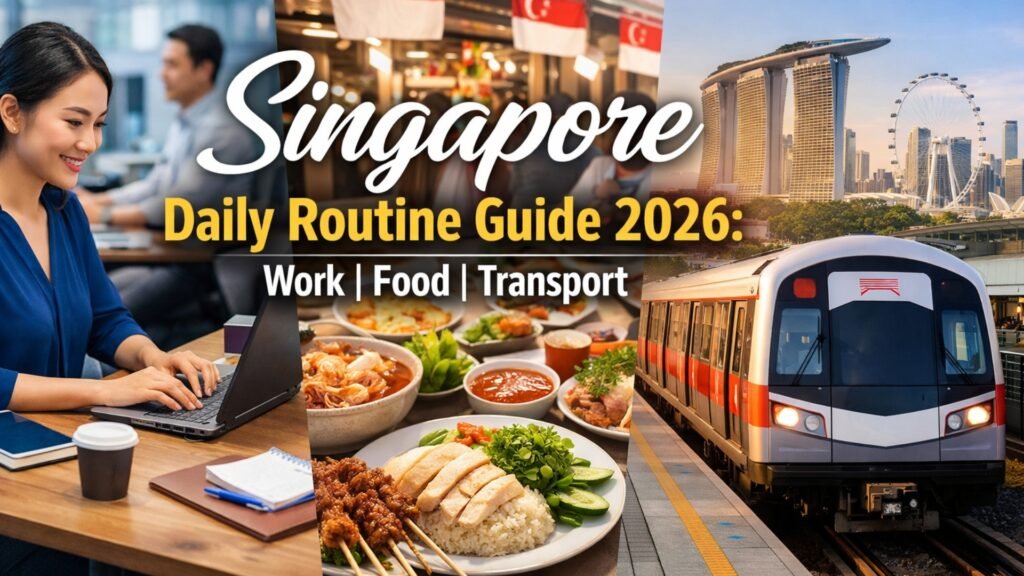
Singapore Daily Routine Guide 2026: Work, Food, Transport & Lifestyle
So you’re thinking about Singapore. Maybe you’ve already googled “is Singapore expensive” at 2am and scared yourself half to death. Fair. The numbers can look brutal at first glance. But here’s the thing — the singapore daily routine guide most websites give you reads like a government brochure. Clean. Optimistic. Suspiciously tidy.
This isn’t that.
This is what daily life in Singapore actually feels like. The hawker centre queues. The MRT at 8am. The landlord who ghosts you. The moment you realise your SGD $4,000 salary feels both huge and somehow not quite enough. Let’s get into it.
What Is Daily Life in Singapore Really Like?
Okay so — imagine this. Your alarm goes off at 6:45am. It’s already 29 degrees. Humid. The kind of humid where your glasses fog up the second you step outside. You shuffle down to the nearest hawker centre in your neighbourhood, grab kaya toast, soft-boiled eggs, and a kopi-o for maybe SGD $4.50. Total. And it’s delicious. That’s your daily routine in Singapore on a normal Tuesday.
Then you tap your EZ-Link card on the MRT, squeeze into a carriage that’s somehow both crowded and functioning perfectly, and you’re at your office in 25 minutes. No traffic. No drama. and No delay message. Just… it works.
That’s Singapore in a nutshell, really. Chaotic underneath. Immaculate on the surface.
The Singapore city life experience is unlike anywhere else in Asia. It’s a city that runs with almost obsessive efficiency — and somehow also has the best street food on the planet. Go figure.
Overview of Lifestyle
Well… the Singapore lifestyle guide starts with one honest truth. This city moves fast. Really fast. Most locals wake before 7am, eat quickly at a kopitiam or hawker centre, and commute via MRT or bus. Lunch? Maybe 20 minutes. Dinner is the meal people actually slow down for — usually at home or a neighbourhood hawker spot with family.
The structured daily routine here isn’t rigid exactly. But there’s definitely a rhythm. You feel it within your first week.
The comfortable lifestyle Singapore offers is real. But it costs money to access. And that’s the conversation nobody wants to have upfront.
Key Facts About Singapore
Before anything else — here are the basics.
| Fact | Detail |
|---|---|
| Population | ~6 million |
| Official Languages | English, Mandarin, Malay, Tamil |
| Currency | Singapore Dollar (SGD) |
| GDP Per Capita | ~USD $65,000+ |
| Land Area | 733 km² |
| Time Zone | GMT+8 |
| Government | Parliamentary Republic |
Singapore is a multicultural society sitting on 733 square kilometres. That’s smaller than London. Way smaller. Yet it hosts one of the most diverse, high-functioning urban populations on the planet. According to the Singapore Department of Statistics, the population is roughly 75% Chinese, 15% Malay, 9% Indian, and the rest Eurasian or other. Four official languages. Four major religious traditions. All somehow sharing one tiny island with remarkable harmony. Most of the time.
Pros and Cons of Living
Look — no place is perfect. Anyone who tells you Singapore is paradise clearly hasn’t paid a rent deposit here. But the trade-offs are real and worth knowing before you commit.
| Pros | Cons |
|---|---|
| World-class public transport Singapore MRT | Housing is genuinely very expensive |
| Extremely low crime | Strict laws — heavy fines for small things |
| High salaries | High-pressure environment at work |
| Excellent healthcare | Small geography — island fever is real |
| Safe and clean environment | Hot and humid literally every day |
| Extraordinary Singapore food culture | Car ownership costs a small fortune |
Singapore Lifestyle, Culture, and Social Norms
Here’s something they don’t put in the relocation brochures. Living conditions in Singapore are shaped just as much by unspoken social rules as by official ones. Nobody tells you that talking loudly on the MRT makes people visibly uncomfortable. Nobody warns you that queue-jumping — even accidentally — is treated like a minor crime. You just… learn. Usually with a stern look from an auntie.
The modern city living experience here is layered. On one level it’s gleaming, modern, efficient. On another level it’s intensely traditional — multigenerational families in HDB flats, temple festivals every other month, food habits passed down for generations. Modern yet traditional life isn’t a marketing phrase here. It’s genuinely what you see every single day.
Daily Habits of Locals
Singaporeans eat breakfast outside. Always. The idea of cooking breakfast at home is… not really a thing for most people. The hawker centre is the kitchen extension. Kaya toast and coffee before 8am. Then work. Then a fast hawker lunch. back to the desk.then home for dinner — which is the meal that actually matters culturally.
Evenings? Lots of families eat together. Not in a formal, sit-down European way. More like — everyone gathers at the coffee shop downstairs, orders from different stalls, and sits together for an hour. Simple. Warm. Regular.
That’s the everyday eating habits baseline. And honestly it’s one of the best parts of urban life in Singapore.
Cultural Diversity
Okay so — Chinese New Year, Hari Raya, Deepavali, and Christmas all happen within a few weeks of each other sometimes. And Singapore celebrates all of them. Properly. The multicultural food options during festival seasons are extraordinary. Your Indian colleague brings murukku to the office. and Your Malay neighbour leaves kueh on your doorstep. Your Chinese colleague drags you to a reunion dinner you weren’t prepared for.
This is multicultural society in daily practice. Not a branding exercise. Not performative. It’s just Tuesday.
Rules and Laws to Follow
Right. So this part is important. Singapore’s rules are strict. Actually strict. Not “we have a sign but nobody enforces it” strict. Actually enforced.
Eating on the mass rapid transit system? SGD $500 fine. Littering? Up to SGD $2,000 for repeat offenders. Jaywalking near a crossing? Up to $1,000. Drug trafficking? Mandatory death penalty. The Singapore Statutes Online database is publicly accessible — and the list is long.
But here’s the flip side. The safe and clean environment this creates is extraordinary. Streets are genuinely spotless. Public spaces feel safe at midnight. Kids take the MRT alone. That trade-off — personal freedom for collective civic quality — is something every resident makes peace with eventually. Most do so pretty quickly.
Cost of Living in Singapore (Full Breakdown)
Alright, let’s talk money. Because cost of living Singapore 2026 is the first thing everyone googles and the last thing anyone fully prepares for. Mercer’s 2025 Cost of Living Survey places Singapore firmly in the top five most expensive cities globally. Every year. Consistently.
But — and this is a big but — salaries are also high. Really high by regional standards. So the question isn’t just “is it expensive?” The real question is: what are you earning, and how do you choose to spend it?
Daily expenses Singapore vary wildly. Someone eating hawker food every day, taking the MRT, and living in an HDB flat? Easily comfortable on SGD $2,800–$3,500/month as a single person. Someone renting a CBD condo, ordering Grab for every meal, and shopping at Cold Storage? Burn through SGD $7,000–$9,000 without noticing. Same city. Completely different financial reality.
Housing and Rent Costs
Housing affordability Singapore is, honestly, the toughest nut to crack. Rental prices Singapore have stayed elevated since 2022 and haven’t corrected dramatically. Foreigners can’t buy HDB flats — that requires PR status. So renting is your reality, at least initially.
| Property Type | Monthly Rent (SGD) |
|---|---|
| HDB Room (shared) | $800 – $1,500 |
| HDB Entire 3-Room Flat | $2,000 – $3,200 |
| 1-Bedroom Condo | $2,800 – $4,500 |
| 2-Bedroom Condo | $4,000 – $7,000 |
| Landed Property | $8,000 – $15,000+ |
Source: PropertyGuru Singapore
Pro tip — look at Tiong Bahru, Bishan, or Clementi instead of the CBD. Same MRT access. Noticeably lower rents. Locals figured this out decades ago.
Food and Grocery Expenses
This is where Singapore quietly redeems itself. Hawker centre Singapore food is cheap. SGD $3.50 for chicken rice. SGD $4 for laksa. and SGD $1.50 for kopi. A full breakfast with coffee under SGD $5. Every. Single. Day.
NTUC FairPrice — Singapore’s main supermarket chain — keeps grocery bills reasonable. Roughly SGD $250–$400/month for one person cooking some meals at home. Wet markets are even cheaper for fresh produce. The street food culture here isn’t just culturally significant — it’s a genuine financial lifeline for residents across every income bracket.
Restaurants bump the numbers hard. Expect SGD $20–$60 per person for a proper sit-down meal. Fine dining? Don’t even ask.
Transport Costs
Monthly public transport spend: roughly SGD $100–$160. For a world-class city. That’s it.
Car ownership is a different story entirely. The Certificate of Entitlement — required before you can even buy a car — routinely exceeds SGD $100,000. Just for the permit. Then you add the car price, road tax, insurance, and parking. It’s absurd. Most residents correctly decide the mass rapid transit system is perfectly sufficient and leave it at that.
Ride-hailing services like Grab and Gojek fill the gaps — short trips within central Singapore run SGD $10–$25 depending on traffic and surge pricing.
Average Monthly Budget
| Expense | Monthly Cost (SGD) |
|---|---|
| Housing (1BR mid-range condo) | $2,800 – $3,500 |
| Food (hawker + occasional dining) | $400 – $650 |
| Transport (MRT + bus + occasional Grab) | $130 – $200 |
| Utilities + Internet | $120 – $200 |
| Phone | $20 – $50 |
| Leisure | $200 – $400 |
| Healthcare / Personal | $100 – $200 |
| Total | $3,770 – $5,200 |
Living in Singapore as a Foreigner
Life in Singapore for foreigners is genuinely achievable. But it takes preparation. Real preparation — not just watching a few YouTube vlogs and assuming you’ve got it figured out.
The good news? English is official here. The expat life in Singapore community is enormous and well-organised. Facebook groups, WhatsApp clusters, professional networks — they all exist and they’re active. You won’t be starting from zero.
The less good news? Housing discrimination happens. Some landlords only rent to certain nationalities or ethnicities. The social scene can feel cliquey at first. Career advancement sometimes prioritises citizens and PRs. These are real patterns — not complaints, just facts worth knowing upfront.
Visa and Residency Options
| Visa Type | Who It’s For | Min. Salary (SGD) |
|---|---|---|
| Employment Pass (EP) | Professionals, managers | $5,000+ |
| S Pass | Mid-skilled workers | $3,150+ |
| Dependant’s Pass | Family of EP/S Pass holders | — |
| Permanent Residency (PR) | Long-term residents (2+ years) | Varies |
Full details at MOM Singapore. PR unlocks HDB purchases, CPF contributions, and lower school fees. Worth pursuing after two to three years if you’re settling long-term.
Challenges for Foreigners
Okay so — nobody warns you about the rental deposit situation. It’s typically two months upfront plus one month agent commission. So before you’ve even bought a mattress, you’re SGD $8,000–$12,000 down. That’s the first month. Budget for this well in advance or it will genuinely blindside you.
Beyond finances, cultural adjustment takes time. Singaporeans are warm — but they’re also reserved with strangers initially. Don’t mistake politeness for friendliness. Give it a few weeks. The warmth emerges gradually once trust builds.
Tips to Settle Easily
Download Singpass immediately. It handles virtually every government service digitally. Join expat groups on Facebook — search “Expats in Singapore” and you’ll find thousands of members with genuine, helpful advice. Learn a few Singlish phrases — even a simple “can lah” earns genuine smiles from locals who appreciate the effort. And eat at hawker centres from Day 1. Nothing accelerates cultural integration faster than sharing a plastic table over char kway teow.
Public Transport in Singapore: MRT and Buses
Honestly? The public transport Singapore MRT system might be the single best daily quality-of-life feature this city offers. It’s that good. Punctual. Clean. Air-conditioned. Affordable. Comprehensive.
If you’re arriving from Jakarta’s traffic, Mumbai’s local trains, or London’s perpetually delayed tubes — prepare for a genuine shock. Everything just… works. Every time. The transport efficiency here is almost unsettling at first.
The public transportation network covers virtually the entire island. Over 70% of daily trips happen via public transport, cycling, or walking. Car ownership is optional in the truest sense of the word. Most residents who try it for a month realise they didn’t need one in the first place.
How MRT Works
Six lines. 130+ stations. Operates roughly 5:30am to midnight daily. Fares start at SGD $0.92. Tap in and out with an EZ-Link card, SimplyGo card, or contactless bank card. The MyTransport.SG app gives real-time arrivals, route planning, and fare estimates. Simple.
Bus System Overview
Over 300 bus routes run through SBS Transit and SMRT. Every bus stop is numbered, covered, and equipped with real-time arrival displays. Night buses run on weekends. Fares mirror MRT pricing — same EZ-Link tap system. Buses reach every corner the MRT misses. Together, the two systems create genuinely seamless commuting convenience across the entire island.
Daily Commute Experience
Peak hours — 7:30am to 9:30am and 5:30pm to 7:30pm — are crowded. But orderly. Singaporeans queue diligently at the yellow boarding lines. Nobody pushes. Nobody cuts. Talking loudly on your phone draws quiet but unmistakable social disapproval. The Singapore daily routine commute is disciplined and genuinely stress-free compared to virtually any other major Asian city.
Transport Tips
Travel before 7:45am on weekdays for an off-peak fare discount. Always top up your EZ-Link card before travel — doing it mid-journey creates unnecessary delays. Google Maps works perfectly for all MRT and bus routing. Keep Grab credit ready for late nights after midnight when MRT has closed. And absolutely do not eat or drink anywhere on the train or at the station. The $500 fine is very real and very enforced.
Food in Singapore: Daily Eating Habits
Singapore food culture is not a feature of daily life here. It IS daily life. Locals talk about food the way other cultures talk about the weather — constantly, passionately, with strong and occasionally heated opinions.
The local cuisine Singapore offers is a direct product of its multicultural history. Chinese, Malay, Indian, Peranakan, and Western influences have blended across generations into something entirely unique. In 2020, UNESCO recognised Singapore’s hawker culture as an Intangible Cultural Heritage of Humanity. First street food tradition ever. That should tell you something.
Hawker Centres and Street Food
Hawker centre Singapore food is the cornerstone of the everyday eating habits of virtually every resident regardless of income. These large open-air complexes house dozens of individual stalls, each typically perfecting one or two dishes across decades. Maxwell Food Centre, Old Airport Road Food Centre, Lau Pa Sat, and Chinatown Complex are the famous ones. But honestly? Every neighbourhood has its own beloved local spot that locals will swear is better than any of the famous ones.
Meals: SGD $3–$7. Drinks: SGD $1–$2. Eat extraordinarily well for under SGD $10. Every day.
Popular Local Dishes
Traditional dishes Singapore residents eat regularly include Hainanese chicken rice (the unofficial national dish), laksa, char kway teow, nasi lemak, roti prata, and bak kut teh. These aren’t occasion foods. They’re Tuesday breakfasts and Sunday lunches. Makansutra is the definitive local guide to finding the best versions of each.
Cost of Food
| Setting | Typical Cost Per Meal (SGD) |
|---|---|
| Hawker Centre | $3 – $7 |
| Kopitiam / Coffee Shop | $5 – $10 |
| Food Court (mall) | $6 – $12 |
| Casual Restaurant | $15 – $35 per person |
| Fine Dining | $80 – $250+ per person |
| Monthly Groceries (1 person) | $200 – $400 |
Halal and Vegetarian Options
Multicultural food options here cater generously to dietary needs. Halal-certified stalls are abundant throughout every hawker centre — look for the MUIS halal certification mark. Vegetarian and vegan options concentrate heavily in Little India, where pure vegetarian restaurants are the norm. Most hawker centres include at least one dedicated vegetarian stall. Nobody goes hungry with dietary restrictions here. It’s one of the genuinely underrated benefits of a multicultural society.
Work Culture in Singapore
Singapore work culture is demanding. Competitive. Results-driven. The professional work environment here attracts ambitious talent from across the region and far beyond. Finance, tech, biomedical, legal — major global firms cluster in this city, creating a competitive job market that’s simultaneously exciting and exhausting.
Office culture Singapore is formal-casual these days. Most offices have relaxed dress codes, particularly in tech. But hierarchy matters. Decisions move through layers. Seniors are addressed respectfully. The professional work environment rewards hard work, measurable output, and long hours — though post-pandemic attitudes are slowly shifting.
Working Hours and Environment
The legal workweek is 44 hours. Reality frequently exceeds this in finance, consulting, and law. Hybrid work is now standard across many MNCs. Work-life balance Singapore conversations happen openly in ways they didn’t five years ago. Flexi-hours and mental health benefits are becoming competitive hiring tools. Progress is real — just slower than most want.
Salary Expectations
| Career Level | Monthly Salary (SGD) |
|---|---|
| Fresh Graduate | $3,000 – $4,500 |
| Mid-Level (3–7 years) | $5,500 – $10,000 |
| Senior Manager | $10,000 – $18,000 |
| Director / C-Suite | $18,000 – $35,000+ |
| Finance / Tech Specialist | $12,000 – $30,000+ |
Source: MOM Singapore Graduate Employment Survey
Work-Life Balance
Work-life balance Singapore is improving — but it remains a genuine pressure point. Burnout is a growing public health concern. IMH Singapore reports rising anxiety cases among working adults annually. Younger professionals are setting boundaries more explicitly. The cultural shift is real. It just moves slower than the MRT.
Job Opportunities
Finance, biomedical science, information technology, logistics, and advanced manufacturing drive the economy. The Economic Development Board actively attracts global firms — keeping job opportunities Singapore well-stocked for skilled professionals. LinkedIn Singapore is the primary job hunting platform. Networking matters enormously. Many senior roles fill through professional connections before reaching any public listing.
Family Life and Living Standards
Singapore family lifestyle is well-supported by extraordinary public infrastructure. Schools are excellent. Hospitals are world-class. Public spaces are safe, clean, and designed with families in mind. The education system Singapore alone draws families from across Southeast Asia. The Singapore standard of living for families is genuinely exceptional — if the budget supports it.
The government backs family formation through Baby Bonus cash gifts, childcare subsidies, tax rebates, and priority HDB allocation for married couples. Family-oriented lifestyle is a national priority — driven partly by the persistently low birth rate that worries planners considerably.
Education System
Singapore tops PISA global rankings in reading, maths, and science consistently. The system runs Primary → Secondary → Junior College or Polytechnic → University. International schools are abundant — annual fees ranging from SGD $20,000 to SGD $50,000+. Rigorous. Results-focused. Competitive from an early age. Both its greatest strength and its most common criticism.
Safety and Security
Singapore safety and cleanliness is extraordinary. The 2025 Economist Safe Cities Index places Singapore in the global top five. Violent crime is exceptionally rare. Women walk alone at midnight routinely. Children commute independently on MRT from age eight or nine. CCTV coverage is comprehensive. This safe and clean environment is arguably Singapore’s single most valuable daily quality-of-life asset.
Cost of Raising a Family
| Family Expense | Monthly Cost (SGD) |
|---|---|
| Childcare (full day, infant) | $1,200 – $2,500 |
| Primary School (local) | $13 – $33 |
| International School | $1,500 – $4,500/month |
| Family Groceries | $600 – $1,000 |
| Family Transport | $200 – $350 |
| Family Medical Insurance | $300 – $700 |
Government subsidies offset some costs meaningfully. But net reality remains: cost of living Singapore 2026 for families is significant and requires serious financial planning in Singapore well before the first child arrives.
Family Lifestyle
Community living in Singapore is warm at the neighbourhood level. HDB estates are designed for community — void decks for gatherings, playgrounds, community centres, neighbourhood markets. Multi-generational households remain common. Grandparents often live in the same block. Weekends revolve around family meals, parks, and extended gatherings that stretch from noon into late evening over multiple rounds of food. The family-oriented lifestyle here is genuine and deeply ingrained.
Is Life in Singapore Stressful or Comfortable?
Both. Genuinely both. Singapore quality of life is extraordinary in measurable, objective terms. Infrastructure works. Food is cheap and extraordinary. Streets are safe. Healthcare is world-class. But the high-pressure environment is equally real. Academic pressure begins in primary school. Career competition is fierce and constant. Housing costs create long-term financial anxiety for many residents.
Stress-free living in Singapore is a lifestyle design challenge — possible, but requiring conscious effort against a dominant culture of productivity and achievement. Mercer’s Quality of Living Survey consistently places Singapore at the top of the Asian regional table. Numbers don’t capture exhaustion though. Or the anxiety of a mortgage stretching finances painfully thin.
Fast-Paced Lifestyle
The fast-paced urban lifestyle is pervasive and real. Everything moves fast. Meals, decisions, commutes, careers. Singaporeans walk fast — literally among the fastest measured globally in urban pedestrian studies. The Singapore standard of living rewards momentum. If you love pace and reward, you’ll thrive. If you need stillness — plan those slowdowns deliberately. The city won’t create them for you.
Work Pressure
Singapore work culture carries significant professional pressure. Long hours remain common. Fear of job loss in a competitive job market drives many to overdeliver consistently. IMH Singapore reports rising burnout cases. Gen Z is pushing back loudly. But cultural change lags the conversation. The high-pressure environment is a known trade-off that most residents consciously accept for the salary and opportunity it provides.
Quality of Life
Despite everything — Singapore quality of life delivers. World-class hospitals. Extraordinary food. Green parks amid dense concrete. A safe and clean environment that makes daily life genuinely pleasant. Every credible global index — Mercer, EIU, Economist Safe Cities — places Singapore in the top tier. Most long-term residents, asked honestly, say they wouldn’t trade it. Stress and all.
What to Do on Weekends in Singapore
Singapore weekend activities punch far above the city’s tiny geographic size. The variety is genuinely surprising once you get off Orchard Road. Social activities Singapore range from tranquil reservoir hiking to rooftop bars overlooking Marina Bay at midnight. The convenient daily life extends into weekends here — everything is accessible, affordable, and surprisingly diverse for an island this small.
Shopping and Malls
Ion Orchard, VivoCity, Jewel Changi Airport, Bugis Junction. Singapore has more malls per square kilometre than almost anywhere on earth. Affordable vs luxury lifestyle sits side by side — Uniqlo a floor below Louis Vuitton. Weekend mall visits are practically a national recreation. Particularly for families seeking air-conditioned relief from tropical heat. Visit Singapore’s shopping guide lists the best options across every budget.
Parks and Outdoor Activities
Gardens by the Bay’s outdoor Supertree Grove — free access. MacRitchie Reservoir — jungle hiking within 20 minutes of the CBD. East Coast Park — 15km of beachside cycling. Bukit Timah Nature Reserve — primary rainforest inside a major global city. Child-friendly facilities everywhere. Singapore’s green infrastructure is seriously underrated and entirely free. On any given Sunday morning, thousands of locals jog through these beautifully maintained corridors of tropical nature.
Nightlife and Entertainment
Clarke Quay roars on Fridays and Saturdays. Zouk remains one of Asia’s top clubs. Rooftop bars at Marina Bay Sands offer incomparable skyline views. CE LA VI, 1-Altitude, and Lantern at Fullerton Bay each offer a completely different vibe at considerable height. TimeOut Singapore is the definitive weekly guide to what’s happening. Whether you’re sipping craft beer or dancing till 4am — the night scene here delivers consistently.
Common Mistakes to Avoid in Singapore
The Singapore daily routine for newcomers usually includes at least one expensive mistake early on. Singapore is forgiving about many things — but not rule-breaking, cultural insensitivity, or naive financial decisions. Knowing the common pitfalls upfront saves money, embarrassment, and occasionally a formal notice.
Breaking Rules Unknowingly
| Offence | Fine (SGD) |
|---|---|
| Eating/Drinking on MRT | Up to $500 |
| Littering | $300 – $2,000 |
| Jaywalking | $20 – $1,000 |
| Feeding Pigeons | Up to $500 |
| Smoking in prohibited areas | Up to $1,000 |
These are enforced. Singapore issues fines, not warnings, for most of these offences. The NEA enforcement page lists every regulated behaviour clearly. Read it once. Follow it always.
Overspending
Restaurants over hawker centres. Grab over MRT. Cold Storage over NTUC FairPrice. These three switches alone can add SGD $1,000–$2,000 to your monthly spend without obvious reason. Financial planning in Singapore from Day 1 — with a realistic monthly ceiling per category — prevents the painful budget reset most newcomers face around month three.
Cultural Mistakes
Never assume someone’s ethnicity based on appearance. Singaporeans hold their ethnic identities with genuine pride and find assumptions disrespectful. Avoid jokes about race, religion, or government. Dress modestly at temples and mosques. Remove shoes before entering traditional homes. Offer name cards with both hands in professional settings. Cultural sensitivity Singapore isn’t performative — it’s genuinely how this multicultural society maintains daily harmony across four ethnic groups on one tiny, dense island.
Singapore vs Other Countries
Singapore standard of living looks different depending entirely on where you’re comparing from. For a Malaysian professional, Singapore means higher salary, higher cost, and higher opportunity — simultaneously. For a British expat, it means better food, superior infrastructure, and warmer weather — but less space, less history, and far less countryside.
Singapore vs Malaysia
| Category | Singapore | Malaysia |
|---|---|---|
| Cost of Living | Very High | Moderate |
| Average Salary | Very High | Moderate |
| Safety | Excellent | Good |
| Pace of Life | Very Fast | Relaxed |
| Food | World-Class | World-Class |
| Language | English dominant | Bahasa Malaysia |
Many Malaysians commute daily across the Causeway from Johor Bahru — living in Malaysia’s lower-cost environment while earning Singapore salaries. Thousands of families have optimised this arrangement over decades.
Singapore vs Dubai
Both global hubs. Both expensive. Dubai offers zero personal income tax. Singapore offers better healthcare, stronger rule of law, superior public transport, and more democratic governance. For families prioritising long-term stability and school quality — Singapore typically edges ahead. For maximising take-home salary above all else — Dubai’s tax-free status is genuinely compelling. Expatistan’s comparison tool gives live cost data.
Singapore vs UK
Singapore wins on safety, transport efficiency, food diversity, and career opportunity in Asian markets. UK wins on cultural history, geographic variety, creative industries, and European access. Life in Singapore for foreigners from the UK involves sharp initial adjustment to the heat, the pace, and the absence of wide countryside. But many British expats who move to Singapore end up staying far longer than originally planned. The Singapore living experience has a way of becoming genuinely habit-forming.
Final Thoughts
Daily life in Singapore rewards those who arrive prepared, curious, and financially realistic. This is not a city that eases you in gently. It moves fast from Day 1. But the infrastructure, the food, the safety, and the career opportunities create a daily environment that few cities anywhere genuinely rival.
The honest singapore daily routine guide summary: know your budget before you arrive. Eat at hawker centres early and often. Use the MRT without question. Respect the rules, the culture, and the extraordinary diversity of this small but remarkable place. Give yourself six months before judging it.
Most people who do discover that Singapore isn’t just a city they live in. It’s a city they chose. And keep choosing. Every single day.
FAQs About Daily Life in Singapore
Is Singapore Expensive?
Yes — consistently ranking in the global top five for cost of living via Mercer’s annual survey. But cost of living Singapore 2026 is highly manageable for professionals earning above SGD $5,000/month who eat at hawker centres, use public transport, and live outside the CBD.
Is Singapore Safe?
Exceptionally. Singapore safety and cleanliness places it in the global top five on the 2025 Economist Safe Cities Index. Violent crime is genuinely rare. Women, children, and elderly residents move freely at all hours. It’s one of the most authentically safe urban environments on the planet.
What Salary Is Enough?
A single professional needs at least SGD $4,000–$5,000/month to live comfortably. A family of four needs SGD $8,000–$12,000/month depending on school choices and housing. Minimum wage earners genuinely struggle in this market. Financial planning in Singapore before arrival is essential, not optional.
Can Foreigners Live Easily?
Yes — with preparation. Life in Singapore for foreigners is made easier by the English-language environment, large expat community, and structured visa framework. The main challenges are housing costs and initial cultural adjustment. Foreigners who research thoroughly, budget carefully, and approach the multicultural society with genuine curiosity consistently find Singapore not just liveable — but deeply rewarding long-term.