
10 Best Things to Do in Clarke Quay: Bars, Clubs & River Views
I came back from Singapore almost four months ago and I’m still — genuinely, embarrassingly still — talking about Clarke Quay in Singapore to anyone who’ll sit still long enough to listen. My coworker Sarah has heard the chili crab story three times. My mom has seen the river photos probably a dozen times. I can’t help it. Some places just get into you.
And Clarke Quay wasn’t even supposed to be the highlight. I had a whole itinerary planned — Marina Bay Sands, Gardens by the Bay, Sentosa. The usual stuff. Clarke Quay was like… filler. My friend Jake had mentioned it casually over text before I left. “You have to go,” he said. That was basically the entirety of his recommendation. No context. No details. Just — go.
So I went. And well yeah. Jake was right.
Introduction to Clarke Quay in Singapore
Here’s the thing nobody tells you before you visit Clarke Quay in Singapore for the first time. It isn’t just a bar strip. It isn’t just a tourist spot. It’s this whole layered thing — history sitting underneath nightlife sitting underneath food sitting underneath architecture sitting underneath the actual physical river running alongside all of it. You peel one layer back and there’s another one underneath.
The Clarke Quay Singapore riverfront has been around, in various forms, since Singapore was a full-on colonial trading port. Like — actual ships. Rubber and spice and tin being loaded off boats along the Singapore River trading port history stretch. The Clarke Quay old godowns — those big warehouse buildings that now house restaurants and clubs — used to store all that cargo. Hard to picture when you’re standing in one ordering a cocktail. But the bones of those buildings are still there if you look up at the ceiling beams.
Today the whole thing has transformed into what everyone calls the Clarke Quay entertainment district. Five heritage blocks — labeled A through E, each with its own personality — lined up along the river. Over sixty restaurants and bars. Live music everywhere. A riverside promenade you could walk for hours. River cruises. Street performers appearing from nowhere at 10 PM and drawing crowds of two hundred people within minutes.
For my fellow Americans — you know how San Antonio has the River Walk? That kind of waterfront energy, but add Nashville’s Broadway strip level of music and nightlife intensity, then transport the whole thing to Southeast Asia, crank up the heat and the humidity, replace the country music with jazz and electronic beats and blues, and serve chili crab instead of barbeque. That’s approximately the vibe. Approximately. It’s actually better than that comparison makes it sound.
Why Clarke Quay Is One of Singapore’s Most Popular Riverside Destinations
So the numbers first, because they’re kind of wild. Singapore Tourism Board consistently places Clarke Quay Singapore attractions in the top five most-visited areas in the entire country. On a busy Saturday night you’re looking at — genuinely — tens of thousands of people packed along that riverside strip. I’d read that stat before going and thought it sounded exaggerated.
It wasn’t exaggerated.
The Clarke Quay Singapore tourist spot reputation is backed up by the actual experience in a way that a lot of famous places frankly aren’t. You know how sometimes you go somewhere really hyped and it’s just… fine? Clarke Quay isn’t that. The hype is real. The Clarke Quay Singapore river walk alone — that pedestrian promenade running the full length of the district along the water — is something I’d genuinely travel back to Singapore just to walk again. And I’m not a “just walk around” kind of traveler usually. I’m usually the person who needs a destination, a plan, a purpose. Clarke Quay somehow turned me into someone who just… wanders. Happily. With no agenda.
Things to do in Clarke Quay Singapore range from proper fine dining to casual river cruises to spontaneous bar hopping to sitting on a riverside bench eating something delicious and watching boats drift past. The range is part of what makes it work for such a diverse crowd.
What Makes Clarke Quay Unique for Travelers
I’ve done some night districts in Asia. Bangkok’s Khao San Road (chaotic, exhausting, brilliant). Tokyo’s Shinjuku (mind-bending, massive, overwhelming in a good way). Hanoi’s Old Quarter (charming, a bit rough around the edges). All worth doing. All memorable.
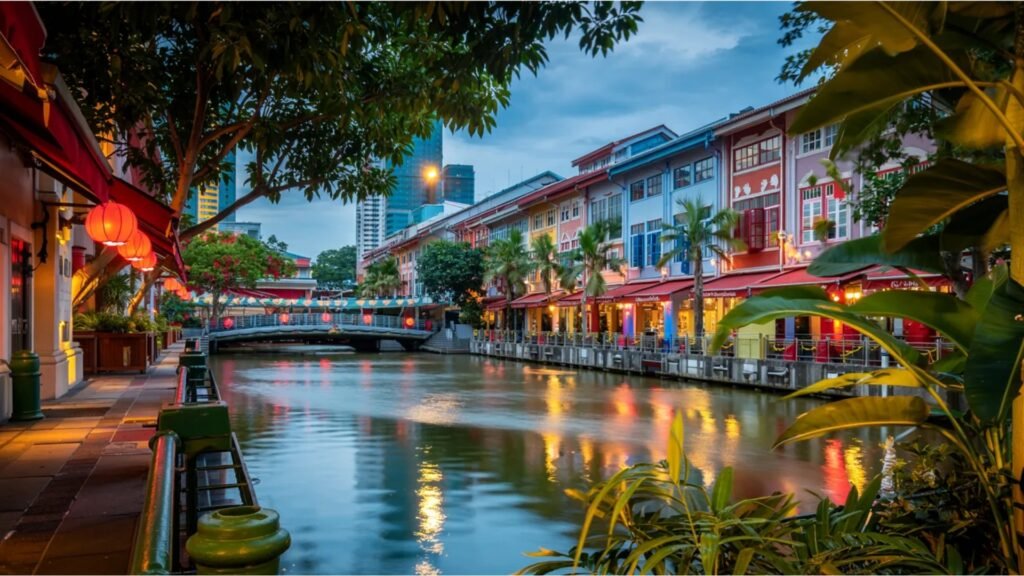
None of them quite have what Clarke Quay has. Which is — elegance. This underlying sense of refinement that runs beneath all the noise and color and nightlife energy. The historic shophouses Clarke Quay are painted in these extraordinary pastel hues — turquoise, coral, deep amber, lemon yellow — and they’re not just pretty facades. They’re original colonial trade warehouses Singapore structures, preserved under heritage conservation district Singapore laws. You can’t just knock them down and build something new. They have to be maintained. And they are — beautifully.
The Singapore street performances that pop up along the river walk are another thing entirely. I’m not talking about mediocre buskers. I mean — a jazz trio that stopped me mid-stride at 9:30 PM. A fire spinner drawing a crowd of maybe three hundred people at the edge of the water. A beatboxer doing things with his voice that didn’t seem physically possible. These performances aren’t scheduled. They just… happen. And that spontaneity is genuinely irreplaceable.
My Expectations Before Visiting the Area
I’ll be fully transparent here. I went in skeptical.
Not because I’d heard bad things. I’d actually heard great things — read a bunch of Clarke Quay Singapore travel guide articles, watched YouTube vlogs, scrolled through tagged Instagram photos until 1 AM the night before my flight. The consensus was overwhelmingly positive. And that actually made me more suspicious, not less. Because I’ve been burned by overhyped “you HAVE to go” places before. We all have.
So I kept my expectations deliberately low. Told myself: probably nice, definitely touristy, possibly overpriced, probably worth an hour or two before heading somewhere more local and authentic.
Then I stepped out of the MRT and the whole cautious-skeptic act dissolved in about ninety seconds flat.
Arriving at Clarke Quay Along the Singapore River
The MRT ride itself — worth mentioning briefly because Singapore’s public transport is genuinely something else. Cleanest metro system I’ve ever used. Anywhere. The North-East Line to Clarke Quay MRT Station (NE5) from my hotel near Orchard Road took maybe fifteen minutes, cost about SGD 1.80 (call it USD 1.35), and was air-conditioned to a degree that felt almost aggressively refreshing given the heat outside.
Exit B. That’s the one you want. Walk out of Exit B and — okay. Here’s where it happens.
The warm night air hits first. That thick, tropical, slightly sweet Singapore evening warmth that wraps around you immediately. Then the sound — music layering from multiple directions at once, crowd noise, laughter, something rhythmic happening somewhere nearby. And then your eyes adjust from the fluorescent MRT lighting to the outdoor scene and the Clarke Quay Singapore riverfront just… unfolds in front of you.
The whole thing — the lit-up shophouses, the river catching all those reflections, the crowds flowing toward the water — it’s all happening simultaneously. I stopped walking. Just stopped. A woman with a stroller navigated around me patiently. An older couple glanced at me with what I can only describe as amused recognition — the expression of people who’ve seen this exact frozen-in-place reaction from a first-time visitor before.
I stood there for a solid two minutes. Taking it in. And then I thought — okay. Jake was very right.
My First Impressions of the Riverside District
My first actual coherent thought — once the initial sensory overload settled slightly — was: “the photos genuinely don’t do this justice.”
Which almost never happens to me. Photos usually overstate things. They pick the perfect angle, perfect light, perfect moment, and present you with this idealized version of a place that reality can’t quite match. The Clarke Quay Singapore river walk at night is one of the rare exceptions. Real life is better.
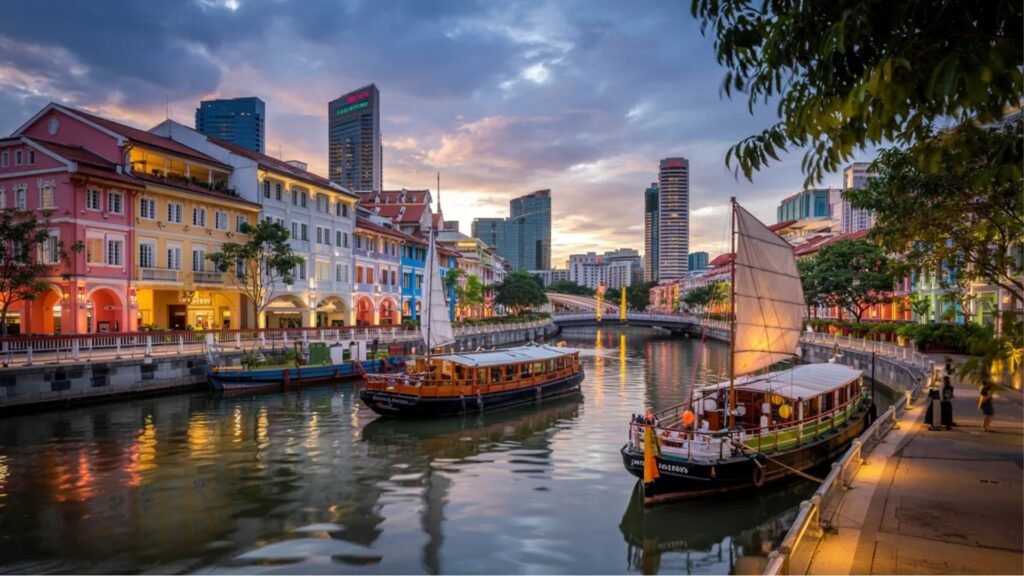
The layering of light is the thing no photo captures properly. The warm amber glow of the historic shophouses Singapore facades. The cooler, more electric neon from bar signage. The natural shimmer of the Singapore River below catching all of it and rippling it back upward in these constantly shifting reflections. And beyond the river, the financial district towers glittering in the middle distance. It all combines into something genuinely beautiful — and strangely intimate for such a busy, populous place.
The Colorful Architecture and Vibrant Streets
So the buildings. I need to talk about the buildings because — look, I’m not an architecture person. I really am not. I’ve walked past buildings on trips that other people rave about and felt basically nothing. I’m the guy who spent three hours in the Louvre and spent most of it thinking about lunch.
But the heritage architecture Singapore at Clarke Quay actually got to me.
The five heritage blocks are original Clarke Quay colonial era Singapore structures — warehouse buildings from the era when this riverfront was all commerce and cargo and merchant hustle. The Clarke Quay old godowns that stored rubber and spice have been converted into restaurants and clubs, but the structural bones are preserved. High ceilings. Heavy wooden beams. Thick walls. Inside certain spots you can look up and see the original roof structure of a nineteenth-century warehouse above a DJ booth. It’s a strange and wonderful juxtaposition.
Outside, the streets between the blocks fill completely by 8 PM. It gets narrow and crowded in the good way — the way that means everything is alive and happening. Lanterns strung overhead in some sections. Overflow seating from restaurants spilling right onto the promenade. The smell of food — garlic, chili, coconut milk, something charred and wonderful — drifting from every direction.
The whole district was named after Sir Andrew Clarke, by the way — the second Governor of the Straits Settlements who signed the Pangkor Treaty of 1874. Under his tenure the Singapore River cargo trade boomed and this stretch of the river became the commercial heart of the colony. Now it’s the entertainment heart of one of Asia’s most dynamic cities. History does funny things sometimes.
Experiencing the Energy of Clarke Quay
Let me try to describe the energy progression across an evening because it’s not static — it builds. And the building is part of what makes it so good.
I arrived around 6:30 PM. At that point the Clarke Quay entertainment district was warming up — restaurants filling, early arrivals settling into riverside tables, the occasional tourist still photographing the shophouse facades in the last of the daylight. Nice. Pleasant. A soft beginning.
By 8 PM the whole thing had shifted gears. More people. Louder music. The river darker now, the reflections brighter. By 9 PM — electric. By 10 PM I genuinely couldn’t have told you which direction the music was coming from because it was coming from everywhere simultaneously and had merged into this singular ambient soundtrack of the whole district being fully, completely alive.
I stayed until almost 1 AM. The energy was still climbing when I finally left. I don’t know when it actually peaks. I suspect the answer is: it doesn’t. Not on a weekend.
Exploring the Restaurants and Dining Spots
Food. This is where I need to take a breath because I feel genuinely emotional about some of what I ate at Clarke Quay in Singapore and I don’t want to undersell it.
Over sixty dining establishments in that one precinct. Sixty. Clarke Quay restaurants and bars span a range that should feel incoherent but somehow doesn’t — Michelin-recommended tables sitting twenty meters from casual riverside hawker setups. Japanese omakase next to a Mexican taqueria next to a Scottish whisky bar next to what is, genuinely, one of the greatest seafood restaurants I’ve ever eaten at in my entire life.
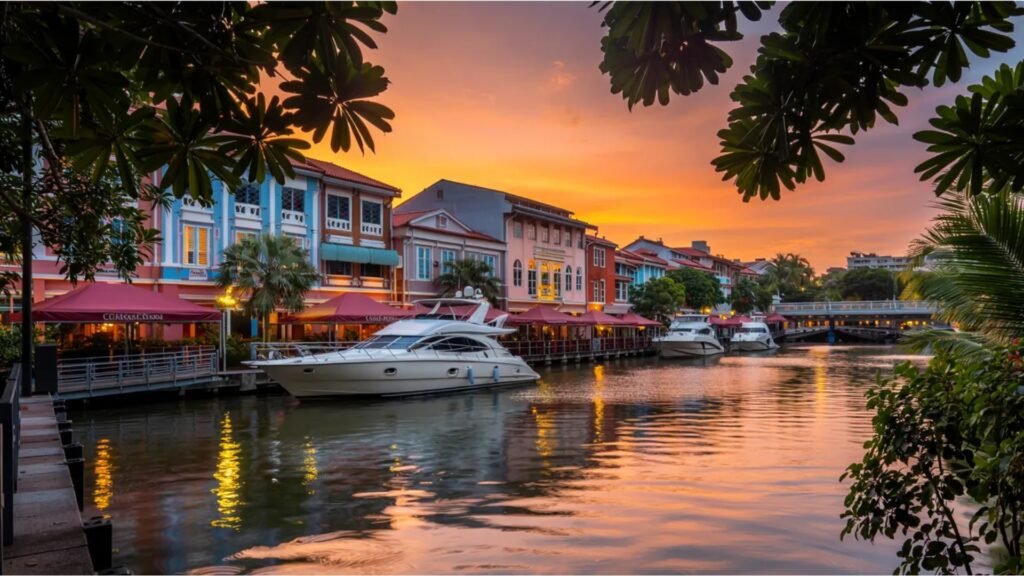
Riverside dining Singapore along Clarke Quay often means your table is right at the water’s edge. Some restaurants extend wooden decking over the river itself. Others line the promenade with outdoor seating behind rows of misting fans — an extremely thoughtful touch given Singapore’s tropical humidity. Even at a casual spot the combination of good food plus river view plus warm night air plus whatever music is drifting over from somewhere nearby transforms an ordinary meal into something memorable.
Budget note for American travelers: casual meals here run SGD 10–20 (roughly USD 7–15). A proper sit-down dinner at a marquee restaurant — like the one I’m about to tell you about — might run SGD 80–150 per person. Worth every cent if you go to the right place. Which brings me to —
Famous Restaurants Around Clarke Quay
| Restaurant | Cuisine | Price Range (SGD) | Don’t Miss | Book Ahead? |
| Jumbo Seafood | Singaporean | $80–$150/pax | Chili Crab + Mantou buns | Yes — always |
| Kinki Restaurant + Bar | Japanese Fusion | $60–$120/pax | Spicy Tuna Roll | Recommended |
| The Pump Room | Modern European | $70–$130/pax | Prime Ribeye | Recommended |
| Brewerkz | Craft Beer & Grill | $50–$100/pax | Burgers + house brews | Walk-in friendly |
| El Mero Mero | Mexican | $40–$80/pax | Fish Tacos | Walk-in friendly |
| Crazy Elephant | Bar & Grill | $40–$70/pax | BBQ Ribs + live music | Walk-in friendly |
Jumbo Seafood. That’s the one. If you do nothing else at Clarke Quay — eat at Jumbo Seafood. I’m not saying that lightly. The Singapore chili crab they serve is one of those dishes that genuinely deserves the word “extraordinary.” Rich, complex sauce. Slightly spicy. Vaguely sweet. Fresh crab, messy to eat, completely worth the mess. They bring deep-fried mantou buns alongside it — pillowy little bread pockets for scooping up the sauce — and you will use every single one and probably wish you’d ordered more.
Book in advance. Seriously. They fill up fast.
Trying Local and International Cuisine
Here’s something I wasn’t fully prepared for — how intensely, almost aggressively flavorful local Singaporean dishes are. I consider myself a reasonably adventurous eater. I’ve eaten fermented shark in Iceland. I’ve had century eggs in Hong Kong. I do not scare easily at a menu.
But laksa — coconut curry noodle soup — just leveled me. It looks manageable. It smells incredible. You take one mouthful and the complexity of it — creamy, spicy, deeply savory, with that characteristic shrimp paste undertone — is almost overwhelming. In the best way. A meal I still think about. Char kway teow (flat rice noodles wok-fried with egg, bean sprouts, Chinese sausage, sometimes cockles) sounds simple on paper and tastes like something assembled by someone who knows things about flavor that most cooks don’t.
For Americans who aren’t quite there yet with adventurous eating — the Clarke Quay waterfront has you completely covered. Brewerkz does proper craft burgers and house-brewed American-style ales. El Mero Mero does solid Mexican. There’s even a Singaporean take on American BBQ at a couple of spots that’s genuinely interesting. No one goes hungry here. No one goes un-pleased here. The range is just too wide.
My Favorite Dining Experience by the River
this is the part of the whole Singapore trip I keep coming back to. The specific memory that just sits there in my head, still vivid, four months later.
Jumbo Seafood. Riverside table — I’d asked specifically when booking and got lucky. Around 8 PM. The sun had just fully set. The city lights were beginning to activate across the water. I’d ordered the chili crab (obviously) and — on a half-impulsive recommendation from the server — the cereal prawns. Which I’d never heard of before. Prawns tossed in this crispy, buttery, lightly sweet cereal coating that sounds deeply weird and is actually one of the best things I’ve ever eaten.
The food arrived. The river was right there — I mean, right there, maybe four meters away. A traditional bumboat drifted past, lit softly, its wake sending small ripples of reflected city light spreading across the water’s surface. I took a bite of the chili crab. Cold Singaporean Tiger beer. Warm night air with that slight riverfront humidity. Music from somewhere down the strip, distant enough to be atmospheric rather than intrusive.
I put my fork down. Just for a second. And sat with it. That rare, specific feeling of being completely, perfectly in the right place at the right time. Travel gives you those moments occasionally if you’re paying attention. That was mine. That night. At that table. On that river.
Experiencing the Nightlife at Clarke Quay
Right — Clarke Quay nightlife Singapore. The thing the district is arguably most globally famous for. And I want to address a misconception upfront because I had it myself going in.
Clarke Quay nightlife isn’t just for people who want to dance until 4 AM in a packed club. That option exists and it’s excellent — but it’s one layer of a much more varied nighttime ecosystem. The Clarke Quay Singapore riverfront nightlife also includes: intimate live blues bars where you sit quietly with a whisky and listen to a four-piece band. Rooftop terraces where couples watch the river. Open-air riverfront spots where groups of friends share beer towers and talk until the small hours. Craft beer bars with calm, convivial energy. The whole spectrum is here, operating simultaneously.
The crowd diversity is something that took me by surprise in the best way. Singapore expats on their Thursday wind-down. Japanese tourists on a first international trip. American couples celebrating anniversaries. Local university students celebrating something (or nothing). Backpackers making their last dollars stretch toward one good night. All of them coexisting along this one riverside strip in a way that feels remarkably frictionless. Clarke Quay Singapore nightlife welcomes everyone. You genuinely never feel out of place here.
Live Music and Street Entertainment
This was my favorite unexpected discovery of the entire evening.
Crazy Elephant — this legendary live music bar that’s been operating at Clarke Quay since before the Clarke Quay redevelopment project transformed the district — had a blues band going when I walked past that stopped me completely. Four-piece outfit. Lead guitarist doing something genuinely extraordinary — the kind of playing that makes you stand still and just listen with your whole body. A crowd of maybe a hundred and twenty people, completely locked in.
I’d planned to keep walking. I stayed for forty-five minutes.
The live music venues across the district cover a spectrum that’s surprisingly wide. Blues and rock at Crazy Elephant. Jazz floating from intimate bar corners. Electronic sets shaking the walls of the bigger clubs. Indie and acoustic at Hood Bar. And then the completely spontaneous Singapore street performances that erupt along the river walk — fire spinners, percussion groups, beatboxers, jazz trios setting up between 9 PM and 11 PM like it’s the most natural thing in the world. Because for them, at Clarke Quay, it probably is.
Evening activities Singapore-style genuinely don’t peak much higher than a cold beer, a live blues set, and the Singapore River twenty meters away.
Popular Bars and Nightclubs in the Area
| Venue | Type | Vibe | Hours | Drink Prices (SGD) |
| Attica | Nightclub | Electric, dancehall | 9 PM – 3 AM | $18–$30 |
| Canvas Club | Underground Club | Raw, electronic | 10 PM – 4 AM | $15–$25 |
| Crazy Elephant | Live Music Bar | Blues, rock, soulful | 6 PM – 2 AM | $12–$20 |
| The Highlander | Scottish Whisky Bar | Warm, relaxed | 5 PM – 1 AM | $14–$22 |
| Brewerkz | Craft Beer Bar | Easygoing, riverside | 12 PM – 1 AM | $10–$18 |
| Hood Bar & Café | Indie Bar | Artsy, low-key | 5 PM – 2 AM | $10–$18 |
Attica is the name everyone mentions — and it earns it. It’s been the flagship nightlife venue at Clarke Quay since 2003. Still drawing queues on Friday nights. The outdoor river-facing terrace is genuinely one of the best spots in the district — standing there at midnight with a drink, watching the Singapore River below and the city stretching out beyond it — that’s a view worth the cover charge by itself.
The Atmosphere of Clarke Quay After Sunset
I’ve been trying to write this section in my head for four months. I’m still not sure I have the right words for it.
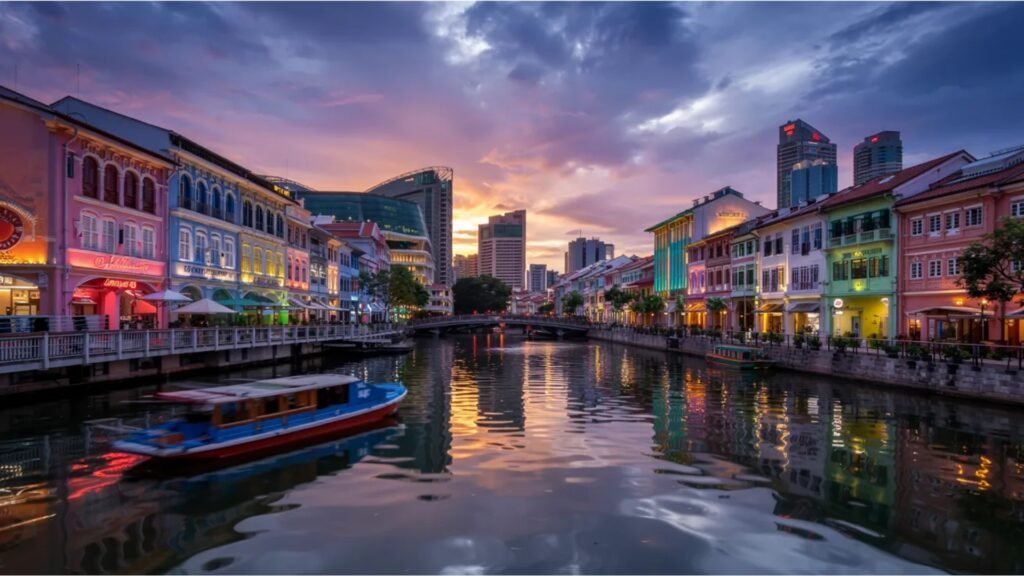
Visiting Clarke Quay at night — specifically in that 9 PM to midnight window — feels like being inside a city that’s finally doing what it was always meant to do. The river shifts from its daytime grey-brown to this deep, reflective black that catches every light source and doubles it. The five heritage blocks glow with their layers of lighting — warm amber uplighting on the facades, cooler neon from the bar signs, the flicker of lanterns in some of the narrower passages between buildings. Music layers on top of music from different venues, creating this ambient, moving soundtrack that follows you as you walk the promenade.
And you slow down. That’s the thing. The Clarke Quay atmosphere after dark actually makes you physically slow your pace. You stop rushing between the next thing and the thing after that. stand at the river railing for ten minutes watching a bumboat drift past. stop at a street performance corner and let forty-five minutes disappear. find a quiet spot on the promenade away from the densest crowd and just… stand there. Letting the whole thing wash over you.
Best places to visit in Singapore at night lists put Clarke Quay near the top every single time. Standing there at 11 PM watching the city shimmer on the water — the reasoning becomes obvious. Completely, wordlessly obvious.
Things That Made My Visit Memorable
Beyond the food and the bars and the photo spots — what I actually carried home from Clarke Quay in Singapore were the smaller, quieter, unplanned things.
The forty-five minutes at Crazy Elephant listening to that blues band I hadn’t planned to stop for. A conversation at the bar with a Singaporean man — must have been in his sixties, maybe older — who’d been coming to Clarke Quay since the early days of the Singapore River cleanup project, when the river was still polluted and the old godowns were derelict and the whole strip was more gritty than glamorous. He talked about what it used to look like. The emptiness. The smell of the old river. And then he gestured around at what surrounded us and just shook his head. “Unbelievable,” he said. “What they did with it.”
I think about that a lot. The Clarke Quay Singapore history baked into the bones of every building. The CapitaLand Clarke Quay project investment and Singapore tourism redevelopment strategy that turned a derelict waterfront into one of Asia’s most celebrated entertainment districts. It’s a genuinely remarkable story — and knowing it makes the experience of standing in Clarke Quay feel richer, more layered, more real.
Walking Along the Beautiful Singapore River
The Singapore River promenade walk is one of the finest free experiences in Singapore. Full stop. No caveat. Free. And extraordinary.
I did the stretch from Clarke Quay downstream toward Boat Quay and back — maybe forty minutes at an unhurried pace that I kept interrupting myself by stopping to look at things. The bumboats moored along the quay are beautiful at night — traditional wooden river vessels, softly lit, their reflections stretching across the dark water in long trembling lines. Historical markers along the Clarke Quay Singapore river walk tell the story of the Singapore River cargo trade and the Clarke Quay colonial era Singapore in short, readable bursts. I actually read every one I passed. Which is not something I typically do.
The Clarke Quay river cruise boats drift past periodically — lit up like moving lanterns, passengers visible on the upper decks photographing the exact riverside view you’re standing in. The Singapore River heritage district connects seamlessly to Boat Quay nightlife downstream and Robertson Quay restaurants upstream, all along this single unbroken promenade. You could walk for hours. You probably will.
Watching the City Lights Reflect on the Water
11:30 PM. I’d had the dinner of my life, wandered into a few bars, stood transfixed by that blues band. Found a quieter section of the river walk — away from the densest crowds, maybe thirty meters from the nearest bar’s outdoor seating — and leaned against the railing.
The city lights of Singapore — the financial district towers, the shophouse uplighting, the bridge lanterns, the passing boats — all reflected in the surface of the Singapore River in these long, constantly-moving, constantly-shifting columns of color. Warm amber. Cool blue. The occasional red pulse from a passing boat’s navigation light. The Esplanade domes glowing softly in the middle distance.
I stood there for fifteen minutes. Maybe twenty. Not doing anything, photographing,checking my phone. Just watching the light move on the water.
Some things don’t photograph well and this was one of them. I tried. I have twelve mediocre photos from that spot. But the actual experience — that stillness, that beauty, the water moving under all that reflected city light — lives only in the memory. And that’s perfectly fine. That’s actually better.
Capturing Photos of the Riverside Views
For the photographers and content creators planning this trip — here’s what actually works at Clarke Quay in Singapore:
| Spot | Best Shot | Ideal Time | Tip |
| Coleman Bridge | Wide panorama — river + skyline | 8:30 PM – 10 PM | Tripod essential for long exposure |
| Riverside Point jetty | Bumboats + shophouse reflections | 9 PM – 11 PM | Shoot at near-water level |
| Clarke Quay MRT pedestrian bridge | Full district aerial angle | 8 PM – 9:30 PM | Great wide establishing shots |
| Block C riverside walkway | Architecture + crowd energy | 7 PM – 9 PM | Catch last golden-hour warmth |
| River Taxi pier | Water reflections + ripple patterns | 10 PM – midnight | Long exposure for silky water effect |
The golden rule for best photo spots in Clarke Quay: arrive before dark, scout your angles, then shoot after 9 PM when all the lighting is fully active. Wide-angle lens handles the scale beautifully. For water reflections — slight downward angle from the railing, as close to water level as you can safely get. That’s the shot.
Practical Tips for Visiting Clarke Quay
Singapore is genuinely one of the most foreigner-friendly cities on earth. Everything in English. MRT is world-class. Grab (the local Uber equivalent) works flawlessly. Clarke Quay in Singapore specifically is incredibly well set up for international visitors — multilingual staff everywhere, card payments universally accepted, well-lit streets, visible but unobtrusive security.
Singapore weather is tropical year-round — consistently hot and humid during the day, settling to a more manageable 27–29°C (80–84°F) after dark. The Singapore monsoon season runs roughly November through January — heavier, more persistent rains that can affect outdoor promenade seating and riverside dining. A compact travel umbrella is honestly worth packing regardless of when you go. The afternoon showers can appear from nowhere even outside monsoon season.
Clarke Quay Singapore travel experience budget breakdown for Americans: budget travelers can have a great evening for USD 30–50 (casual dinner, a couple of drinks, river cruise). Mid-range: USD 80–120 for a proper riverside dinner and a few bars. Splurge: USD 150–200+ for fine dining plus premium nightclub entry and premium drinks. All of these are valid ways to experience the district.
Best Time to Visit Clarke Quay in Singapore
| Factor | Best Option | Notes |
| Season | February – April | Lower humidity, less rain, comfortable evenings |
| Day | Thursday – Saturday | Peak energy; Sunday noticeably quieter |
| Arrive | 7 PM – 8 PM | Beat dinner rush; secure riverside tables |
| Peak hours | 10 PM – 1 AM | Full energy window |
| Special event | F1 Singapore Grand Prix (September) | District atmosphere goes to another level entirely |
| Skip | Monday – Tuesday | Quieter, some venues closed early |
Best time to visit Clarke Quay in Singapore for the full experience without peak weekend crushing: Thursday evening, late February through April. Weather more forgiving, crowds substantial but navigable, riverside tables available without 45-minute waits.
How to Reach Clarke Quay Easily
MRT — North-East Line to Clarke Quay MRT Station (NE5). Exit B drops you right at the riverfront. From Changi Airport: ~45 minutes, ~SGD 2.50 (about USD 1.85). Get an EZ-Link card at the airport for seamless transit across the whole city. Route planning:smrt.com.sg.
Grab — Download before you leave the USA. Rides from Marina Bay to Clarke Quay run SGD 8–14. After midnight expect surge pricing — factor this in for late-night returns.
Clarke Quay river cruise — Departs from Clarke Quay jetty, loops past Boat Quay toward Marina Bay. About SGD 25–30 per adult. An extraordinary perspective on the Singapore River heritage district from the water. Schedules atrivercruise.com.sg.
Walking from Boat Quay — If you’re already at Boat Quay nightlife area, Clarke Quay is 10–15 minutes upstream along the river promenade. One of the most pleasant ways to arrive.
Important Things to Know Before Your Visit
Singapore’s laws are genuinely enforced. Littering: fines up to SGD 2,000 for first offenders. Jaywalking: regularly ticketed. Public intoxication: can result in arrest. These aren’t theoretical Singapore travel tips — they’re real and applied. The city runs cleanly and safely because the rules actually work. Respect them and you’ll have zero issues.
Tipping — don’t. Most restaurants add 10% service charge automatically. Extra tipping isn’t expected and can cause genuine confusion. Locals don’t tip. You don’t need to either.
Dress codes — casual smart gets you into most places. Clean sneakers, shorts or jeans, neat shirt. For higher-end clubs (Attica, specifically), avoid flip flops and sleeveless tops. When uncertain, slightly overdress rather than under.
Tap water is safe. WHO standard. Don’t waste money on bottled water constantly.
A Brief History Worth Actually Knowing
Most people visit Clarke Quay and enjoy it without knowing the history underneath. Which is fine. But knowing it makes the experience significantly richer.
The quay was named after Sir Andrew Clarke — the second Governor of the Straits Settlements who signed the Pangkor Treaty of 1874 and dramatically expanded Singapore’s commercial footprint along the river. The Clarke Quay colonial era Singapore period saw the riverside lined with enormous Clarke Quay old godowns — warehouses packed with rubber, pepper, tin, and spice from across Southeast Asia, central to the booming Singapore River cargo trade.
By the 1980s commercial shipping had relocated. The old warehouses sat empty. The river — once the economic heart of colonial Singapore — had become badly polluted and visually neglected. Then came the Singapore River cleanup project under Prime Minister Lee Kuan Yew — one of the most ambitious urban environmental turnarounds in Asian history. The Clarke Quay redevelopment project followed through the 1990s and into the 2000s, driven largely by the CapitaLand Clarke Quay project investment that converted the derelict warehouse district into the heritage conservation district Singapore it is today. The Singapore tourism redevelopment strategy guiding this transformation has since been studied internationally as a model of successful urban heritage conservation.
Standing in Clarke Quay today — knowing what it once was, what it took to transform it — makes every lit-up shophouse and every music-filled bar feel like something genuinely earned.
Nearby Quays Worth Your Time
The Singapore River precinct attractions extend in both directions from Clarke Quay and genuinely reward exploration:
| Quay | Best For | Walk from Clarke Quay | Vibe |
| Boat Quay nightlife | Pub crawl, casual bars, sports pubs | 5 min downstream | Louder, rawer, more local-expat mix |
| Robertson Quay restaurants | Fine dining, wine bars, quieter evenings | 10 min upstream | Refined, intimate, less touristy |
| Marina Bay area | Luxury hotels, Supertree Grove, rooftop bars | 20 min MRT | Grand, spectacular, unmissable |
Boat Quay nightlife is Clarke Quay’s scrappier younger sibling — excellent for casual hopping between casual bars among a mix of locals and expats. Robertson Quay restaurants sit at the opposite end: quieter, more intimate, with some genuinely excellent fine dining tucked into beautifully converted heritage architecture Singapore spaces. Doing all three across multiple Singapore evenings gives you a complete picture of Singapore riverfront nightlife areas across every register and mood.
Final Thoughts on Clarke Quay in Singapore
Four months home. Still talking about it.
Clarke Quay in Singapore earned that. Everything it has a reputation for — the food, the nightlife, the architecture, the river atmosphere — it delivers on, fully, without the hedging and partial-credit that most famous travel destinations require. It’s genuinely as good as people say it is. Actually it might be better, depending on who’s been telling you about it and how well they describe things.
For American travelers building a Singapore itinerary — give Clarke Quay two evenings. Not one. One evening for the food: do the riverside dining properly, book Jumbo Seafood in advance, eat slowly, stay at the table after the meal and just watch the river. Second evening for the nightlife: follow the energy, let the night find its own shape, end up somewhere you didn’t plan to end up because that’s what Clarke Quay does to you when you let it.
Walk the Singapore River promenade. Eat the chili crab. Find a quiet spot at the riverbank at midnight. Watch the city lights move on the water. Listen to whatever music is drifting from whichever direction. Just — be there. Fully. Without rushing.
Why Clarke Quay Is Worth Visiting
Because it’s the rare travel destination that delivers on every front simultaneously without asking you to compromise. Clarke Quay in Singapore gives you history AND nightlife AND extraordinary food AND architectural beauty AND river views AND live music AND photography opportunities — all in one walkable, accessible, genuinely magical riverside strip.
Best places to visit in Singapore at night lists consistently put it near the top. After experiencing it firsthand that ranking feels not just accurate but almost modest. It’s one of the best nighttime urban experiences in all of Asia. And I say that having spent nights in Tokyo, Bangkok, Hong Kong, Hanoi, and Taipei.
My Overall Experience at Clarke Quay
Would I go back? Without a second of hesitation. Already looking at flights, honestly.
If there’s one thing I want you to take from this whole article — it’s this. Don’t make Clarke Quay the filler item on your Singapore itinerary. Don’t do what I almost did and treat it as an afterthought squeezed in between “real” destinations. Give it the time and the unhurried attention it deserves.
Because Clarke Quay in Singapore doesn’t just give you a good night out. It gives you one of those travel experiences — the kind that stay with you — where the food was that good, and the river was that beautiful, and the music was that perfect, and the whole warm Singapore night wrapped around you in a way that you’d genuinely like to stay inside forever.
That’s what it gave me. And I’m still not over it.
“Clarke Quay isn’t just Singapore’s entertainment district. It’s proof that a city can honor everything it used to be while fully, joyfully becoming something extraordinary.”
Honest Final Ratings:
| Category | Score /10 | Real Talk |
| Atmosphere | 10 | Best after-dark atmosphere in Singapore. Nothing close. |
| Food & Dining | 9.5 | The chili crab alone justifies a trip to Singapore |
| Nightlife | 9 | World-class. Every style of night-out covered. |
| Value for Money | 8 | Pricier than hawker centres — genuinely worth it |
| Accessibility | 10 | MRT access doesn’t get easier anywhere |
| Photography | 9.5 | Stunning from every angle after 9 PM |
| Historical Depth | 9 | Rich history if you look beneath the surface |
| Overall | 9.3 / 10 | Non-negotiable on any Singapore trip |